
Why Does Dust Return So Quickly After Cleaning?
Dust can return surprisingly quickly after cleaning because your home is never truly finished producing or collecting particles. Outdoor dirt enters through doors and windows, fabrics shed fibers, people and pets move through rooms, cooking and other activities create airborne particles, and settled dust is continually stirred back into the air. A freshly wiped table may therefore look dusty again within a day or two without anything being unusually wrong.
The useful goal is not to eliminate dust completely. It is to reduce how much enters the home, capture more of it before it settles, and clean in a way that does not simply redistribute it from one surface to another.
Dust is constantly being created and brought indoors
Household dust is not one single substance. It is a changing mixture of particles from indoors and outdoors. Depending on the home, it can include textile fibers, skin flakes, hair, soil, pollen, pet debris, cooking particles, and material tracked in on shoes or carried through open doors and windows.
This explains why dusting is temporary by nature. Even after a thorough cleaning, new material begins entering and settling almost immediately. A home beside a busy road, a house with frequently opened doors, or a household with several people and pets may accumulate visible dust faster than a lightly occupied home with fewer outside-air pathways.
Your cleaning method may be putting dust back into circulation
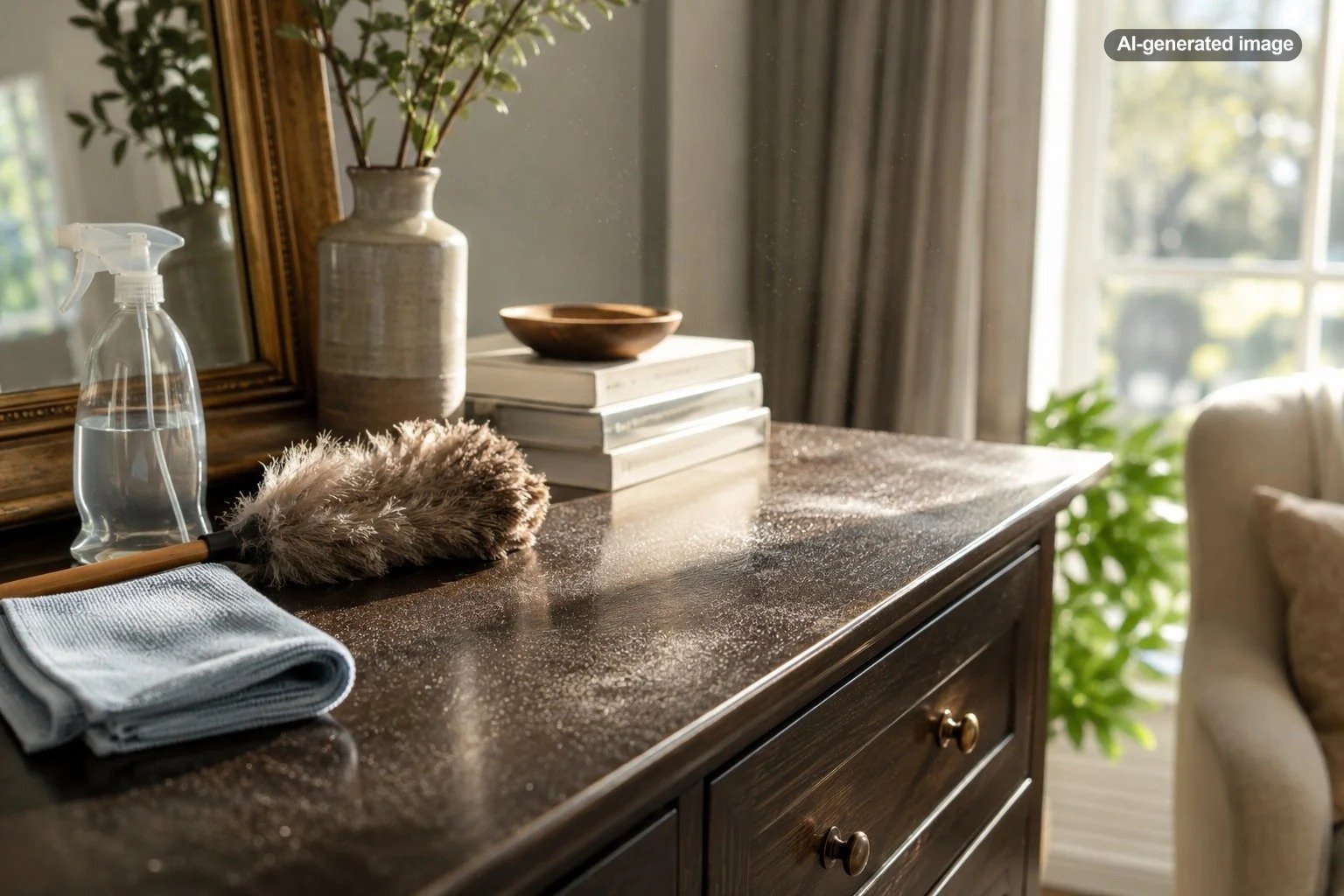
A dry cloth, feather duster, or aggressive sweeping motion can lift settled particles without capturing all of them. Some remain suspended long enough to settle again on nearby furniture after the room appears clean.
For ordinary hard surfaces, a slightly damp microfiber cloth or another tool designed to capture particles is often more effective than simply brushing dust away. The U.S. Environmental Protection Agency similarly recommends dusting with a damp cloth because dampening helps prevent settled material from becoming airborne again.
What to do
- Start with ceiling fans, upper shelves, cabinet tops, and other elevated surfaces.
- Work downward through furniture, lamps, electronics, trim, and baseboards.
- Use a cloth or duster that captures particles rather than merely moving them.
- Vacuum floors, rugs, and upholstery after the higher surfaces are finished.
- Give recently disturbed airborne dust time to settle before judging whether the room is actually clean.
Fabric-heavy rooms tend to release and collect more particles
Bedrooms and living rooms can seem especially dusty because they contain plenty of soft materials. Bedding, upholstered furniture, rugs, curtains, throw blankets, pillows, clothing, and fabric storage bins can all collect particles and release fibers through everyday use.
If one room becomes dusty much faster than the rest of the house, compare its furnishings rather than assuming the entire home has a filtration problem. A carpeted bedroom with open shelving and layered textiles has far more surfaces for dust to settle on than a sparsely furnished room with hard flooring and closed storage.
The fastest way to make dust less noticeable is not endless wiping; it is reducing the places where particles accumulate and improving how you capture them.
Clutter makes a normal amount of dust look like much more
Decorative objects, books, charging cables, open baskets, picture frames, plants, and small appliances create dozens of edges and horizontal ledges. None of these items necessarily creates excessive dust, but they increase the number of places where it becomes visible.
Closed cabinets and drawers generally require less detailed dusting than open storage. If you enjoy layered shelves, the tradeoff is simply more cleaning. Grouping smaller objects on trays can make routine dusting easier because an entire group can be lifted at once instead of cleaning around every object individually.
Outdoor air can noticeably change how fast surfaces get dusty
Open windows are pleasant, but they also create a direct path for outdoor particles. The effect varies with weather, landscaping, nearby construction, traffic, pollen conditions, and how much air moves through the opening.
Entryways are another major transfer point. Shoes, bags, packages, pets, and foot traffic can carry material indoors. A practical entrance routine, such as using effective doormats and regularly cleaning the floor near exterior doors, can keep some of that material from spreading farther into the house.
HVAC filtration can affect airborne particle levels
Central heating and cooling filters capture particles only from air that actually passes through the system, so they are one part of dust control rather than a complete solution. The EPA notes that HVAC filtration can supplement source control and ventilation, but no household filter removes every pollutant or particle from indoor air.
A dirty or overloaded filter may also perform poorly. Follow the filter and HVAC manufacturer’s replacement guidance rather than assuming every household should use the same schedule. If considering a higher-efficiency filter, make sure it is appropriate for the equipment. The EPA advises using the highest-rated filter the system fan and filter slot can accommodate and notes that professional guidance may be appropriate when determining compatibility.
Vacuuming can either capture dust or redistribute some of it
Carpet, rugs, sofas, upholstered chairs, mattresses, and other soft surfaces can hold a substantial amount of settled material that becomes disturbed during normal activity. Regular vacuuming helps remove it before more is released into the room.
The EPA recommends considering a vacuum with HEPA filtration to help reduce dust buildup and limit the amount of collected material that escapes back into the air. Whatever vacuum you use, maintain its filters, bags, bins, seals, and brushes as directed by the manufacturer. A machine that is clogged or poorly sealed may not perform as expected.
Air movement makes some surfaces look dusty first
Dust does not settle evenly. Air currents from supply registers, ceiling fans, portable fans, frequently opened doors, and normal movement through a room can create predictable accumulation zones.
Watch where dust returns first after a complete cleaning. A dark dresser beneath a vent may reveal particles long before a pale wood table across the room does. Electronics can also make fine dust especially visible because smooth dark surfaces show light-colored particles easily.
That distinction matters: sometimes a room is not becoming dramatically dustier; certain surfaces are simply better at advertising the dust that is already there.
A simpler routine can keep dust from becoming a major project
Trying to deep-clean every surface at once is rarely necessary. A short recurring routine tends to be easier to maintain and prevents heavy buildup in the areas that matter most.
Before you decide your house is unusually dusty
- Check whether windows or exterior doors are frequently open.
- Look at the condition of the HVAC filter and follow its replacement instructions.
- Notice whether one room has more rugs, bedding, upholstery, or open shelving.
- Make sure your dusting tools are capturing particles instead of pushing them into the air.
- Vacuum after dusting rather than before it.
- Clean entryways and other high-traffic floors regularly.
- Compare how quickly dust returns on different surfaces and in different rooms.
When unusually heavy dust deserves a closer look
A gradual layer of ordinary household dust is expected. A sudden, substantial change deserves more investigation, especially if it follows remodeling, sanding, construction, duct work, or another activity that generates large quantities of fine particles.
If debris appears to be coming directly from HVAC registers, or the heating and cooling system is behaving abnormally, have the system evaluated rather than assuming repeated cleaning will solve the source. Likewise, visible material associated with water damage, suspected mold, deteriorating building materials, or another potentially hazardous source should not be treated as ordinary cosmetic dust.
Frequently asked questions
Why is my furniture dusty again the day after I clean it?
Particles that were already airborne may settle after you finish cleaning, particularly if dry dusting or vigorous sweeping stirred them up. New particles also enter and are created continuously. Changing to a dust-capturing method and vacuuming after dusting can reduce the quick rebound.
Does opening windows make a house dustier?
It can. Open windows allow outdoor particles to enter, although the amount varies greatly with local conditions, weather, traffic, vegetation, and how much air moves through the opening.
Will an air purifier eliminate household dust?
No. A properly selected portable air cleaner can reduce airborne particles in the room where it operates, but it cannot capture everything or prevent dust from being tracked in, shed from fabrics, or deposited directly onto surfaces.
Should I dust or vacuum first?
For most routine cleaning, dust from high surfaces downward and vacuum afterward. That gives you a chance to capture particles that fall onto the floor during dusting.
Is a dusty house necessarily a dirty house?
No. Dust accumulation is a normal result of occupancy, outdoor air, fabrics, airflow, and everyday activity. The better question is whether the amount has changed suddenly or whether a specific room, surface, or system is contributing disproportionately.