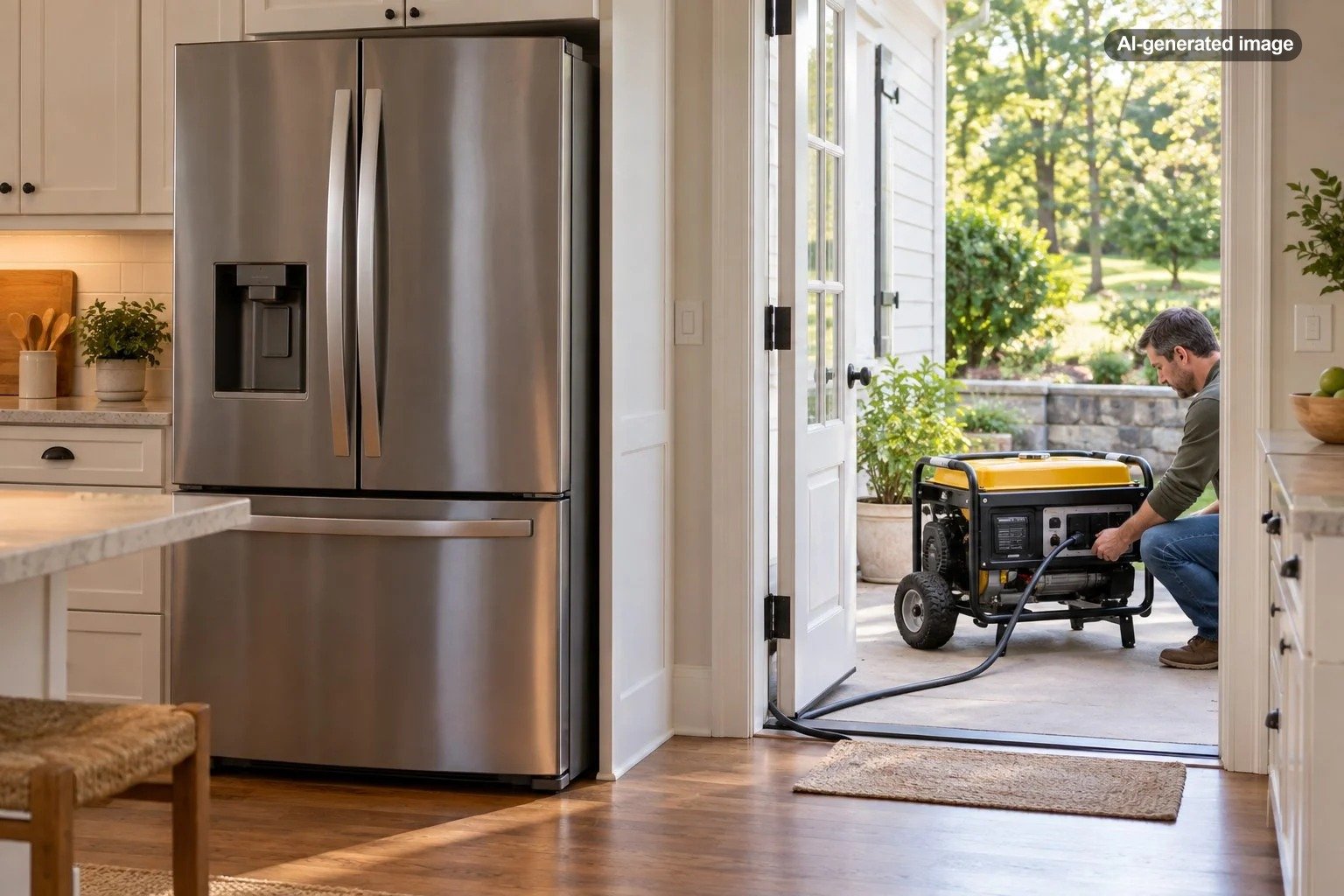
How Much Generator Power Does a Refrigerator Need?
A refrigerator usually does not require an enormous generator, but choosing the right size involves more than looking at its normal running wattage. The compressor needs a brief burst of additional power when it starts, so the generator must handle both the refrigerator’s steady electrical load and its startup surge. The most reliable way to size backup power is to check the refrigerator’s rating plate or manual, determine its actual running requirement, and then allow sufficient generator capacity for startup.
Why refrigerator wattage is not one fixed number
Two refrigerators that look similar can place noticeably different demands on a generator. Size, compressor design, ice makers, defrost systems, age, controls, and other features can all affect electrical requirements.
That is why a blanket statement such as “every refrigerator needs a 1,000-watt generator” is not a dependable sizing method. Even annual energy consumption is not the same thing as instantaneous generator demand. ENERGY STAR refrigerator listings, for example, publish annual energy use in kilowatt-hours, but a generator must also accommodate what the appliance demands at a particular moment.
For generator sizing, the appliance’s own electrical information matters most. GE Appliances specifically directs owners to the refrigerator rating plate when running amperage or wattage is needed for generator applications.
Running watts and starting watts are different
A refrigerator’s compressor cycles on and off rather than drawing exactly the same power every minute of the day. When the compressor is already operating, the appliance has a running load. When that motor starts, it can briefly demand considerably more electricity.
That temporary demand is commonly called starting watts, surge watts, or motor-starting power. A generator can appear large enough based on running watts yet still struggle if it cannot provide enough short-duration surge capacity.
How to estimate your refrigerator’s requirement
The simplest approach is to start with information from the refrigerator rather than an internet average.
What to do
- Find the rating plate or manual. Look for voltage, amperage, wattage, or model-specific electrical requirements.
- Calculate watts if necessary. When the label gives volts and amps rather than watts, GE Appliances recommends using volts multiplied by amps to determine wattage.
- Account for startup demand. GE says startup amps and watts are usually about three times running values, while Whirlpool advises allowing for a motor-start surge and specifically recommends doubling running wattage as a refrigeration startup consideration. Follow the guidance for your actual refrigerator whenever the manufacturer provides it.
- Add anything else the generator will power. Lights, a freezer, furnace controls, pumps, electronics, and other loads all consume part of the generator’s available output.
- Compare the total with both generator ratings. Confirm that continuous loads fit within the generator’s running capacity and that simultaneous motor starts will not exceed its surge capacity.
A practical sizing example
Suppose a refrigerator’s rating information indicates a 300-watt running requirement. If the manufacturer indicates that startup demand may reach roughly three times the running requirement, the starting load could be around 900 watts for sizing purposes. That does not mean the refrigerator continuously consumes 900 watts. It means the generator needs enough momentary headroom to start the compressor without being overloaded.
If the same generator is also carrying 300 watts of lighting and electronics, the calculation changes again. The refrigerator’s startup event could temporarily coincide with those other loads. This is why simply buying a generator whose running rating equals the refrigerator’s normal draw leaves too little information about actual performance.
Size backup power around the refrigerator’s startup demand and the other loads running at the same time, not around one generic wattage estimate.
Why bigger is not automatically better
Extra capacity can provide useful flexibility, especially if the generator will power multiple essential loads. But buying far more generator than the household needs may mean more equipment, fuel storage, noise, weight, and expense than necessary.
A better strategy is to decide what truly needs power during an outage. A refrigerator, selected lights, communications equipment, and perhaps another critical home system may matter more than trying to run an entire household exactly as usual.
Do not overlook the generator connection method
Having enough wattage does not automatically mean the setup is appropriate. Follow the generator manufacturer’s instructions for cords, connections, grounding, weather protection, and load limits. Do not improvise a connection that sends generator power backward through household wiring.
If a generator will supply circuits through a home’s electrical system rather than powering individual loads according to the equipment instructions, installation and connection requirements should be evaluated by a qualified electrician. Electrical codes and requirements can vary by location and installation type.
Portable generator placement is a life-safety issue
Portable generators produce carbon monoxide, an odorless and colorless gas that can be fatal. The U.S. Consumer Product Safety Commission says portable generators should never be operated inside homes, garages, basements, crawlspaces, sheds, or other enclosed areas, even with doors or windows open.
Follow the generator manufacturer’s instructions for operation in wet conditions and for refueling. CPSC also advises allowing a generator to cool before adding fuel rather than refueling it while it is running.
What if the refrigerator will not start on the generator?
If a refrigerator runs normally on utility power but repeatedly fails to start on a generator, do not assume the appliance is defective. The generator may be overloaded, another appliance may be starting at the same moment, the connection arrangement may be unsuitable, or the generator may not have enough surge capability.
Start by disconnecting nonessential loads and reviewing the electrical ratings for both the refrigerator and generator. If the generator should theoretically handle the refrigerator but still trips, stalls, produces unstable operation, or cannot maintain output, stop experimenting and consult the relevant equipment manufacturers or a qualified electrical professional.
Frequently asked questions
Can a small portable generator run a refrigerator?
Potentially, yes, provided its continuous and surge ratings meet the actual requirements of the refrigerator and any other connected equipment. Check model-specific appliance information rather than assuming that every small generator will work.
Why does a refrigerator need more power when it starts?
The compressor motor can draw a brief surge of electrical current as it starts. Once running, its demand is generally lower. Generator sizing therefore needs to account for both conditions.
Can I calculate refrigerator watts from amps?
When appropriate rating information is available, watts can be calculated by multiplying volts by amps. GE Appliances specifically gives this method for determining refrigerator wattage. Model-specific documentation remains the preferred reference.
Should I include other appliances when sizing the generator?
Yes. Add the loads that may operate simultaneously and consider the starting requirements of motor-driven equipment. Whirlpool recommends totaling the wattage of appliances intended to operate at the same time.
Is it safe to run a generator in an open garage?
No. CPSC says portable generators should not be used in garages even when doors or windows are open. Operate them outdoors at least 20 feet from the home, with exhaust directed away from the building and its openings.