Should You Dry Towels on High or Low Heat?
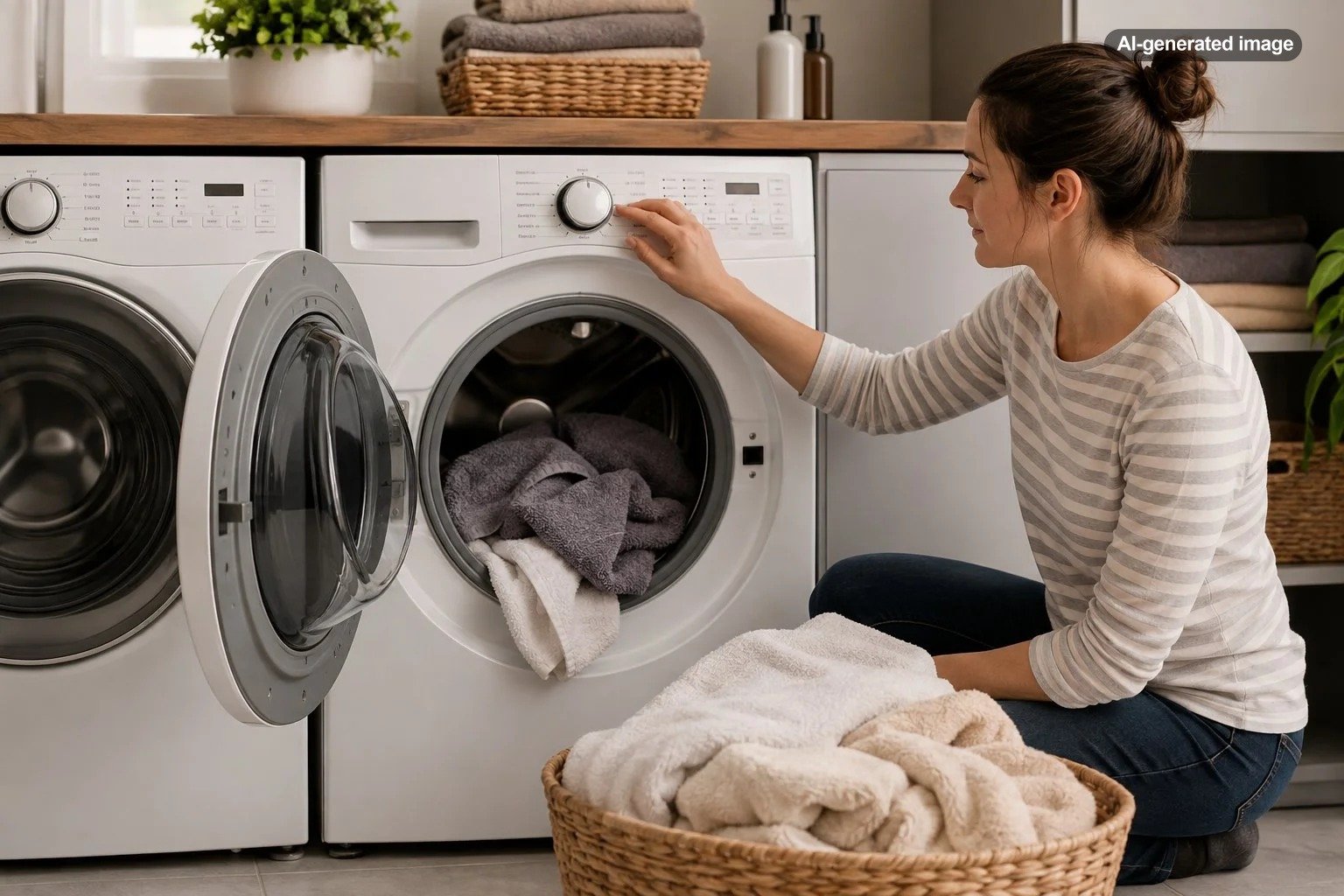
For most towels, low or medium heat is the better everyday choice. It dries cotton thoroughly while reducing the fiber wear, roughness, fading, and shrinkage that can come from repeated high-heat cycles. High heat can be useful for an occasional load of sturdy, all-cotton towels when the care label permits it, but it should not be the automatic setting for every towel in the linen closet.
The most important instruction is the one sewn into the towel. Cotton, bamboo-derived rayon, microfiber, decorative trims, and blended fabrics can have very different drying limits. When the label conflicts with general advice, follow the label.
Why low or medium heat is usually best
A towel does not become drier in a useful way once its remaining moisture is gone. Continuing to tumble a dry towel in high heat merely exposes the fabric to more heat, friction, and movement. Over time, that treatment can leave loops flattened or broken and make the towel feel less plush.
Low and medium settings take a gentler approach. They may require a little more time, particularly with thick bath sheets, but they give the dryer more opportunity to remove moisture without repeatedly stressing the fibers. Medium heat is often the practical middle ground for a household load of substantial cotton towels.
Low heat is especially sensible for deep colors that you want to protect from premature fading, lightweight towels that dry quickly, and towels with borders, embroidery, elastic, or decorative components. It is also the safer default when a towel’s fiber content is uncertain and the care label is missing.
The best dryer setting is not the hottest one; it is the gentlest setting that gets the entire load completely dry.
High heat versus low heat at a glance
| Setting | Best suited to | Main advantage | Main tradeoff |
|---|---|---|---|
| Low heat | Microfiber, lightweight, dark, delicate, or embellished towels | Gentler on fibers, color, and trim | Thick loads may need more time |
| Medium heat | Most everyday cotton bath towels | Balances drying time with fabric care | Still requires prompt removal |
| High heat | Sturdy cotton towels when the label permits | Can finish a heavy load more quickly | Raises the risk of shrinkage, fading, and overdrying |
| Air dry or no heat | Very delicate items or towels restricted by the label | Minimal heat exposure | Requires more time and good airflow |
When high heat can make sense
High heat is not forbidden; it is simply easy to overuse. A load of thick, durable cotton towels may tolerate it when the care labels explicitly allow tumble drying at a high temperature. It can also be a practical choice when a properly sized load is taking unusually long to finish on a lower setting.
The key is to avoid treating high heat as compensation for an overloaded dryer. Towels need room to separate and tumble so warm air can move around them. When the drum is packed tightly, the outsides may feel hot while folded centers and dense hems remain damp. Adding still more heat can overexpose some towels without solving the airflow problem.
If you use high heat, select a moisture-sensing cycle when available and check the load promptly. Do not assume that adding a fixed block of time is better. A sensor cycle can reduce unnecessary tumbling, although bulky items may still need to be rearranged if they roll together.
How towel material changes the answer
Traditional cotton towels
Most everyday cotton towels do well on medium heat. Thick, densely woven towels may need a longer cycle, but that does not automatically mean they need the highest temperature. Shake each towel before loading it so creases open and the loops are less compressed.
Premium or extra-plush cotton
Heavy towels can hold a surprising amount of water in their centers, hems, and borders. A medium sensor cycle followed by a short additional low-heat period is often gentler than one prolonged high-heat cycle. Dry them in a modest load so they have space to tumble.
Microfiber towels
Microfiber generally calls for low heat or air drying because high temperatures can harm its fine synthetic structure. Keep microfiber separate from lint-producing cotton towels when practical; otherwise, lint can cling to the fabric and reduce the clean finish people expect from microfiber.
Bamboo-derived and blended towels
Towels marketed with bamboo-derived fibers are commonly blended with cotton or made with regenerated fibers such as rayon. Their allowable settings vary, so the care label matters more than the marketing name. Low heat is the cautious choice unless the manufacturer directs otherwise.
Decorative and embellished towels
Embroidery, contrasting borders, fringe, appliques, and other details may react to heat differently from the main fabric. Choose the setting required by the most delicate component. A cotton towel body does not make a heat-sensitive border any more resilient.
A better routine for soft, evenly dried towels
What to do
- Read the care labels. Separate towels that require different temperatures or drying methods.
- Untangle the load. Shake towels after washing and separate any pieces wrapped around one another.
- Leave tumbling room. Avoid compressing a full washer load into a dryer that cannot accommodate it loosely.
- Start with medium or low heat. Use medium for ordinary cotton and low for more delicate fibers, colors, or trims.
- Use the moisture sensor. If your dryer has one, it can help limit unnecessary heat after the load is dry.
- Check dense areas. Feel hems, folded corners, and the centers of thick bath sheets rather than judging only by the warm surface.
- Remove and fold promptly. Store towels only when they are completely dry and cool enough to assess accurately.
Dryer balls can help separate towels and improve movement inside the drum, but they do not make an overloaded dryer behave like a spacious one. They also do not change a towel’s care instructions. Treat them as a small aid rather than the solution to every slow-drying load.
Common towel-drying mistakes
Using maximum heat for maximum time is the most obvious error. Towels often feel wonderfully warm immediately after a cycle, which can disguise overdrying. Assess their texture after they cool rather than assuming hotter means softer.
Mixing very different weights creates uneven results. Hand towels may be finished while thick bath sheets are still damp. Sorting by weight allows the whole load to reach the same finish at roughly the same time.
Adding too many fabric-coating products can also work against absorbency. Dryer sheets and some softeners leave residues intended to change how fabric feels. If towels seem slick, less absorbent, or unusually slow to dry, simplify the laundry routine and follow the towel and product instructions.
Folding towels while slightly damp invites a stale smell in the cabinet. Check the densest parts before putting the load away. If only one or two heavy pieces remain damp, remove the dry towels and give those pieces a short additional cycle rather than reheating everything.
How to choose the right setting for your household
Before you decide
- Follow the lowest heat limit shown on any care label in the load.
- Use low heat for delicate fibers, microfiber, dark colors, and decorative details.
- Use medium heat as the default for most cotton bath towels.
- Use high heat only for compatible, durable towels and avoid overdrying.
- Split oversized loads rather than increasing the temperature.
- Confirm that hems and centers are dry before storing towels.
Households that wash towels frequently may find that medium heat offers the easiest balance between fabric longevity and drying time. People with lightweight towels or a little extra time can favor low heat. If thick towels regularly emerge damp after a full, uncrowded cycle, clean the lint screen, confirm that airflow is not obstructed, and consult the dryer’s manual for maintenance guidance.
Frequently asked questions
Will low heat leave towels damp?
Not if the load has enough room, the dryer has adequate airflow, and the cycle runs long enough. Low heat may take longer. Separate very thick towels from lighter pieces and check dense hems before folding.
Does high heat make towels softer?
Heat can make towels feel warm and relaxed immediately after drying, but repeated high heat and overdrying can eventually make fibers rougher. Adequate rinsing, correct detergent use, room to tumble, and prompt removal matter more for lasting softness.
Can towels and sheets go in the dryer together?
They can when their care instructions are compatible, but it is rarely ideal. Sheets can wrap around towels, creating a bundled center that dries slowly while exposed fabric becomes overdried. Separate loads usually dry more evenly.
What setting should I use if the care label is gone?
Low heat is the cautious starting point, especially when the fiber content or trim is uncertain. If the towel is clearly a sturdy, ordinary cotton towel, medium heat is a reasonable next choice. Avoid high heat when you cannot identify the material.
What is the final verdict?
Use low to medium heat for most towels, with medium heat as the practical default for everyday cotton. Choose low for delicate or synthetic materials, and reserve high heat for sturdy towels whose labels permit it. Whatever setting you choose, proper load size and prompt removal do more for even drying than simply turning up the temperature.