
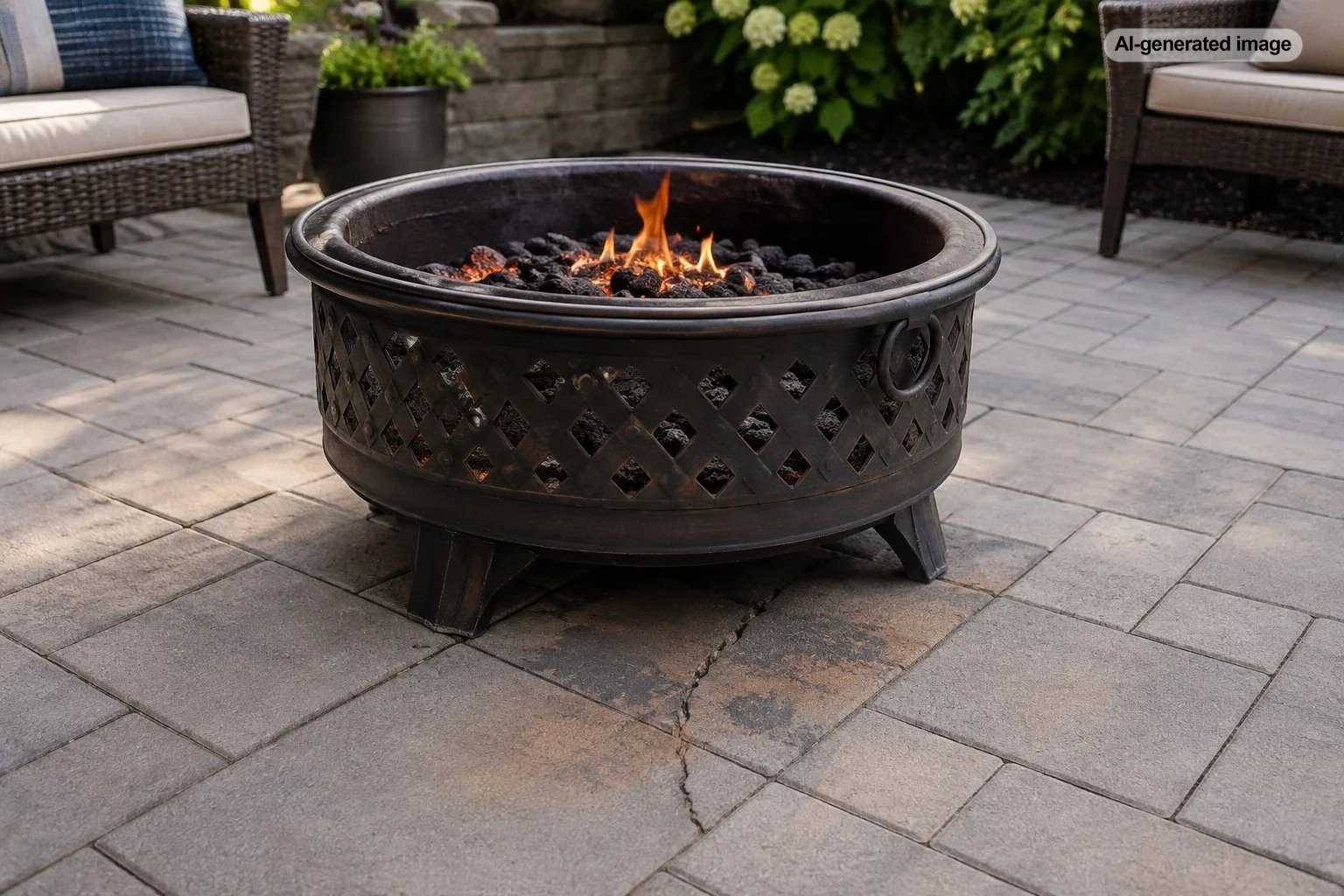
Can a Fire Pit Cause Pavers to Crack?
Yes, a fire pit can cause pavers to crack, chip, discolor, or weaken. The risk is greatest when intense heat or burning material reaches ordinary concrete pavers directly, especially if the pavers are damp, already damaged, or supporting an improperly installed wood-burning pit.
That does not mean a fire pit and a paver patio are incompatible. A purpose-built fire feature can work beautifully on or within a paver installation when its manufacturer permits the placement and the design includes the correct liner, base, clearances, and heat protection. The important distinction is between pavers used as a finished patio surface and materials specifically approved to form or protect a firebox.
Why heat can crack pavers
Concrete pavers are durable outdoor materials, but ordinary patio pavers are not necessarily designed for prolonged exposure to an open flame. A hot fire creates steep temperature differences: the exposed face heats rapidly while the underside and surrounding patio remain cooler. Uneven expansion can produce internal stress and eventually a crack or spalled surface.
Moisture makes the situation less predictable. Concrete is porous, so a paver may hold moisture after rain, irrigation, cleaning, or humid weather. Strong, sudden heating can turn that moisture into vapor. Existing hairline cracks, freeze-thaw damage, manufacturing variation, and repeated heating and cooling may further reduce the paver’s tolerance.
Damage is not limited to dramatic cracks. Heat and soot can alter the color of a paver or its surface treatment. Hot embers may leave concentrated marks, while the weight of a large fire feature can contribute to settlement if the patio base was not prepared for that load.
A paver can be noncombustible without being suitable as the unprotected floor or wall of a firebox.
Which fire pit arrangements carry the most risk?
The answer depends on where the heat goes, what fuel is burned, and whether the appliance or structure was designed for the installation.
| Arrangement | Typical concern | Practical response |
|---|---|---|
| Wood fire built directly on patio pavers | Flames, coals, and rapid heating contact ordinary pavers | Avoid unless every component is specifically approved for that use |
| Masonry-style pit without a liner | Concrete wall units receive sustained extreme heat | Use the specified metal insert or refractory system |
| Portable wood-burning pit | Radiant heat, falling embers, and hot legs concentrate heat | Follow the manual and use an approved protective base if required |
| Gas fire table or pit | Heat still reaches the surface; fuel connections add installation requirements | Confirm surface compatibility, ventilation, clearance, and fuel instructions |
| Purpose-built hardscape kit | Risk increases if components or installation details are omitted | Install the complete system according to its current documentation |
A wood fire directly on pavers
This is generally the arrangement most likely to damage the patio. The fire concentrates heat in a small area, and embers may remain hot long after visible flames subside. Simply surrounding the fire with loose blocks does not turn the underlying patio pavers into a suitable hearth.
A fire pit built from concrete wall units
Decorative wall blocks can form an attractive exterior, but the inner face needs the protection specified for the system. Unilock warns that wood-burning pits must be lined with an appropriate metal insert or refractory, fire-rated brick because extreme heat can affect concrete’s structural integrity. Belgard likewise recommends a metal insert or fire-ring liner to help protect concrete components from direct heat, discoloration, and damage.
A portable fire pit placed on a patio
Elevation alone is not proof that the surface below will remain cool. Bowl depth, leg height, shielding, fuel load, and airflow all influence the temperature at the patio. Use the appliance only on surfaces allowed by its manual, maintain the specified clearances, and do not improvise a shield from an unidentified household material.
A gas or propane fire feature
A gas flame usually avoids the bed of glowing wood coals associated with a traditional pit, but the unit can still send considerable heat downward and outward. The burner, enclosure, ventilation openings, fuel line, regulator, and surface beneath it must conform to the manufacturer’s instructions. Permanent gas connections should be handled by a qualified professional, with local requirements checked before installation.
How to protect a paver patio
What to do
- Identify both products. Find the paver manufacturer and product line if possible, then locate the fire pit’s model number and current instructions.
- Check surface approval. Confirm whether the appliance may sit on concrete pavers and whether a thermal barrier, hearth pad, or minimum elevation is required.
- Separate the firebox from decorative concrete. For a built-in wood-burning pit, use the specified metal insert or refractory liner rather than exposing ordinary blocks directly to fire.
- Assess the patio base. A heavy permanent feature needs stable support. A contractor may recommend removing pavers beneath it and building the feature on a properly prepared base to reduce settlement.
- Respect every clearance. Keep the installation away from the house, fences, overhangs, branches, furniture, and other combustibles as directed by the manual and local rules.
- Control sparks and fuel. Use only the fuel allowed by the manufacturer, avoid oversized fires, and use an approved spark screen when appropriate.
- Inspect after use. Once everything is fully cool, look for new cracks, flaking, rocking units, discoloration, or opened joints.
For a new patio, it is usually easier to plan the fire feature before laying the field pavers. The base, fuel routing, drainage, edge restraint, and replacement access can then be designed as one project. Retrofitting can still work, but setting a heavy feature wherever it looks convenient may lead to settlement or poor clearances.
If you live in a condo, townhome community, rental, or wildfire-prone area, approval and operating restrictions may matter as much as the patio material. Local fire rules, burn restrictions, association policies, lease terms, and manufacturer instructions can all be more restrictive than general advice.
What to do if the pavers are already cracked
First, stop using the fire pit until the cause and extent of the damage are understood. Photograph the setup and affected area after it has cooled. Note whether the cracks sit directly beneath the bowl, radiate from a leg, appear inside a built-in ring, or continue into surrounding pavers.
A single replaceable patio paver with a surface crack may be a localized repair. Multiple fractured units, crumbling concrete, loose fire-pit walls, sudden settlement, a damaged liner, or exposed gas components deserve professional evaluation. Replacing a paver without correcting the heat path or base problem invites a repeat performance.
Common mistakes that increase the chance of damage
- Assuming all masonry is fireproof: Brick, natural stone, concrete pavers, wall blocks, and refractory brick do not have identical heat performance.
- Using an oversized wood load: A larger fire can exceed the heat conditions anticipated by the pit’s design.
- Skipping a supplied insert: The liner is a functional component, not merely a decorative accessory.
- Placing a pit over wet or damaged pavers: Existing moisture and cracks can make the response to sudden heat less predictable.
- Letting ash collect in joints: Debris can stain the patio and interfere with drainage or maintenance.
- Choosing appearance before clearance: The most photogenic spot may be too close to an overhang, fence, planting, or traffic path.
- Making an improvised heat shield: An unidentified slab or tile may itself crack and may not provide the air gap the appliance requires.
Frequently asked questions
Can concrete pavers withstand a fire pit?
Some paver systems can be used around or beneath certain fire features, but suitability depends on the exact products and installation. Ordinary patio pavers should not be treated as firebox materials unless their manufacturer specifically approves that application.
Will a fire pit mat prevent cracking?
An appropriately rated pad may protect the surface in an installation that permits one. It does not make every fire pit safe for every patio, and it cannot compensate for prohibited placement, insufficient clearance, unstable legs, or poor ventilation. Confirm compatibility with both the fire pit and the pad manufacturer.
Are natural-stone pavers safer than concrete?
Natural stone is not automatically immune to thermal damage. Different stones have different mineral structures, porosity, moisture behavior, thicknesses, and finishes. Ask the supplier whether the specific stone is suitable for the proposed exposure instead of relying on the broad label of natural stone.
Should pavers be removed beneath a permanent fire pit?
That can be the better construction detail for some heavy, built-in features. Belgard notes that cutting out the pavers and placing a fire pit on the same prepared base may reduce pressure on the pavers and help prevent settling. The correct detail still depends on the chosen system and site.
Can cracked pavers be replaced?
Individual interlocking pavers often can be removed and replaced. Before doing so, correct the heat exposure, liner, weight, or base issue that caused the damage. Damage involving the fire-pit structure, gas system, or widespread patio movement calls for qualified help.
The sensible bottom line
A fire pit can crack pavers, particularly when a wood fire, hot coals, or unlined firebox exposes ordinary concrete directly to extreme heat. The safest path is to treat the fire feature as an engineered installation: match the appliance to the surface, use every required liner or barrier, prepare the base correctly, maintain clearances, and follow current manufacturer and local instructions.
If the pavers or fire pit cannot be positively identified, pause before lighting it. A hardscape contractor or the relevant manufacturers can help determine whether the existing setup needs a liner, a purpose-made protective base, relocation, or reconstruction.