
Can You Install a Ceiling Fan on a Sloped Ceiling?
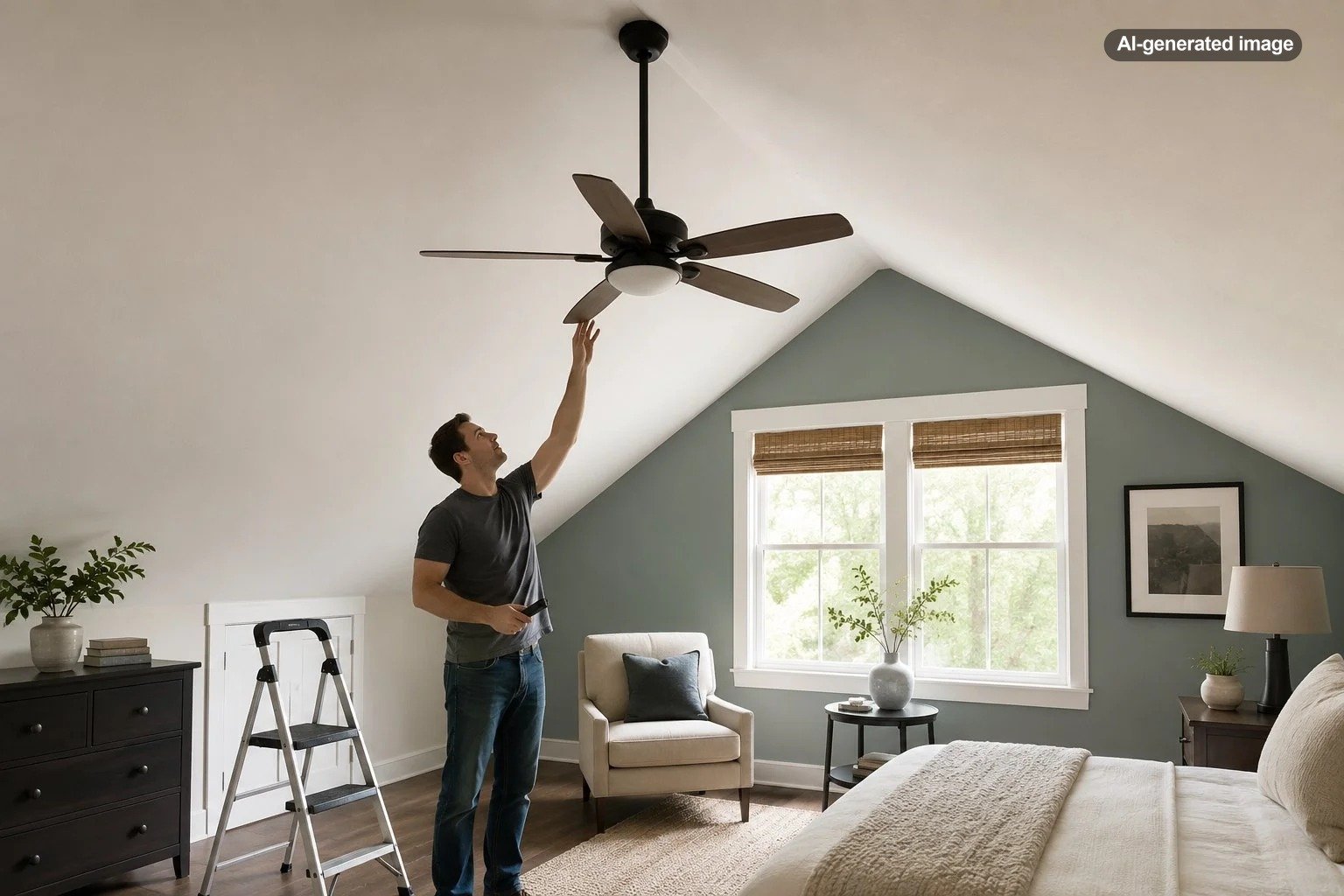
Yes, you can install a ceiling fan on a sloped ceiling, but the fan, mounting hardware, ceiling angle, downrod, and electrical support all have to work together. A gentle slope may be accommodated by a fan’s standard hanging system, while a steeper ceiling can require a manufacturer-approved angled mounting adapter or a different fan altogether. The safest starting point is the installation manual for the exact fan you plan to use rather than a universal rule about what will fit.
The important distinction is that a sloped ceiling changes more than the appearance of the installation. The fan still needs to hang vertically, the blades need adequate clearance, and the mounting point must be designed to support a ceiling fan rather than an ordinary light fixture. Manufacturer limits also vary considerably: one fan may accept a particular ceiling pitch with its normal mount while another may prohibit angled installation entirely.
Start with the fan’s approved mounting method
Ceiling fans designed for downrod mounting commonly use a hanging ball and bracket arrangement that allows the downrod to remain vertical while the canopy meets the ceiling above it. That built-in movement can accommodate some slopes, but there is always a limit determined by the specific product.
For example, Hunter documentation for some fan models states that an angled ceiling can require a longer downrod and that ceilings steeper than 34 degrees require the company’s angled mounting kit. Hunter also sells angled mounting hardware for selected fans and specifies compatibility limits for those accessories. Other manufacturers publish different limits, which is precisely why it is risky to assume that one brand’s angle applies to another. Hunter’s angled ceiling mounting guidance describes the company’s approach to sloped installations.
Big Ass Fans likewise publishes model-specific mounting guidance. Its Haiku recommendations, for example, distinguish low-profile mounting for flat ceilings from universal mounting configurations that can be used on flat or sloped ceilings within the stated limits. The document lists sloped-ceiling capability up to 33 degrees for certain Haiku configurations, illustrating how close-looking products can still have different requirements. Big Ass Fans’ residential fan mounting guide provides those model-specific examples.
Measure the ceiling slope before choosing hardware
The slope determines whether the fan’s standard mounting system can articulate far enough to hang correctly. If you already know the roof or ceiling pitch, the fan manufacturer may provide a corresponding angle limit. Otherwise, the angle can be measured with a digital angle finder or calculated from rise and run.
This measurement should happen before ordering a fan, especially under a dramatic cathedral or vaulted ceiling. A ceiling that looks only moderately steep from the floor can exceed the fan’s standard mounting range, and discovering that after the motor is unpacked is an avoidable inconvenience.
What to check before installation
- Measure or determine the ceiling angle at the intended mounting location.
- Find the maximum sloped-ceiling angle permitted in the exact fan’s installation manual.
- Confirm whether the standard canopy is approved or whether an angled mounting kit is required.
- Determine the downrod length needed to keep the fan at an appropriate height and clear the surrounding ceiling.
- Verify that the mounting box and supporting structure are suitable for ceiling fan support.
- Check blade clearance from walls, beams, lighting, cabinetry, and other obstructions.
The downrod does much of the practical work
On a sloped ceiling, the downrod allows the motor and blades to hang below the angled surface while remaining level. A longer downrod can also move the blades away from the rising side of a vaulted ceiling, which may be necessary to maintain the clearances specified by the fan manufacturer.
That does not mean the longest available downrod is automatically better. The correct length depends on ceiling height, ceiling angle, fan diameter, room proportions, and the manufacturer’s approved components. Longer rods also change the fan’s visual position in the room, so there is a design judgment after the functional requirements have been satisfied.
A fan needs fan-rated support, not merely a ceiling box
The mounting point deserves as much attention as the slope. Ceiling fans create weight and dynamic forces that ordinary lighting hardware may not be intended to support. Manufacturer instructions commonly require the outlet box to be securely attached to the building structure and marked or approved for ceiling fan support.
Craftmade’s fan installation documentation, for example, tells installers using an existing box to verify that it is securely attached to the building structure and clearly marked as suitable for fan support. Its manuals also show that angle limits differ by model, with some fans permitting vaulted-ceiling mounting and others explicitly prohibiting it. Craftmade’s ceiling fan installation guide is one example of why the exact manual matters.
Do you always need a sloped-ceiling adapter?
No. Some downrod-mounted fans are designed to accommodate a modest angle through their standard hanging system. A separate slope adapter becomes necessary only when the manufacturer’s instructions require one for the ceiling angle or installation configuration.
It is equally important to recognize that not every ceiling fan is a candidate for a sloped ceiling. Certain flush-mount or low-profile fans are intended only for flat ceilings because their motor housing sits close to the surface instead of hanging from an articulating downrod. Big Ass Fans’ published Haiku mounting recommendations, for instance, identify low-profile mounting as a flat-ceiling configuration while showing sloped-ceiling use with its universal mount.
| Situation | What usually matters | Next check |
|---|---|---|
| Gentle ceiling slope | The standard hanging system may accommodate it | Confirm the exact angle limit in the fan manual |
| Steep vaulted ceiling | An angled mount may be required | Check manufacturer-approved adapters and compatibility |
| High ceiling | A longer downrod may improve placement and clearance | Use an approved downrod length and diameter |
| Low-profile fan | Many are intended for flat ceilings only | Verify whether the model permits angled mounting |
| Existing light fixture box | The box may not be suitable for fan support | Confirm fan rating and structural attachment |
Clearance matters on both sides of the fan
A fan on a level ceiling has fairly predictable geometry. A fan under a slope is different because one side of the ceiling rises away while the other remains closer to the blade tips. Beams, dormers, chandeliers, recessed architectural details, and nearby walls can further complicate the available space.
Manufacturer clearance requirements should therefore be checked with the fan in its actual proposed position, not simply measured from the electrical box. Published guidance can include minimum distances from the fan to the floor, walls, and obstructions. Those dimensions are product-specific and should be taken from the current manual for the fan being installed. Big Ass Fans, for example, publishes minimum clearance guidance alongside its residential mounting recommendations rather than treating fan diameter and downrod length as purely decorative choices.
The question is not simply whether a fan can hang from a slope, but whether the entire installation can hang level, clear its surroundings, and use the hardware the manufacturer intended.
What commonly goes wrong
The most common planning mistakes happen before anyone touches the wiring. A fan is chosen for style without checking whether it accepts an angled mount. The ceiling angle is guessed rather than measured. A short downrod is selected to keep the fan visually close to the ceiling even though the uphill blade needs more clearance. Or an existing fixture box is assumed to be adequate simply because it has held a light for years.
Another easy oversight is remote-control hardware. Some fans place a receiver inside the canopy, and an angled mounting accessory may alter the available space or have specific compatibility restrictions. Hunter, for example, notes that one of its angled mounts is not compatible with remote-controlled fans requiring a canopy-mounted receiver. That does not make remote fans unsuitable for slopes in general; it shows why the fan, adapter, and controls need to be treated as one system. Hunter’s accessory documentation provides a current example of that type of compatibility limitation.
Before you decide
- Is the fan specifically approved for a sloped or vaulted ceiling?
- Is your ceiling angle within the model’s published limit?
- Does the manufacturer require an angled mounting kit?
- Is the selected downrod approved for the fan and suitable for the ceiling height?
- Will the blades clear the ceiling, walls, beams, and other fixtures?
- Is the electrical box suitable for fan support and securely attached to the building structure?
- Are remote receivers, canopies, and other accessories compatible with the proposed mount?
When to call an electrician
Replacing a ceiling fan can involve both electrical work and load-bearing mounting hardware, and conditions vary from one house to another. A qualified electrician is the sensible choice when you cannot confirm the fan rating of the existing box, when a new mounting point must be created, when wiring must be extended or altered, when the ceiling structure is inaccessible or uncertain, or when the fan instructions do not clearly match the existing conditions.
Manufacturer manuals also commonly direct people who are unfamiliar with wiring to use a qualified electrician. That guidance is particularly relevant on vaulted ceilings, where access itself can add difficulty and where the mounting location may be well above normal ladder height. Local electrical and building requirements can differ, so do not assume that an installation method shown for one house or jurisdiction automatically applies to another.
FAQ
Can any ceiling fan be installed on a vaulted ceiling?
No. Some fans support angled mounting, some require a special adapter above a certain angle, and some models are intended only for flat ceilings. Check the installation manual for the exact model before purchasing accessories or beginning work.
Does a ceiling fan have to hang straight on a sloped ceiling?
The downrod and motor assembly should hang in the orientation specified by the manufacturer, which normally leaves the fan blades operating level even though the canopy is attached at an angle. An approved mounting system allows the ceiling connection and hanging fan to accommodate those different orientations.
How do I know whether I need a longer downrod?
Consider the ceiling height, slope, fan diameter, and the clearances specified in the fan manual. On a steeper slope, additional downrod length may be necessary to move the blades below the closer, uphill portion of the ceiling.
Can I use the electrical box that already holds my ceiling light?
Only if it is suitable for ceiling fan support and installed as required for the fan. Do not assume that a box designed to hold a light fixture can safely support a fan. If the rating or structural attachment cannot be verified, have it evaluated before installation.
Is a flush-mount fan better for a sloped ceiling?
Usually not. Many low-profile or flush-mount fans are intended for flat ceilings because they do not use the articulating downrod arrangement commonly used on slopes. The exact fan documentation should make the permitted mounting orientations clear.
Sources & further reading
- Hunter Fan: Angled Ceiling Mounts – manufacturer guidance on angled mounting and slope adapters.
- Big Ass Fans: Residential Fan Recommended Size and Mounting Options – manufacturer mounting, slope, downrod, and clearance guidance.
- Craftmade: Ceiling Fan Installation Guide – manufacturer instructions covering vaulted-ceiling limits, fan-support boxes, and installation precautions.
- Hunter Fan: Original Angled Ceiling Mount – manufacturer compatibility information for an angled mounting accessory.