
Is a Tankless Water Heater Worth the Cost?
A tankless water heater can be worth the cost when you value long service life, compact equipment, lower standby energy loss, and a continuous supply of hot water. It is less compelling when the installation requires major gas, electrical, venting, or plumbing upgrades, or when your household routinely uses several hot-water fixtures at once.
The deciding factor is not simply whether tankless technology is more efficient. It is whether the complete system will meet your peak demand without turning the installation into an expensive infrastructure project.
What you are really paying for
A storage water heater heats a tank of water and keeps it ready. A tankless unit activates when water begins flowing through it, heating the water as it passes through a heat exchanger. This avoids the standby heat loss associated with maintaining a full tank at temperature.
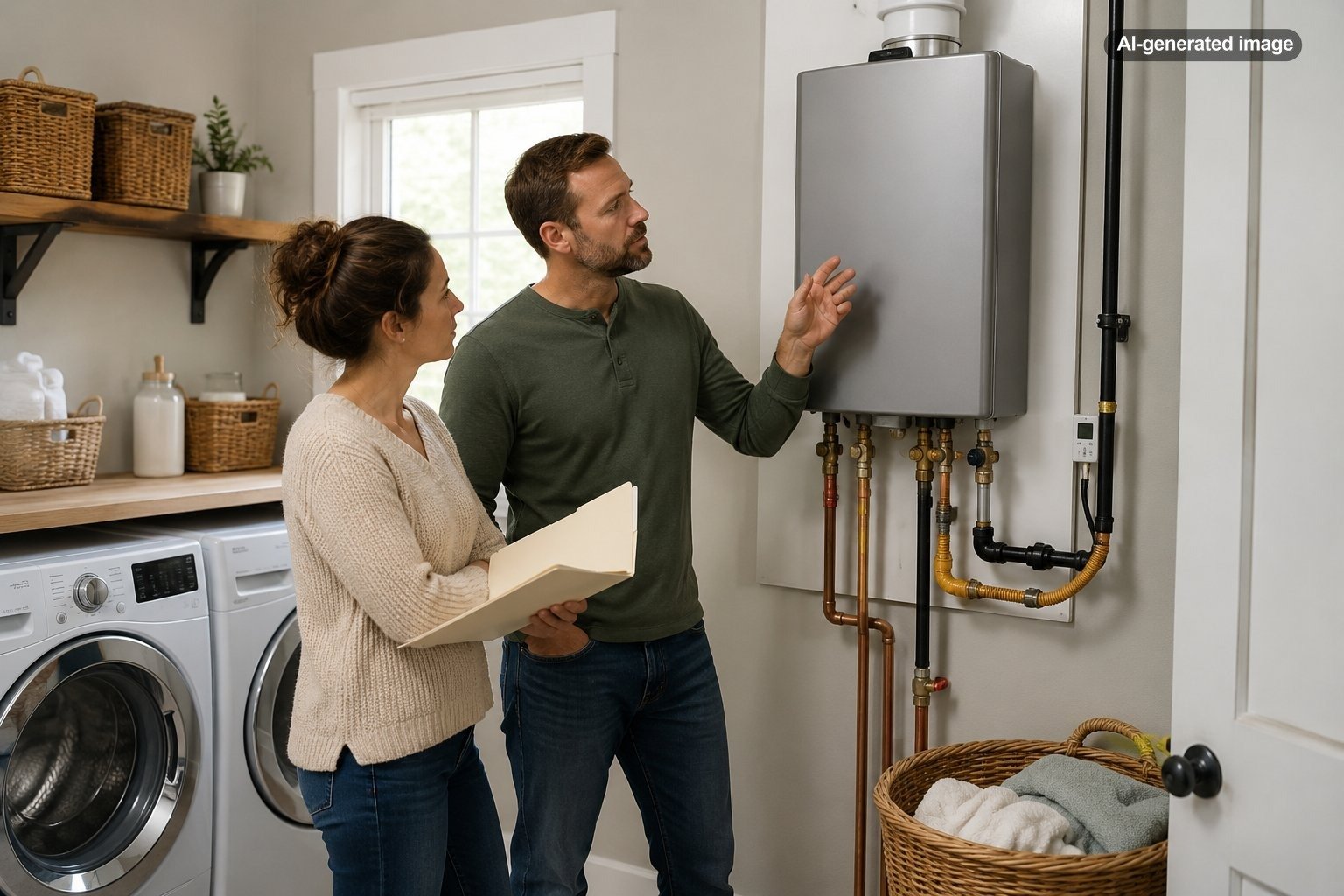
The equipment itself is only one part of the investment. A replacement may also involve changes to the gas supply, electrical service, exhaust venting, condensate drainage, water lines, mounting location, shutoff valves, or exterior penetrations. Requirements vary by the selected unit, fuel type, climate, home layout, and local rules.
A straightforward installation can make tankless attractive. A complicated conversion from an older storage heater can make the financial case much weaker, even when the new unit uses less energy.
How tankless and storage heaters compare
| Consideration | Tankless heater | Storage heater |
|---|---|---|
| Hot-water supply | Continuous within the unit’s rated flow capacity | Limited by stored volume and recovery rate |
| Peak simultaneous use | Must be carefully sized for combined flow and temperature rise | The tank can help absorb short periods of heavy demand |
| Energy use | Avoids most standby tank losses | Uses energy to maintain stored water temperature |
| Installation | May require utility, venting, drainage, or electrical upgrades | Often simpler when replacing a similar existing unit |
| Space | Usually wall-mounted and compact | Requires floor space for the tank |
| Maintenance | Periodic service is important, especially where scale develops | Tank flushing, anode inspection, and other maintenance may apply |
| Service life | Often longer, with many replaceable components | Generally shorter than tankless equipment |
The U.S. Department of Energy reports that demand water heaters can be 24% to 34% more energy efficient than conventional storage heaters in homes using 41 gallons or less of hot water per day. The advantage narrows in households with substantially higher daily use. Those percentages describe energy efficiency, not a guaranteed reduction in the total household utility bill.
The most important issue is peak flow
Tankless water heaters do not run out of stored water, but they can run out of heating capacity. Every unit has a maximum flow rate at a given temperature rise. The colder the incoming water and the hotter the desired output, the harder the unit must work.
To estimate demand, list the hot-water fixtures and appliances that may operate together. Add their flow rates, then compare that total with the heater’s capacity at the required temperature rise. A shower, a bathroom faucet, and a dishwasher running simultaneously can create a very different requirement from a single shower.
Do not size a tankless unit only by the number of bedrooms or bathrooms. Household routines, fixture flow rates, groundwater temperature, fuel supply, and the distance to fixtures all matter.
When the higher initial cost is easier to justify
Tankless equipment becomes more appealing when several benefits matter at the same time rather than when energy savings are the only goal.
Advantages
- Continuous hot water when demand stays within rated capacity
- Reduced standby energy loss
- Compact, wall-mounted installation in many homes
- Longer expected service life than many storage heaters
- Replaceable components may extend usable life
- No large tank that can rupture and release its full stored volume
Tradeoffs
- Higher equipment and installation expense in many conversions
- Flow limitations during simultaneous use
- Possible gas-line, venting, electrical, or condensate work
- Regular maintenance may be important in hard-water conditions
- Hot water still takes time to travel through long pipes
- A power outage can disable ignition, controls, or electric heating
A compact unit can be especially valuable in a small utility room, garage conversion, condo, or renovation where reclaiming floor space has practical value. It can also suit households that take long showers but do not frequently operate several hot-water fixtures at once.
However, a modest reduction in energy use may take a long time to recover if the conversion requires extensive utility upgrades. That does not make the purchase wrong, but it means comfort, space, longevity, and replacement timing may be stronger reasons than payback alone.
Gas and electric tankless systems are not interchangeable
Gas-fired tankless heaters generally offer higher whole-house flow capacity than electric models, but they require appropriate fuel delivery and combustion venting. Some high-efficiency units also produce condensate that must be drained according to manufacturer instructions and local requirements.
Whole-house electric tankless heaters can place a substantial instantaneous load on the electrical system. A home may need adequate panel capacity, correctly sized circuits, and other electrical work. Smaller electric units are often more practical for point-of-use applications, such as a remote sink, than for supplying several fixtures simultaneously.
Maintenance can change the ownership equation
Tankless does not mean maintenance-free. Mineral scale can collect inside the heat exchanger, particularly in homes with hard water. The appropriate inspection and service schedule depends on water quality, usage, equipment design, and manufacturer instructions.
Ask the installer how the unit will be isolated and serviced. Properly placed service valves can make future flushing or descaling more practical. Also ask about inlet screens, condensate components, vent inspection, freeze protection where applicable, and access to replacement parts.
A neglected unit may lose performance or develop problems earlier than expected. Conversely, periodic maintenance and replaceable components can help a tankless heater remain useful for many years.
Tankless does not automatically mean instant hot water
The heater may begin producing hot water quickly, but water must still travel from the unit to the faucet. A distant bathroom can therefore have a noticeable wait even with a tankless system.
A recirculation system may reduce waiting, but it adds equipment, controls, installation considerations, and potential heat loss from piping. Some homes are better served by relocating the heater, adding a carefully selected point-of-use unit, improving pipe insulation, or accepting a brief wait rather than circulating hot water continuously.
When a storage or heat-pump heater may be the better choice
A conventional storage heater can remain a sensible option when the existing installation is simple, the budget is tight, and the household needs a large burst of hot water over a short period. The stored volume provides a buffer that can be useful during busy mornings.
An electric heat-pump water heater is another option worth comparing when there is sufficient installation space, airflow, drainage, and electrical capacity. It stores hot water but uses heat-pump technology to reduce electricity consumption. Its suitability depends on the installation location, climate, household demand, noise considerations, and recovery requirements.
The best comparison is therefore not always tankless versus a basic storage heater. Depending on the home, it may be tankless versus a high-efficiency storage model, a heat-pump water heater, or a hybrid system.
How to decide before requesting bids
Before you decide
- Record which hot-water fixtures commonly operate at the same time.
- Estimate their combined gallons-per-minute demand.
- Determine the seasonal incoming-water temperature for your area.
- Confirm the available gas supply or electrical capacity.
- Inspect the proposed venting, drainage, and mounting route.
- Ask how local water hardness affects maintenance.
- Compare complete installed proposals, not equipment prices alone.
- Review efficiency, output, maintenance, and warranty information for the exact model.
- Consider storage and heat-pump alternatives using the same household assumptions.
Request written estimates that separate the equipment, labor, utility upgrades, venting or drainage work, permit responsibility, removal of the old heater, and included service valves. This makes competing proposals easier to compare and exposes expensive assumptions before work begins.
So, is a tankless water heater worth it?
It is often worth it for homeowners who plan to stay in the property, have predictable hot-water demand, want to save space, and can install the system without disproportionate infrastructure work. It may also be worth choosing for comfort and longevity even when the energy savings alone do not produce a quick financial return.
It is less likely to be the best value when several people regularly use hot water at the same time, the home needs major gas or electrical upgrades, maintenance is likely to be neglected, or a straightforward storage replacement already meets the household’s needs.
The best water heater is not the one with the most appealing technology; it is the one sized for the household and practical for the house.
Frequently asked questions
Can a tankless water heater supply an entire house?
Yes, provided it is sized for the required flow rate and temperature rise. Large or high-demand households may need a higher-capacity unit, multiple units, or a different system design.
Will a tankless heater lower every homeowner’s utility bills?
No. It reduces standby losses, but actual savings depend on hot-water use, fuel prices, equipment efficiency, maintenance, and household behavior. Installation expense also affects whether the total investment pays back financially.
Does tankless water get hot immediately?
The unit heats water on demand, but the cooled water already sitting in the pipes must leave first. Fixtures far from the heater may still have a waiting period.
Do tankless water heaters need annual maintenance?
Maintenance frequency is model- and site-specific. Water hardness, usage, installation conditions, and manufacturer instructions should guide the service schedule rather than a universal rule.
Should a homeowner install a tankless heater without a contractor?
Tankless installation can involve high-amperage electrical work, gas piping, combustion venting, condensate disposal, plumbing, and local code requirements. The Department of Energy recommends using a qualified plumbing and heating contractor, particularly for gas-fired systems.