
Why Does My House Smell Like Dust When the Air Conditioner Turns On?
Your house may smell like dust when the air conditioner turns on because the system is moving air across a dirty filter, dusty return grille, debris near the air handler, or particles that settled inside the duct system. A brief dusty odor after the system has been idle can be fairly ordinary. An odor that persists, grows stronger, smells damp, or returns every day deserves closer attention.
The useful question is not simply whether dust exists somewhere in the system. Dust exists in nearly every home. The goal is to determine whether you are smelling a small amount of settled debris, an airflow problem that is pulling dust from unintended places, or moisture that is creating a different odor altogether.
The most common cause is a dirty or poorly fitted air filter
Your HVAC filter is intended to capture particles before they accumulate on system components or circulate through the home. When the filter is overloaded, damaged, installed backward, or too small for the slot, air may carry more dust through the system or slip around the filter entirely.
A filter can also look acceptable from one angle while being heavily loaded within its pleats. Turn the system off before removing it, note the airflow arrow, and inspect the entire surface under good light. Replace it when it is visibly dirty or according to the equipment and filter manufacturer’s instructions.
Do not automatically install the densest filter you can find. Higher filtration is not universally better if the system cannot maintain proper airflow through it. A qualified HVAC professional can help determine an appropriate filter type for the equipment, ductwork, household needs, and blower capacity.
Dust may be sitting on grilles and nearby surfaces
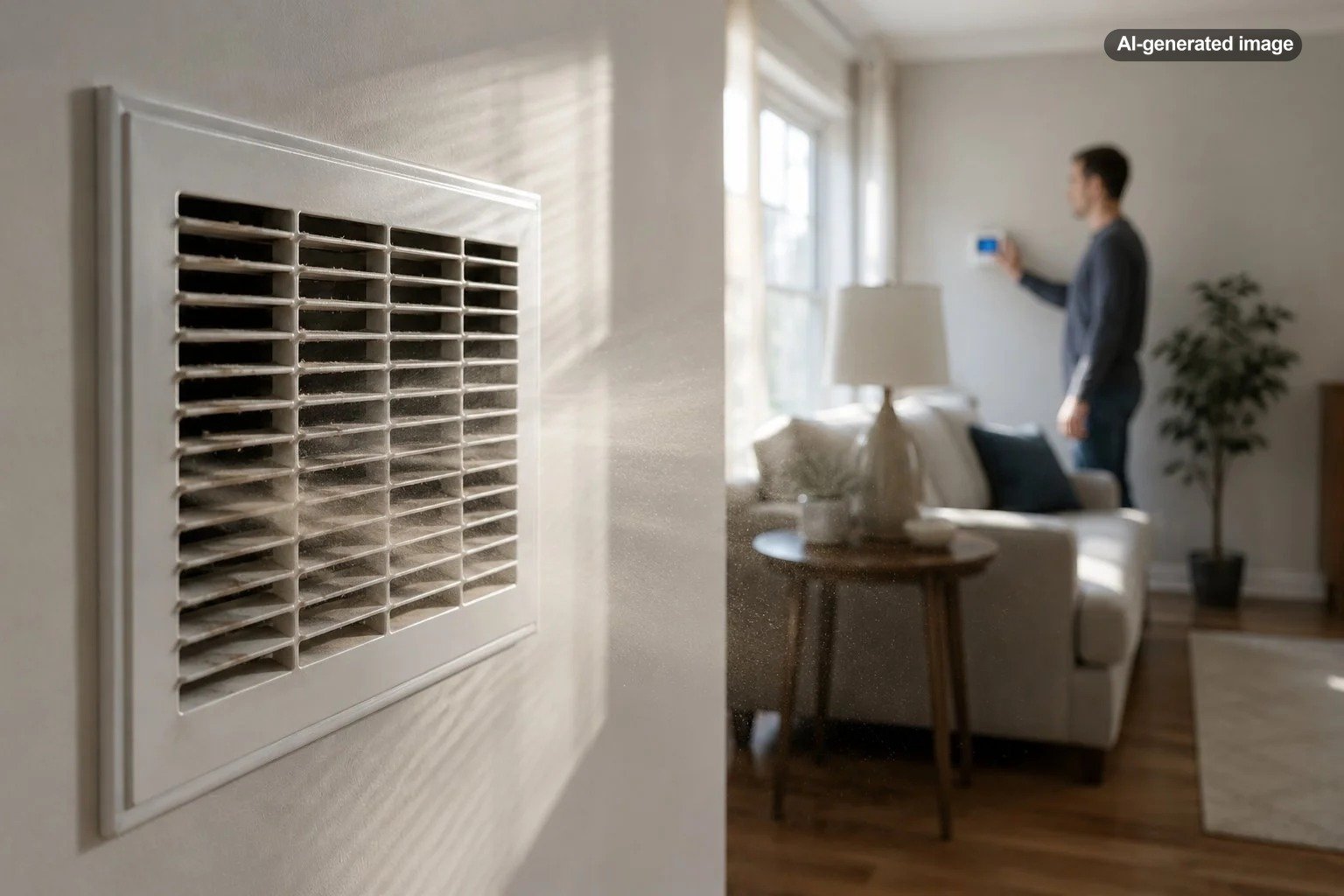
Return grilles draw room air back toward the air handler, so they tend to collect lint, pet hair, and ordinary household dust. Supply registers can also develop a visible coating, especially around their edges. When airflow begins, these particles may be disturbed enough to create a short-lived dusty smell.
With the system off, vacuum the accessible grille surfaces using a soft brush attachment. Wipe washable metal grilles with a lightly dampened cloth, then dry them before restarting the system. Avoid pushing tools, wet cloths, sprays, or vacuum hoses deep into duct openings.
Also inspect the floor, wall, or ceiling immediately around each grille. A dark outline does not necessarily mean the ducts are filthy. It can result from air movement depositing particles on the surrounding finish, particularly where a grille is loose or air is leaking around its edges.
What to do
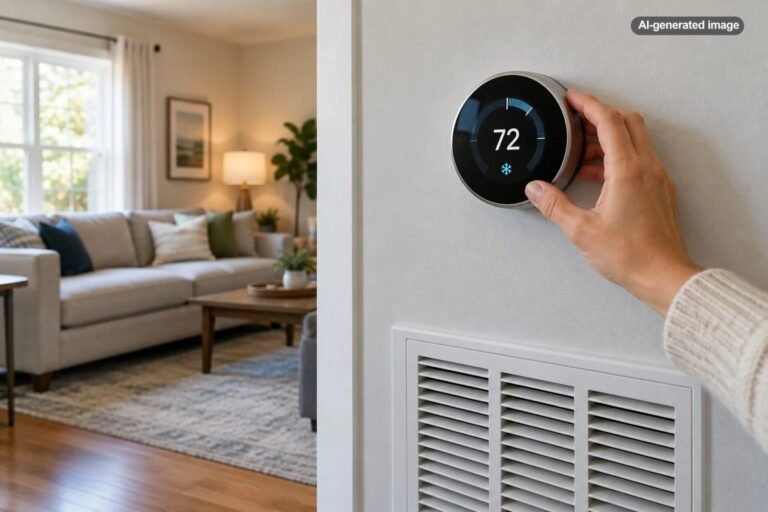
- Turn the cooling system off at the thermostat.
- Inspect the filter for heavy dust, damage, gaps, or incorrect orientation.
- Vacuum accessible return grilles and supply registers.
- Look for dust trails or gaps around the filter cabinet, return grille, and indoor unit.
- Restart the system and note where the odor appears first and how long it lasts.
- Schedule service if the smell remains, returns frequently, or comes with weak airflow, moisture, noise, or visible contamination.
A long-idle system can release a temporary dusty odor
If the air conditioner has not run for weeks or months, a light layer of settled dust may be disturbed during the first cooling cycle. This is more likely after renovation work, extended vacancy, seasonal storage, or a period when windows were frequently open.
A mild odor that disappears quickly and does not return is usually less concerning than one that remains through repeated cycles. Open interior doors to support normal airflow, make sure registers are unobstructed, and observe the system for the next several cycles rather than masking the smell with fragrance.
Leaky return ducts can pull dust from hidden spaces
The return side of a forced-air system operates under negative pressure. If return ductwork has gaps, disconnected joints, or poorly sealed cavities, it may draw air from an attic, crawlspace, utility area, wall cavity, or dusty mechanical closet. The result can be recurring dust, uneven airflow, and an odor that appears whenever the blower starts.
Clues include unusually rapid filter loading, persistent dust despite regular cleaning, dust streaks near the air handler, rooms that are difficult to cool, or odors that change with attic or crawlspace conditions. These symptoms require more than wiping a register. A technician may need to inspect the return path, filter rack, blower compartment, and accessible duct connections.
Do not use ordinary cloth-backed duct tape as a permanent duct-sealing repair. Accessible duct joints are typically sealed with materials intended for HVAC applications, and hidden or damaged ductwork should be evaluated before any repair is attempted.
The odor may actually be coming from the indoor unit
Dust and debris can accumulate on components such as the blower assembly, cabinet surfaces, and evaporator coil. A neglected filter, filter bypass, nearby construction dust, or years of ordinary operation can contribute to buildup. Because the coil and drain system also handle moisture, odors from this area may be difficult to distinguish without inspection.
Homeowners can safely check the visible surroundings of the unit and look for obvious water, debris, or a loose access panel. Internal cleaning, electrical access, coil work, blower removal, and drain repairs should be left to a qualified professional. Spraying household cleaners or fragrance products into the cabinet can damage components, introduce irritants, and conceal the original symptom.
A musty smell points toward moisture, not ordinary dust
People often describe a dry, stale, earthy, or musty odor simply as dust. If the smell resembles a damp basement, wet cardboard, or a closed room after humid weather, moisture may be involved. Possible areas to inspect include the condensate drain, drain pan, evaporator coil area, nearby insulation, ductwork in humid spaces, and building materials around the unit.
Moisture does not automatically mean widespread mold, and an odor alone cannot identify what is growing or where. The practical response is to find and correct the moisture source. Look for standing water, repeated drain backups, damp insulation, ceiling stains, condensation on duct surfaces, or water around the indoor unit.
Should you have the air ducts cleaned?
Duct cleaning is not automatically the right response to every dusty odor. The U.S. Environmental Protection Agency notes that duct cleaning generally includes more than the visible ducts; it can involve registers, coils, drain pans, fan components, and the air-handling unit. Cleaning only one part of a contaminated or poorly maintained system may not solve the underlying issue.
Professional duct inspection may be reasonable when there is substantial visible debris, evidence of pests, confirmed contamination, construction material inside the ducts, or particles being released from registers. It is less persuasive as a first step when the real problem is an overdue filter, a leaky return, moisture, or a dirty blower compartment.
Before hiring a company, ask what evidence supports the recommendation, which components will be inspected, how the home will be protected, and whether the contractor will address the source of contamination rather than simply vacuuming accessible openings. Be cautious about dramatic claims based solely on a photograph of ordinary household dust.
A dusty odor is a symptom to trace, not a reason to clean every hidden surface without a diagnosis.
How to prevent the smell from returning
- Check the filter regularly: Inspect it more often during heavy cooling seasons, renovation work, wildfire smoke events, or periods of high household activity.
- Keep returns clear: Do not block return grilles with furniture, curtains, storage, or rugs.
- Control renovation dust: Isolate work areas, protect returns, and follow contractor guidance rather than operating the system through heavy sanding or demolition dust.
- Maintain the indoor unit: Arrange routine professional maintenance that includes relevant filters, coils, drainage components, airflow, and accessible mechanical parts.
- Manage moisture: Correct drain problems, duct condensation, plumbing leaks, and excessive indoor humidity instead of relying on deodorizing sprays.
- Seal obvious bypasses: Have gaps around filter racks, air-handler panels, and duct connections assessed so air travels through the intended filtration path.
Frequently asked questions
Is a dusty AC smell dangerous?
A brief dusty smell after a long period of inactivity is not necessarily dangerous. Persistent odors, visible particle release, moisture, respiratory irritation, burning smells, or electrical symptoms require further evaluation.
Why does the smell happen only when the blower starts?
The blower creates airflow through the return system, filter, indoor unit, ducts, and registers. That airflow can disturb settled debris or draw dusty air through leaks that are not noticeable while the system is off.
Can a new air filter fix the problem?
It may fix the problem when the old filter is dirty, damaged, incorrectly installed, or allowing air to bypass its edges. It will not correct contaminated components, moisture, duct leakage, or debris already inside the system.
Can I spray an air freshener into the vents?
No. Fragrance can mask the symptom without addressing its cause, and sprays may leave residue in the duct system or irritate household members. Trace the odor and correct the underlying maintenance or moisture issue instead.
When should I call an HVAC professional?
Arrange service when the odor lasts beyond the first few cycles, returns daily, is strongest near the indoor unit, accompanies weak airflow or unusual noise, or appears with water, visible debris, rapid filter loading, smoke, or an electrical smell.