
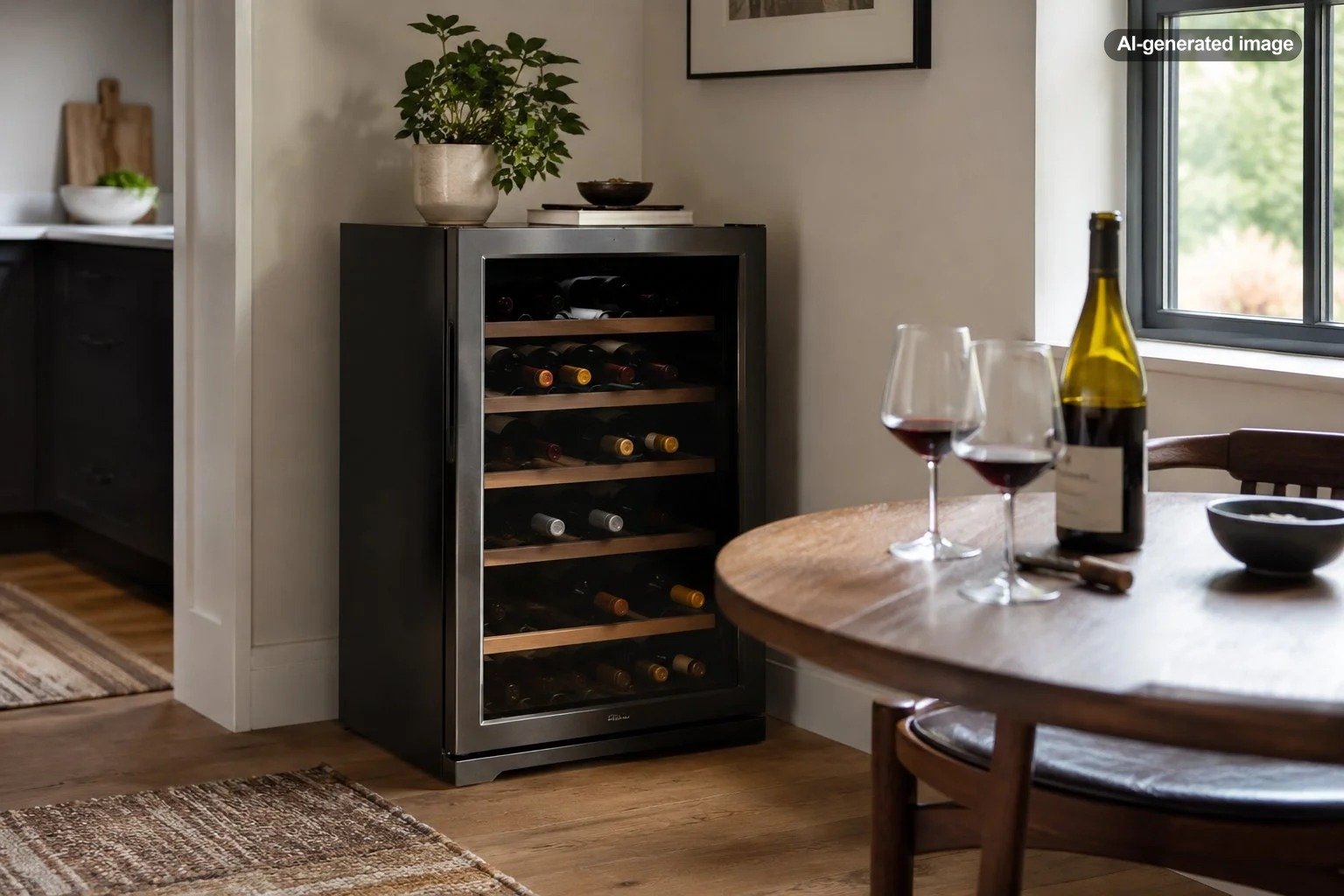
Is a Wine Fridge Worth It for Casual Wine Drinkers?
A wine fridge can be worth it for a casual wine drinker, but not simply because wine fridges look polished in a kitchen. The real question is whether you regularly keep more wine than you plan to drink soon and whether your home offers a consistently cool, dark place for those bottles.
If you usually buy one bottle on Friday and finish it over the weekend, a dedicated appliance is probably unnecessary. If six, twelve, or twenty bottles tend to gather on a counter, above the refrigerator, or in a warm pantry, a compact wine fridge may provide useful storage rather than decorative overkill.
What a wine fridge actually does
A wine fridge creates a cooler and generally more stable environment than a kitchen counter, open rack, or cabinet near an oven. It also protects bottles from direct sunlight and gives them a dedicated place where they are less likely to be moved, knocked over, or forgotten behind the mustard.
The key benefit is not extreme cold. Wine is usually stored at a moderate temperature rather than the colder setting used for everyday food refrigeration. A regular refrigerator is designed around food safety, frequent door openings, and short-term storage. A wine fridge is designed around bottles and a steadier storage environment.
That distinction matters most when bottles remain unopened for a while. A few days on a counter in a comfortable room will not usually create a household crisis. Repeated exposure to warm temperatures, sunlight, and large temperature swings is a more meaningful concern when wine sits for months.
When a wine fridge is probably worth it
You keep a small collection on hand
A dedicated fridge begins to make practical sense when your household routinely stores more than a few bottles. The exact number is less important than turnover. Twelve bottles consumed within two weeks are different from twelve bottles slowly accumulating for six months.
Consider where the bottles are currently stored and how long they stay there. Wine lined up on a sunny kitchen shelf or placed on top of a refrigerator may experience more heat and movement than bottles kept in a cool interior closet.
Your home runs warm
Warm climates, hot upper floors, sun-exposed kitchens, and homes with fluctuating indoor temperatures can make passive storage difficult. A wine fridge can be useful even for a modest collection if there is no naturally cool location in the home.
Apartment and condo residents may also appreciate the predictability. A small freestanding unit can provide controlled storage without requiring a cellar, renovation, or built-in cabinetry.
You entertain often
A wine fridge keeps bottles organized and reduces competition for space in the main refrigerator before dinner parties or holidays. It can also make it easier to keep white, rose, and sparkling wine ready to serve while leaving food shelves available for food.
For casual hosts, convenience may be the strongest argument. The appliance creates one dependable location for wine, mixers, and perhaps other beverages permitted by the manufacturer’s instructions.
You buy mixed cases or save special bottles
Buying several bottles at once can be convenient, but it also lengthens the time some of them spend at home. A wine fridge offers more protection for bottles intended for birthdays, holidays, or future dinners.
A wine fridge earns its space by solving a storage problem, not by proving that you are serious about wine.
When you can comfortably skip it
You probably do not need a wine fridge if you buy wine shortly before drinking it, rarely keep more than two or three unopened bottles, or already have a suitable storage location. A dark interior closet or pantry away from appliances, exterior walls, and direct sun may be perfectly adequate for short-term storage in a consistently comfortable home.
Skipping the appliance also makes sense when floor and counter space are already scarce. Even compact models require ventilation clearance, access to an outlet, and enough room for the door to open fully. The storage benefit may not justify losing valuable prep space in a very small kitchen.
There is also the question of ownership overhead. A wine fridge adds another appliance to clean, power, and eventually repair or replace. Casual drinkers should count those realities alongside the pleasure of neatly arranged bottles.
Advantages
- Provides dedicated, organized bottle storage
- Maintains a cooler, steadier environment
- Protects wine from direct light
- Frees space in the main refrigerator
- Keeps frequently served wine conveniently available
Tradeoffs
- Uses floor, cabinet, or counter space
- Adds electricity use and appliance noise
- Requires cleaning and ventilation clearance
- May be unnecessary for rapid bottle turnover
- Advertised capacity may not match every bottle shape
Wine fridge versus regular refrigerator
| Consideration | Wine fridge | Regular refrigerator |
|---|---|---|
| Primary purpose | Dedicated bottle storage | Food preservation |
| Typical use | Unopened wine kept for weeks or months | Opened bottles and short-term chilling |
| Interior layout | Shelves shaped around bottles | Mixed food and beverage storage |
| Convenience | Keeps a collection organized | Avoids buying another appliance |
| Space impact | Requires a separate footprint | Uses existing refrigerator space |
A regular refrigerator remains useful for chilling a bottle before serving and storing opened wine. The disadvantage is that unopened bottles can occupy a surprising amount of shelf space, especially when stored horizontally. Food odors, frequent door openings, and an interior designed for cartons and containers rather than bottles also make it less convenient as a long-term wine cabinet.
How large should a casual drinker’s wine fridge be?
Choose capacity according to your normal collection, not the fantasy collection you might own after developing a vineyard and a French accent. A household that generally keeps eight bottles does not necessarily need a towering unit designed for dozens.
However, buying exactly to your current bottle count can be frustrating. Capacity figures are commonly based on standard bottle shapes and efficient shelf arrangements. Wider sparkling bottles, Burgundy-style bottles, and unusually shaped packaging may reduce the number that fits comfortably.
A practical approach is to list how many bottles you currently keep, how often you buy by the case, and whether you need room for larger bottles. Then allow a modest buffer rather than doubling the size without a clear reason.
Single zone or dual zone?
A single-zone fridge maintains one general temperature throughout the cabinet. It is usually the simpler choice for casual drinkers, particularly when the goal is stable storage rather than keeping every style at an exact serving temperature.
A dual-zone model divides the cabinet into two temperature areas. This can be convenient if you regularly want white and sparkling wine colder while keeping red wine somewhat warmer. The tradeoff is greater complexity, and each zone may offer less usable capacity than expected.
Remember that storage temperature and serving preference are not identical problems. You can keep mixed bottles together at a moderate storage setting, then chill a white wine further in the regular refrigerator before dinner or allow a red wine to warm slightly after removal.
Features that matter more than flashy extras
Before comparing finishes, lighting effects, or digital displays, focus on how the appliance will function in your room.
Before you decide
- Placement: Confirm whether the unit is designed for freestanding or built-in installation.
- Ventilation: Follow the required clearance around the appliance.
- Dimensions: Measure the full space, including door swing and nearby baseboards.
- Noise: Consider whether the unit will sit near a bedroom, desk, or quiet seating area.
- Shelf spacing: Check whether shelves accommodate the bottle shapes you buy.
- Door protection: A solid or UV-resistant door may be useful in a bright room.
- Controls: Look for a clear display and controls that are not easily changed by accident.
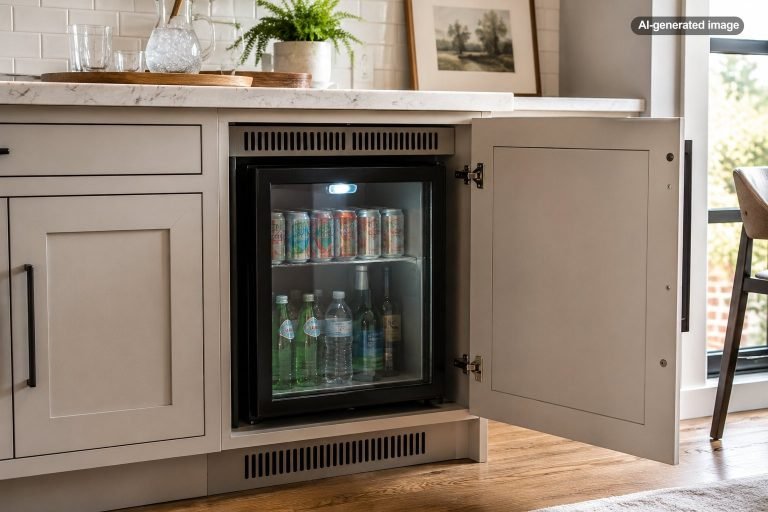
Placement instructions deserve particular attention. A freestanding wine fridge should not automatically be enclosed under a counter. Built-in models are designed to vent differently, while many freestanding units require open space around them. Use the manufacturer’s installation instructions for the specific appliance.
Where to put a wine fridge
The kitchen is convenient, but it is not the only option. A dining room, butler’s pantry, home bar, finished basement, or temperature-controlled utility area may offer a better combination of space and accessibility.
Avoid placing the appliance beside an oven, range, radiator, or area receiving strong afternoon sun. Make sure the floor is level and the outlet is accessible without relying on an extension cord unless the manufacturer explicitly permits it.
Also consider everyday movement. A door that opens into a narrow walkway will become irritating quickly. A unit wedged beneath a counter with inadequate clearance may run poorly or conflict with installation requirements.
The final verdict
For a casual wine drinker, a wine fridge is worthwhile when it protects a rotating collection, improves organization, or solves a warm-home storage problem. You do not need rare bottles, formal tasting notes, or encyclopedic knowledge to appreciate those benefits.
It is not worth buying merely to chill the occasional bottle or fill an empty kitchen corner. Start by observing how much wine you actually keep, how long you keep it, and whether your current storage area stays cool and dark. When those answers reveal a genuine problem, a modest wine fridge can be a sensible household appliance rather than an indulgence.
Frequently asked questions
Can I store red and white wine in the same wine fridge?
Yes. Mixed bottles can share a single-zone fridge at a moderate storage temperature. You can adjust the serving temperature afterward by chilling white wine further or letting red wine warm slightly before pouring.
Should wine bottles be stored on their sides?
Bottles sealed with natural cork are commonly stored horizontally during longer storage so the wine remains in contact with the cork. Screw-cap and alternative-closure bottles do not depend on that contact and can generally be stored upright if space permits.
Is a countertop wine fridge useful?
It can be useful for a very small collection, provided the counter has adequate ventilation space and is not near heat or direct sunlight. Measure carefully because a small appliance can still consume valuable work surface.
Does a wine fridge use much electricity?
Energy use varies by capacity, cooling design, room temperature, door type, and efficiency. Review the model’s energy information rather than assuming that every compact unit has the same operating cost.
Can I keep opened wine in a wine fridge?
Yes, if the bottle is resealed securely. Opened wine has a limited life because exposure to oxygen continues after opening, so refrigerated storage slows change but does not preserve it indefinitely.