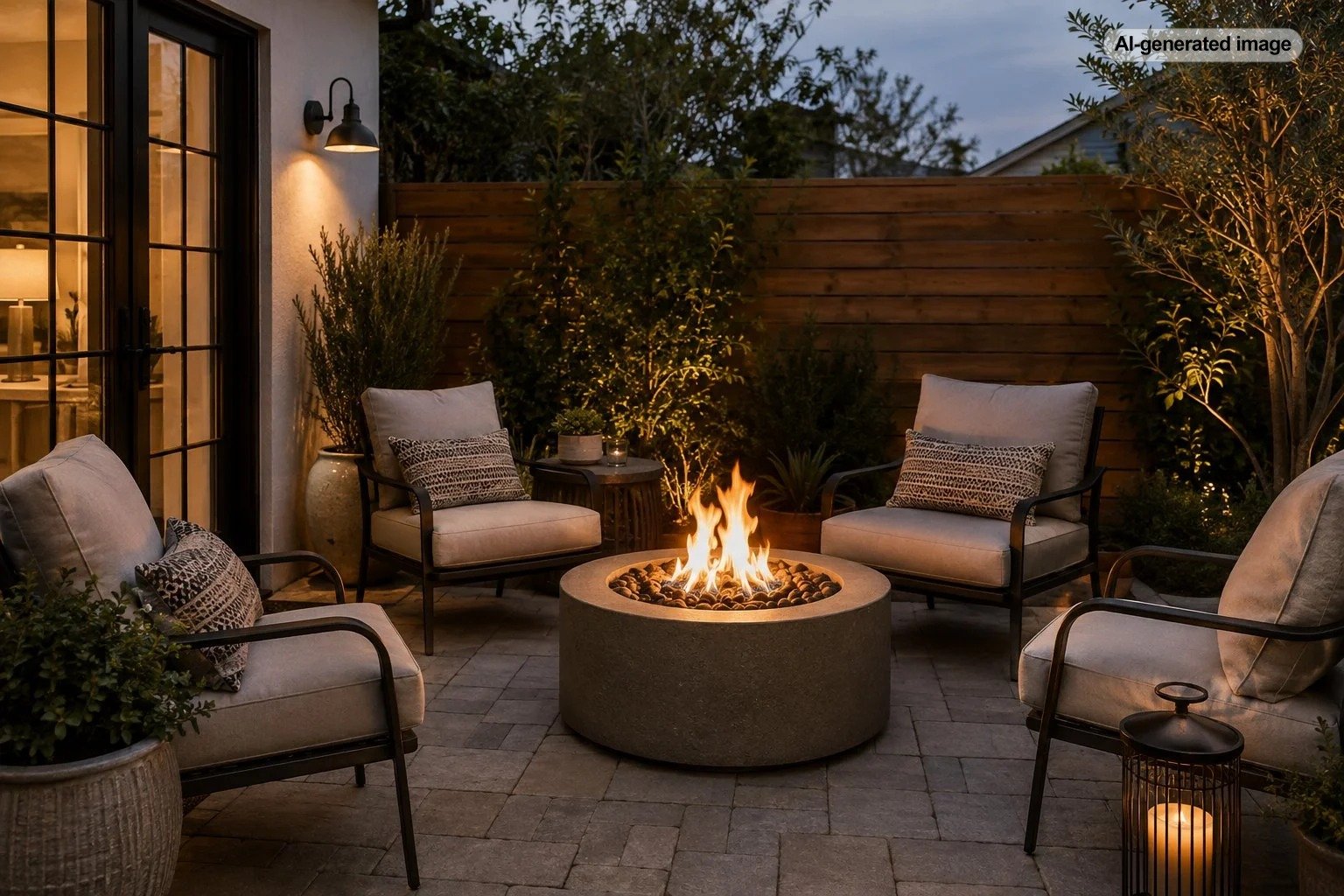
What Is the Best Fire Pit Shape for a Small Patio?
For most small patios, a round fire pit is the best all-around shape. It creates a natural conversation circle, gives people similar access to the warmth, and avoids sharp corners in tight walking paths. That said, a square fire pit can fit a compact, rectilinear patio more neatly, while a narrow rectangular model may be the smarter choice for a long balcony-style terrace or a slim seating arrangement.
The best answer therefore depends less on which silhouette looks fashionable and more on how people will move, sit, and maintain safe clearance around the flame. On a small patio, the usable space around the fire pit matters more than the footprint of the fire pit alone.
Why round usually works best on a small patio
A round fire pit is forgiving. Chairs can be shifted a few inches without making the arrangement look crooked, and guests can join the circle without forcing an exact furniture plan. This flexibility is useful on patios that must serve several purposes, such as morning coffee, outdoor dining, and evening conversation.
Round edges also reduce the chance that a projecting corner will intrude into a narrow walkway. The benefit is not that a round pit is automatically smaller; a wide bowl can consume more room than a compact square model. The advantage is that its footprint and circulation pattern feel less rigid.
A round fire pit is especially well suited to three or four movable lounge chairs, low-profile Adirondack chairs, or a curved bench. It is less ideal when the patio is dominated by straight built-in seating, a sectional sofa, or a narrow wall-to-wall layout.
The right fire pit is the one that leaves enough room for both conversation and common sense.
When a square fire pit is the better fit
Square fire pits often make efficient use of patios built from square pavers or arranged around straight furniture. Their sides align naturally with benches, compact sectionals, and pairs of chairs. On a small patio, that visual order can make the entire arrangement feel intentional rather than squeezed together.
A square model can also provide a small ledge around the burner or bowl, depending on its design. Treat that ledge as part of the hot appliance, not as an ordinary coffee table. Never assume it is safe for drinks, phones, serving dishes, or children’s hands unless the manufacturer’s instructions specifically describe an area as usable and heat-safe.
The main tradeoff is circulation. Corners project farther into diagonal walking paths, so a square pit needs careful placement. It works best when people approach from predictable directions and when the chairs are arranged parallel to its sides.
When a rectangular fire pit makes sense
A rectangular fire pit is often the best shape for a long, narrow patio. It can sit parallel to a bench or compact outdoor sofa and provide a linear flame that feels proportionate to the space. This arrangement may preserve a clearer route from the house to the yard than a wide circular conversation zone would.
Rectangular models are less successful when guests need to gather evenly from every side. People seated at the short ends may feel farther from the center of the flame, while a long unit can dominate a patio that is merely small rather than truly narrow.
Round vs. square vs. rectangular at a glance
| Shape | Best for | Main advantage | Watch for |
|---|---|---|---|
| Round | Flexible chair circles | Easy conversation and softer circulation | A large diameter can consume more space than expected |
| Square | Square patios and straight furniture | Orderly layout and efficient alignment | Corners can project into walkways |
| Rectangular | Long, narrow patios | Fits linear sofas and benches | Can feel oversized on a compact square patio |
Measure the safety zone, not just the fire pit
Product dimensions tell you only how much floor area the unit occupies. They do not tell you whether the full setup fits. Add the required clearance around the appliance, the depth of each chair, room for legs, and a practical walking route. Then account for doors, steps, railings, planters, umbrellas, overhead branches, eaves, siding, and anything else that can burn.
General fire-safety guidance from the National Fire Protection Association recommends using fire pits outdoors, placing them on level ground that will not catch fire, and keeping them at least 10 feet from anything combustible. The U.S. Fire Administration likewise advises keeping a 3-foot safety zone around fire pits to help protect children and pets. These are useful baselines, but the appliance manual and local rules may require more distance or prohibit a fire pit in a particular setting.
Before you decide
- Mark the proposed fire pit footprint with painter’s tape or cardboard.
- Add the manufacturer’s required clearance on every side.
- Place the actual chairs around the marked area.
- Sit down and check knee, foot, and walking space.
- Open nearby doors and gates to confirm they do not enter the fire zone.
- Check overhead and nearby combustible materials, not just the patio floor.
- Verify local fire rules, lease terms, condo restrictions, and HOA requirements.
Fuel type matters as much as shape
Wood-burning fire pits create sparks, smoke, ash, and a need for fuel storage and cleanup. Gas models generally offer a more controlled flame and quicker shutdown, but they still require correct installation, ventilation, fuel handling, and clearance. A compact tabletop flame is not automatically a low-risk substitute.
The U.S. Consumer Product Safety Commission has issued warnings about certain alcohol- or other liquid-burning tabletop fire pits because pooled fuel and refilling hazards can cause flame jetting and severe burns. Avoid any design that requires pouring liquid fuel into an open bowl or refilling near a flame, and check current CPSC warnings or recalls before using a tabletop product.
Common small-patio mistakes
Buying by fire pit dimensions alone
A 30-inch fire pit does not create a 30-inch arrangement. Chairs and safe circulation can require far more space than the appliance itself. Test the complete layout before ordering.
Pushing the pit against an edge
A corner may appear to save floor space, but nearby fences, railings, walls, plants, or furniture can make that location unsuitable. Shape cannot compensate for inadequate clearance.
Using oversized chairs
Deep lounge chairs can overwhelm a small patio even when the fire pit is compact. Upright chairs with modest depth, movable stools used only when the fire is off, or a slim bench may produce a more comfortable layout.
Treating the surround as a tabletop
Some fire tables have broad surrounds, but surfaces near a flame can become hot. Keep combustible items, loose fabric, and clutter away, and follow the product instructions for permitted use.
So, which shape should you choose?
Start with a round fire pit if your patio is roughly square, your seating is movable, and conversation is the priority. Choose square when the patio and furniture follow a strict grid. Choose rectangular when the space is narrow and the seating runs in a straight line.
Then let safety eliminate any option that does not leave adequate clearance, stable footing, an open route to the door, and room for people to sit without crowding the flame. A slightly smaller fire pit with a comfortable safety zone will serve a small patio better than a dramatic model that leaves everyone shuffling sideways.
Frequently asked questions
Is a round or square fire pit more space-efficient?
A square fire pit may align more efficiently with straight furniture and square pavers, while a round pit usually allows more flexible chair placement and smoother circulation. Measure the entire seating arrangement rather than comparing appliance width alone.
What size fire pit is best for a small patio?
There is no universal diameter or width because chair depth, required clearances, fuel type, and patio shape vary. Mock up the footprint and safety zone before choosing a size.
Can a fire pit go on a small deck or balcony?
Possibly, but only when the appliance is approved for that surface and setting, the manufacturer instructions are followed, and local fire rules, building policies, lease terms, or association rules allow it. Many balconies and multifamily properties restrict open flames.
Is a tabletop fire pit safer for a tiny patio?
Not necessarily. Small size does not remove burn, fuel, ventilation, or flame-spread hazards. Pay particular attention to CPSC warnings involving pooled alcohol and liquid-fuel tabletop products.