
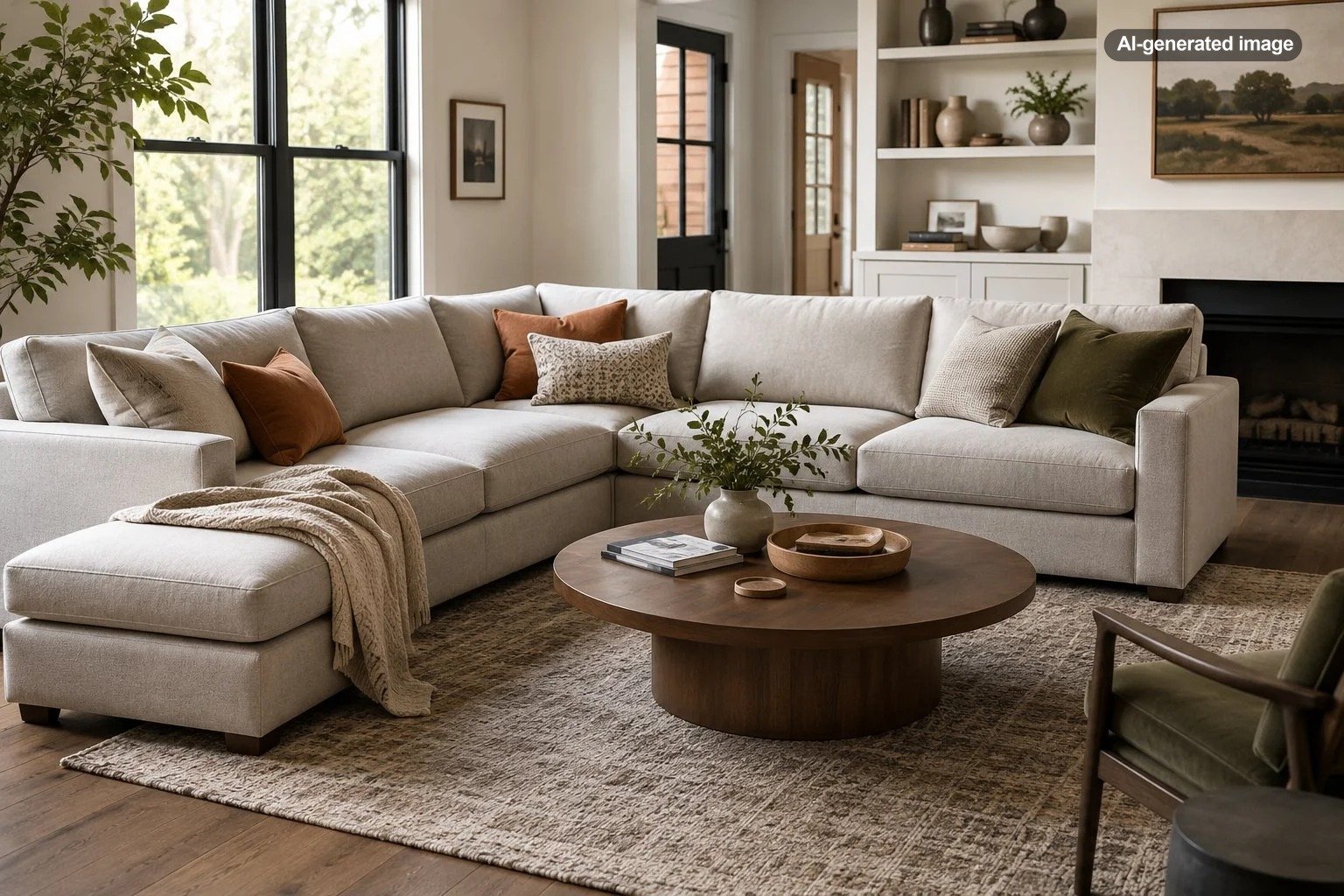
What Is the Best Coffee Table Shape for a Sectional?
For most sectionals, the best coffee table shape is either round or square. Both shapes fit naturally into the open area created by an L-shaped or U-shaped sofa, keeping the table accessible from multiple seats without extending awkwardly into the room. A round table is especially helpful when circulation is tight, while a square table usually offers more usable surface area.
That does not mean rectangular and oval tables are wrong. The ideal shape depends on the sectional’s configuration, the dimensions of the open seating area, how people move through the room, and what the table needs to hold. Shape starts the decision, but proportion and placement determine whether the arrangement actually works.
Match the table to the sectional’s open area
A common mistake is choosing a coffee table according to the full outside dimensions of the sectional. What matters more is the shape and size of the open floor area directly in front of the seats.
An L-shaped sectional often creates a roughly square or slightly rectangular opening. A U-shaped sectional usually surrounds a central square or broad rectangular area. A sofa with one chaise may leave a longer, narrower opening that resembles the space in front of a standard sofa.
Look at that negative space before looking at table styles. The table should occupy the center comfortably without pressing too close to the chaise, disappearing beside a large sectional, or blocking the main route through the room.
The best coffee table follows the usable space inside the sectional, not merely the outline of the room.
How the main coffee table shapes compare
| Shape | Best fit | Main advantage | Possible drawback |
|---|---|---|---|
| Round | Compact L-shaped sectionals and busy walkways | Easy circulation with no projecting corners | Less surface area near the outer seats |
| Square | Balanced L-shaped and U-shaped sectionals | Reaches several seats and fills the center well | Can feel bulky in a narrow room |
| Oval | Sectionals with one chaise or narrow openings | Combines length with softened ends | May not reach seats deep in a large corner |
| Rectangular | Long sectionals with a dominant straight side | Offers generous, practical surface space | Can crowd the chaise or interrupt circulation |
| Nested or modular | Flexible rooms and changing seating needs | Can be separated and repositioned | May look visually busy if poorly coordinated |
Round coffee tables are best for flow
A round coffee table is often the most forgiving choice. Its curved edge provides visual relief from a sectional’s straight lines, and the absence of corners makes it easier to move between the sofa and the rest of the room.
This shape works particularly well in apartments, family rooms, and layouts where the main walkway passes close to the seating area. It is also useful when a reclining section, chaise, or movable ottoman changes the available clearance.
The tradeoff is reach. A small round table may look graceful in the center while remaining inconvenient for people seated at the far ends. For a large sectional, consider a generously scaled round table, two coordinated round tables, or a cluster of nesting tables rather than one undersized piece.
Square coffee tables create the strongest balance
A square table is frequently the most visually satisfying companion for an L-shaped sectional. It echoes the geometry of the seating arrangement and provides a broad surface that can be reached from the sofa’s corner and adjoining seats.
Square tables are also strong choices for U-shaped sectionals, particularly when the open center is nearly equal in width and depth. A substantial table anchors the arrangement and prevents the furniture from appearing to orbit an empty patch of rug.
Scale requires care. A deep square table can occupy more floor space than expected, and its corners may become obstacles in a narrow living room. An open base, slender legs, or a visually light material can reduce the sense of bulk without sacrificing useful surface area.
Oval and rectangular tables suit longer layouts
A sectional with one chaise often behaves more like a conventional sofa with an extension than a fully enclosed seating group. In that arrangement, an oval or rectangular coffee table may fit the available space better than a broad square.
An oval table is the more circulation-friendly option. It provides useful length for drinks, books, and trays while softening the end nearest the chaise or walkway. It is particularly effective in long, narrow rooms where a square table would consume too much depth.
A rectangular table makes sense when most people sit along one long side of the sectional. It offers generous surface area and may align neatly with the main sofa run. However, avoid choosing a table so long that it projects beyond the seating area or forces people to walk around its corners.
Measure before choosing a shape
General furniture formulas can provide a starting point, but a sectional rarely behaves like a simple three-seat sofa. Measure the opening that people will actually use rather than relying only on the sectional’s total length.
What to do
- Measure the open area between the sectional’s opposing edges, chaise, and nearby furniture.
- Mark a comfortable band of space between the table and each accessible seat. There should be room to pass while keeping the tabletop within easy reach.
- Check the main traffic route from the doorway to the rest of the room. Preserve noticeably more clearance there than in the seated reach zone.
- Use painter’s tape, flattened boxes, or newspaper to outline the proposed table on the floor.
- Walk through the room, sit in several positions, and test whether the outline feels useful rather than merely attractive.
The table’s height matters as well. A surface close to the height of the sectional’s seat cushions usually feels natural to use. A noticeably taller table can interrupt sightlines, while a very low table may be inconvenient for meals, laptops, games, or anyone who prefers to avoid a deep reach.
Consider how the room is actually used
A sculptural round table may be ideal in a conversation-focused living room, but a household that regularly serves snacks or plays board games may appreciate the broad surface of a square table. Someone who moves the table often may prefer nesting pieces, while a household that needs hidden storage may accept a heavier silhouette in exchange for drawers or a lift top.
Also consider who uses the room. Rounded edges can reduce unpleasant bumps in active households, although no table shape replaces attentive childproofing or appropriate supervision. In a pet-friendly home, a stable base and enough floor clearance for movement may matter more than whether the top is perfectly round or square.
Common mistakes to avoid
Choosing a table that is too small is the most frequent visual problem. A tiny table floating inside a large sectional looks accidental and may be unreachable from most seats. Two smaller coordinated tables can work, but they should read as an intentional group.
Ignoring the chaise is another common error. A rectangular table may suit the sofa’s main run but leave almost no room beside the chaise. Measure from the nearest projecting edge, not just from the back cushions.
Centering the table in the room instead of the seating group can also create an awkward arrangement. The coffee table belongs to the sectional, so align it with the usable seating area even when that position is not the mathematical center of the rug or room.
Finally, do not let a dramatic base compromise legroom. Sculptural supports, solid drums, and oversized pedestal bases can make a table feel much larger than its top measurements suggest.
Before you decide
- Identify the shape of the open area inside the sectional.
- Preserve the widest clearance along the main walking route.
- Confirm that the table can be reached from the seats used most often.
- Choose a height that suits the sectional’s seat cushions and daily activities.
- Outline the full tabletop and base on the floor before buying.
- Account for recliners, ottomans, pets, children, and movable chaise sections.
Frequently asked questions
Is a round or square coffee table better for an L-shaped sectional?
A square table usually creates stronger symmetry and more surface area. A round table is often better when the room is compact, the walkway is tight, or the sectional already feels visually heavy.
Can a coffee table be longer than the chaise?
It can, but the arrangement may feel unbalanced if the table projects far beyond the main seated area. More importantly, the extra length should not narrow a walkway or create a corner that people repeatedly have to avoid.
Should the coffee table be centered under the ceiling light?
Not necessarily. Center it according to the sectional and the seats that need access. A ceiling fixture may define the room broadly, but it should not force the table into an inconvenient position.
Can an ottoman replace a coffee table?
Yes. An upholstered ottoman works well when comfort, flexible seating, and softer edges matter most. Add a stable tray when a firm surface is needed, and remember that upholstery generally requires more protection from spills than wood, stone, glass, or metal.
What is the safest choice when the room is very small?
A round or oval table with a modest footprint is usually easiest to move around. Nesting tables can be even more flexible because they expand only when additional surface space is needed.
The final verdict
For a typical L-shaped sectional, start with a round or square coffee table. Choose round when smooth circulation and visual softness matter most; choose square when you want stronger balance and a larger shared surface. For a sectional with one chaise or a long, narrow seating area, an oval table is often the most adaptable alternative.
Whatever shape you prefer, test its footprint before committing. A properly scaled table with comfortable clearance will look more intentional, feel more useful, and serve the room better than a fashionable shape chosen without measuring.