What Indoor Humidity Level Is Too High for a Condo?
Indoor humidity above 60% is generally too high for a condo, especially when it stays elevated for long periods. For everyday comfort and moisture control, a practical target is 30% to 50% relative humidity, with around 40% to 50% often being a useful goal in humid climates. A brief increase after a shower is not necessarily a serious problem, but persistent readings above 60% deserve attention.
Condos present some unusual moisture challenges. Shared walls, limited exterior ventilation, compact bathrooms, cooling systems, and neighboring units can all influence how humidity behaves. A condo may feel comfortably cool while still holding more moisture than its furnishings and interior surfaces can comfortably tolerate.
The important question is not simply whether a humidity meter occasionally displays a high number. It is whether excess moisture persists, where it collects, and what is preventing the space from drying out.
What Is a Healthy Indoor Humidity Level for a Condo?
Relative humidity measures the amount of water vapor in the air compared with the maximum that air could hold at its current temperature. A reading of 60% means the air contains 60% of the moisture it could hold before becoming saturated at that temperature.
The U.S. Environmental Protection Agency recommends keeping indoor relative humidity below 60%, ideally between 30% and 50%. The Centers for Disease Control and Prevention advises keeping humidity no higher than 50% for mold prevention.
These recommendations are useful benchmarks, but the actual condition of the condo matters too. A home with a 48% reading and a leaking window can still develop water damage. Another condo might briefly reach 58% during a shower without having an ongoing moisture problem.
| Relative humidity | What it generally means | Practical response |
|---|---|---|
| Below 30% | Potentially too dry for comfort | Review heating and indoor conditions before adding moisture |
| 30%-50% | Preferred general target | Maintain ventilation and monitor problem areas |
| 51%-59% | Above the preferred range | Watch for persistent elevation and condensation |
| 60%-69% | Too humid for sustained indoor conditions | Identify moisture sources and improve humidity control |
| 70% or higher | Substantially elevated humidity | Investigate promptly, particularly if dampness is visible |
These ranges are practical household guidance, not a prediction that mold will appear at one exact percentage. Mold growth depends on moisture at surfaces, temperature, materials, and how long conditions remain damp.
Why Condos Can Have High Humidity Even When the Air Conditioner Is Running
Air conditioning normally removes some moisture while cooling indoor air. However, a low thermostat setting does not guarantee effective humidity control.
The condo cools before enough moisture is removed
On mild but humid days, the air conditioner may run only briefly because the indoor temperature is already near the thermostat setting. Those shorter operating periods can leave humidity higher than expected.
An oversized cooling system can also reach the desired temperature quickly without providing adequate moisture removal. However, equipment sizing is only one possibility, and a humidity problem should not be treated as proof that the air conditioner is oversized.
Outdoor humidity enters the living space
Balcony doors, poorly sealed windows, exterior penetrations, and frequent door openings can introduce humid outdoor air. This becomes especially noticeable in Florida and other coastal or subtropical climates.
Opening windows is not automatically a good way to lower indoor humidity. If outdoor air contains more moisture than indoor air, ventilation may make the problem worse. Outdoor dew point is often a more useful indicator than outdoor relative humidity alone when deciding whether opening windows will help.
Everyday activities add moisture
Showers, cooking, wet towels, indoor laundry drying, and large numbers of houseplants can contribute moisture to indoor air. In a compact condo, that moisture may be concentrated in a relatively small amount of living space.
A bathroom without effective exhaust ventilation can affect nearby bedrooms and closets. Similarly, moisture generated in an open kitchen can spread throughout a combined kitchen and living area.
Shared-building conditions complicate the diagnosis
Some condos have shared ventilation systems, common mechanical infrastructure, or building-envelope conditions that affect individual units. Water intrusion near windows, plumbing chases, and exterior walls may also originate outside the owner’s direct control.
That is why persistent humidity or localized dampness sometimes requires coordination with building management rather than another adjustment to the thermostat.
How to Measure Humidity Accurately in a Condo
A thermostat may show room temperature without displaying relative humidity. Even thermostats that measure humidity generally report conditions near the thermostat, which may not represent every room.
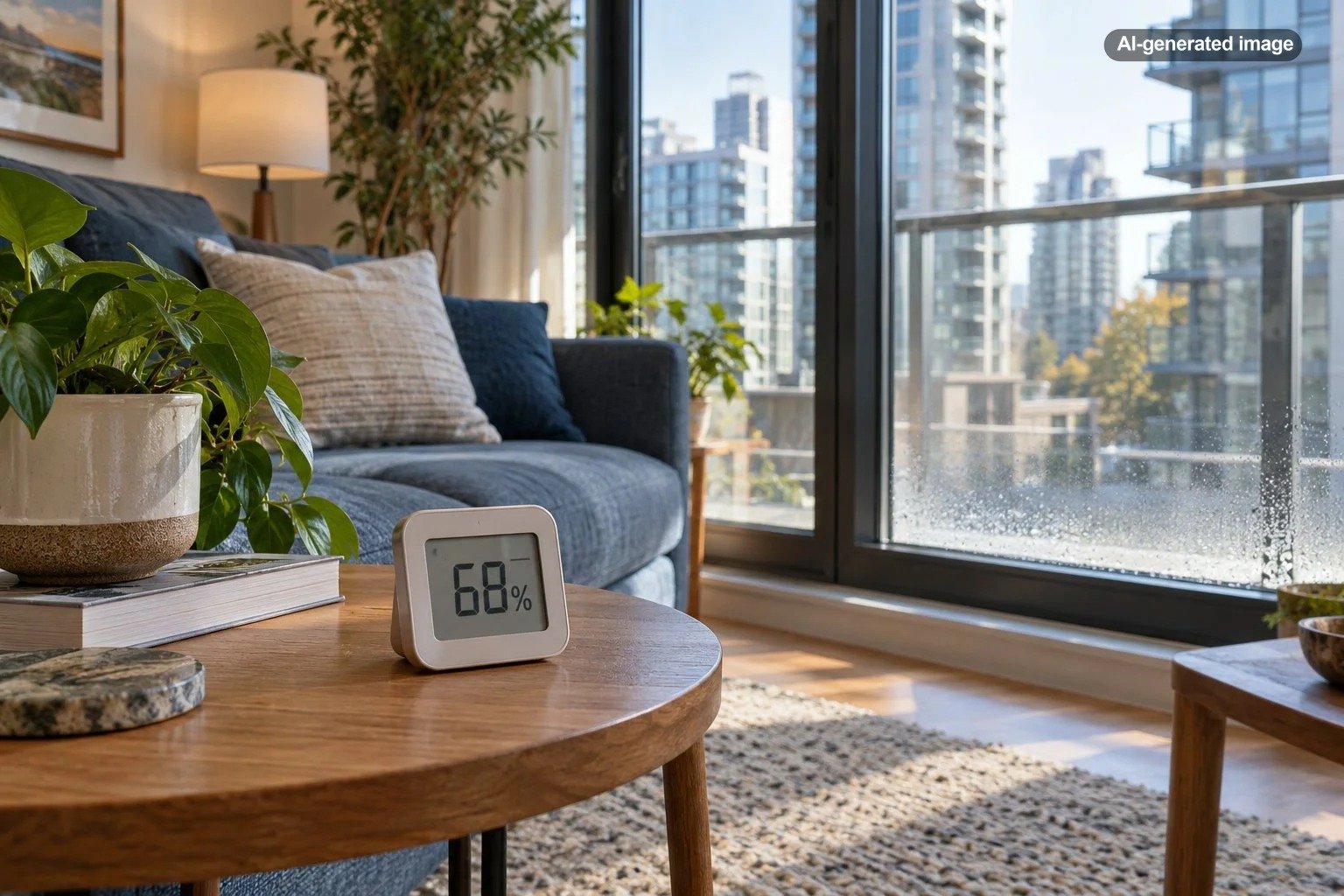
A separate digital hygrometer provides a useful way to check moisture conditions throughout the condo.
Place the meter away from direct sunlight, air-conditioning supply vents, open windows, and immediate sources of steam. Allow it to stabilize according to its instructions before interpreting the reading.
For a more complete picture, compare several locations:
- Main living area: Establish the general indoor humidity level.
- Bedroom: Check conditions overnight and during hours when doors remain closed.
- Bathroom: See how quickly humidity returns toward normal after showering.
- Closet or storage area: Look for unusually damp conditions in enclosed spaces.
- Room with an exterior wall: Investigate differences near windows or other potentially cool surfaces.
Record readings in the morning, afternoon, and evening for several days. Include the approximate indoor temperature, recent showering or cooking activity, and whether the air conditioner was operating.
One isolated reading can be misleading. A pattern of high humidity across several rooms is more informative than a temporary spike in the bathroom.
Affiliate disclosure: CraneManor.com may earn a commission when you purchase through links on this page. This does not affect the price you pay. Learn more.
For straightforward spot checks, a compact device such as a digital hygrometer can help you compare room temperature and relative humidity without relying exclusively on the thermostat. The purpose is to identify moisture patterns, not to diagnose mold or locate leaks.
Signs Your Condo Has Too Much Moisture
Humidity readings are useful, but physical evidence often tells you where to investigate first.
Common warning signs include:
- Condensation repeatedly collecting on interior windows or cool pipes.
- Musty odors that return after cleaning.
- Closets that smell damp or contain clothing that feels persistently clammy.
- Peeling paint, swollen trim, or discolored drywall.
- Visible mold-like growth around damp surfaces.
- Persistent moisture near balcony doors, exterior walls, or plumbing fixtures.
These signs do not all have the same cause. Window condensation may reflect warm humid air contacting cool glass. A localized stain beneath a window could indicate water intrusion from outside. Dampness around plumbing may result from a leak rather than high room humidity.
The distinction matters because a dehumidifier cannot repair a leaking pipe, failed window seal, or building-envelope defect.
How to Lower Humidity in a Condo
The most effective approach depends on whether moisture comes from routine activities, outdoor air, inadequate equipment performance, or water intrusion.
What to do
- Confirm the pattern. Measure humidity in more than one room at different times. Determine whether the problem is widespread or localized.
- Control moisture at the source. Use bathroom exhaust ventilation during showers and afterward as needed. Cover pots when practical, use kitchen exhaust ventilation that actually vents outdoors when available, and avoid unnecessary indoor laundry drying.
- Limit humid outdoor air. Close windows and balcony doors when outdoor conditions would increase indoor moisture. Check accessible weatherstripping without modifying shared building components.
- Review cooling operation. Use the thermostat’s normal cooling settings and follow equipment instructions. If the air conditioner runs poorly, cycles unusually, or leaves humidity consistently elevated, arrange professional evaluation.
- Consider dehumidification. A portable dehumidifier can help when routine cooling and ventilation do not keep humidity in the preferred range. Follow the manufacturer’s placement, drainage, electrical, and maintenance instructions.
- Investigate persistent dampness. If humidity remains high or visible moisture returns, ask building management or a qualified contractor to assess possible leaks, ventilation problems, and HVAC performance.
Should you lower the thermostat to remove humidity?
Not necessarily. Lowering the temperature may increase air-conditioner operating time in some circumstances, but it is an unreliable humidity strategy and can make the space unnecessarily cold. Cooler surfaces may also experience condensation when exposed to humid air.
When a condo is already comfortable but too humid, it makes more sense to evaluate moisture removal rather than continuously lowering the temperature.
Does a portable dehumidifier make sense?
A portable dehumidifier may be useful for a condo with elevated humidity during mild weather, a damp bedroom, or an enclosed living area that does not receive adequate moisture removal from the cooling system.
The tradeoffs include electricity use, operating noise, added heat, space requirements, and the need to empty a collection tank or arrange appropriate drainage.
Choose equipment based on the space and actual moisture problem, not merely the condo’s total square footage. A small dehumidifier may help one enclosed room without correcting humidity throughout an entire open-plan unit.
If high humidity results from a leak, repair remains the priority. Dehumidification may assist drying, but it is not a substitute for correcting water intrusion.
What About High-Rise Condos and Florida Condos?
Warm, humid climates create additional challenges because outdoor moisture levels may remain elevated for much of the year. In South Florida, for example, a condo can experience high indoor humidity even when outdoor temperatures are not particularly hot.
Units with extensive glazing, balcony access, shaded bedrooms, and limited ventilation may develop noticeably different conditions from room to room.
High-rise buildings can introduce additional variables, including pressure differences, shared mechanical systems, and exposure to wind-driven rain. Not every building has these issues, but they are worth considering when ordinary humidity-control measures do not work.
For seasonal residents, monitoring becomes especially important when the condo is vacant. Before leaving for an extended period, confirm that cooling or approved humidity-control equipment can operate appropriately, drainage is reliable, and building policies are followed.
Do not assume an unattended portable dehumidifier is suitable for continuous use without reviewing its operating instructions and drainage arrangements. Also avoid switching off necessary climate control merely to reduce energy use when the unit may be exposed to prolonged humid conditions.
Who Is Responsible for Humidity Problems in a Condo?
Responsibility depends on the governing documents, local requirements, and the source of the moisture.
An owner may be responsible for maintaining an individual cooling system, controlling household moisture, or addressing plumbing located within the unit. The condominium association may have responsibility for certain common elements, shared mechanical components, exterior assemblies, or other building systems.
These divisions vary considerably. A persistent leak near a balcony door, for example, should not automatically be treated as either an owner repair or an association repair without checking the applicable documents.
Document the problem with dated photographs, humidity readings, descriptions of affected rooms, and any visible changes. Notify the appropriate management contact promptly, especially when water damage appears to involve shared components or neighboring units.
A written record can also help an HVAC technician or building professional identify patterns that would be difficult to reproduce during a short inspection.
Common Humidity-Control Mistakes to Avoid
Several intuitive responses can make troubleshooting harder.
- Running a ceiling fan and assuming humidity has dropped: Air movement can improve comfort and help some damp surfaces dry, but a fan does not directly remove water vapor from a closed room.
- Opening windows whenever the condo feels stuffy: On humid days, incoming air may increase the moisture load.
- Keeping the thermostat fan set to ON without considering humidity: Continuous fan operation can affect moisture removal in some air-conditioning systems. Ask an HVAC professional about the appropriate setting for your equipment.
- Relying on one humidity measurement: Conditions can differ substantially between a living room, bathroom, and closed closet.
- Buying a dehumidifier before checking for leaks: Removing moisture from the air does not solve water entering through damaged building materials.
- Trying to make the condo extremely dry: Lower is not always better. Very dry indoor air can create its own comfort problems.
A useful humidity-control plan combines measurement, moisture-source control, appropriate ventilation, functioning cooling equipment, and timely attention to leaks.
Frequently Asked Questions
Is 60% humidity too high for a condo?
Yes, 60% is above the preferred indoor humidity range. A brief reading at that level does not prove damage is occurring, but sustained readings around or above 60% warrant corrective action and investigation of possible moisture sources.
Is 55% humidity acceptable in a condo?
A temporary 55% reading is not necessarily alarming, but it is above the 30%-50% range preferred for general moisture control. If readings consistently stay near 55%, especially in a humid climate or near damp surfaces, consider ways to reduce moisture and monitor for condensation.
Can a condo have mold with humidity below 50%?
Yes. A room humidity reading below 50% does not prevent a localized leak or a cold surface from becoming wet. Mold can develop where materials remain damp, even when the air in another part of the condo appears reasonably dry.
Why is my condo humid when the AC is set to 72 degrees?
The thermostat controls temperature, not necessarily relative humidity. Short cooling cycles, ventilation problems, humid air entering from outdoors, or insufficient moisture removal can leave indoor air damp despite a comfortable temperature.
Should I leave a dehumidifier running while my condo is vacant?
Only if the specific equipment is appropriate for unattended operation under its manufacturer’s instructions and the drainage, electrical, maintenance, and building requirements are addressed. For extended absences, a professionally evaluated climate-control strategy may be preferable to relying on an unattended portable appliance.
The Bottom Line
For most condos, 30% to 50% indoor relative humidity is a sensible target, and sustained readings at 60% or above are too high. In warm, humid climates, keeping humidity near or below 50% when practical provides a useful margin for moisture control.
However, humidity is only part of the picture. Condensation, leaks, and persistently damp materials deserve attention regardless of what the meter says. Measure conditions in several rooms, reduce avoidable moisture, confirm that ventilation and cooling equipment work properly, and involve building management when the problem may extend beyond the unit.
The goal is not to chase a perfect number every hour. It is to maintain a comfortably dry condo without allowing hidden moisture problems to become part of the building.
Sources & Further Reading
- U.S. Environmental Protection Agency: A Brief Guide to Mold, Moisture and Your Home – Indoor relative humidity recommendations, condensation, moisture control, and prevention.
- U.S. Environmental Protection Agency: Mold Course, Chapter 9 – Building moisture management, ventilation, dehumidification, and maintenance guidance.
- Centers for Disease Control and Prevention: Mold – Indoor moisture prevention and the recommendation to maintain humidity no higher than 50%.
- U.S. Environmental Protection Agency: Mold House Tour – Practical examples of moisture sources in kitchens, bathrooms, closets, and other household areas.