Why Does Indoor Humidity Rise at Night?
Indoor humidity often rises at night because the air cools, the air conditioner runs less frequently, and moisture from everyday activities remains inside the house. A higher humidity reading does not always mean more water has entered the air. Sometimes, the temperature has simply dropped enough to make the same amount of moisture register as a higher percentage of relative humidity.
If your bedroom feels sticky before sunrise or your humidity monitor consistently climbs after sunset, several ordinary household factors may be working together. Understanding whether the change comes from temperature, additional moisture, or reduced moisture removal is the first step toward fixing it.
Why Cooler Nighttime Air Makes Humidity Readings Rise
The most important distinction is between relative humidity and the actual amount of water vapor in the air.
Relative humidity describes how much water vapor the air contains compared with the amount needed for saturation at its current temperature. Warmer air has a higher saturation vapor pressure than cooler air. Consequently, when air cools without losing moisture, its relative humidity increases.
Imagine a room measuring 76 degrees Fahrenheit with 50% relative humidity. If the same air cools to approximately 70 degrees without gaining or losing water vapor, its relative humidity can increase to roughly 61%.
That change can look dramatic on a digital display even though no additional moisture entered the room. The example assumes the amount of water vapor stays constant; actual homes experience changing ventilation, moisture generation, and air-conditioning conditions.
Why Air Conditioning Can Remove Less Moisture Overnight
Air conditioners do two related jobs: they cool indoor air and remove some of its moisture as water vapor condenses on the cold evaporator coil.
During a warm afternoon, an air conditioner may run frequently enough to remove a meaningful amount of moisture. After sunset, the outdoor temperature often falls, indoor heat gains decline, and the thermostat may require less cooling.
That means fewer cooling cycles and fewer opportunities to remove water vapor. Indoor humidity can rise even while the house remains comfortably cool.
The difference between cooling and dehumidifying
An air conditioner responds primarily to its temperature controls. It does not necessarily continue removing moisture after the desired indoor temperature has been reached.
This is especially noticeable during mild but humid nights. The outdoor air may not be hot enough to create much cooling demand, yet significant moisture remains indoors.
Oversized cooling equipment can create another complication. A system that rapidly satisfies the thermostat may run in short cycles, potentially limiting moisture removal. However, short cycling can have several causes, and a humidity reading alone cannot establish whether equipment is oversized.
If high humidity persists despite normal cooling, an HVAC professional can evaluate airflow, equipment operation, condensate drainage, thermostat controls, and whether the system is appropriately matched to the house.
Everyday Activities That Add Moisture Before Bedtime
Evening routines can introduce moisture just as the cooling system begins operating less frequently.
Common contributors include:
- Hot showers: Steam and evaporation increase moisture levels, particularly when bathroom exhaust ventilation is insufficient.
- Cooking dinner: Boiling water, simmering food, and running moisture-producing kitchen appliances can raise indoor humidity.
- Dishwashing: Hot water and drying dishes can release additional moisture into the surrounding air.
- Indoor laundry: Damp towels, clothing hung to dry, and inadequately vented dryers can contribute significant moisture.
- People and pets: Breathing and perspiration continuously release moisture, including while everyone sleeps.
- Humidifiers: A bedroom humidifier operating overnight can raise humidity beyond the intended level.
These effects are often more noticeable in smaller homes, apartments, and bedrooms with limited air circulation.
For example, a closed bedroom occupied by two sleeping adults may develop a different overnight humidity pattern than an unoccupied room elsewhere in the house. The occupied bedroom has an ongoing moisture source, while the closed door can influence how air mixes with the rest of the home.
Can Humid Outdoor Air Make Indoor Humidity Rise at Night?
Yes. Moisture can enter through open windows, gaps around doors, building-envelope leaks, and mechanical ventilation systems that introduce outdoor air.
In humid climates, nighttime outdoor conditions may remain moisture-laden even after the temperature falls. Opening windows for cooler air can therefore increase indoor moisture rather than improve comfort.
This is particularly relevant in Florida, coastal areas, and regions experiencing humid summer weather.
However, outdoor relative humidity alone does not tell you whether ventilation will dry the house. Cool outdoor air can have very high relative humidity while still containing less water vapor than warmer indoor air.
Compare dew points when possible. If outdoor dew point is lower than indoor dew point, outdoor air generally has greater potential to reduce indoor moisture content through ventilation. If outdoor dew point is higher, bringing that air inside can add moisture.
The result also depends on how much air enters, whether the HVAC system is operating, and how the indoor temperature changes afterward.
What Is a Normal Indoor Humidity Level at Night?
There is no special nighttime humidity target that replaces ordinary indoor moisture-control guidance.
The U.S. Environmental Protection Agency recommends keeping indoor relative humidity below 60% where possible, ideally between 30% and 50%. This range helps reduce conditions that support mold growth and certain indoor allergens.
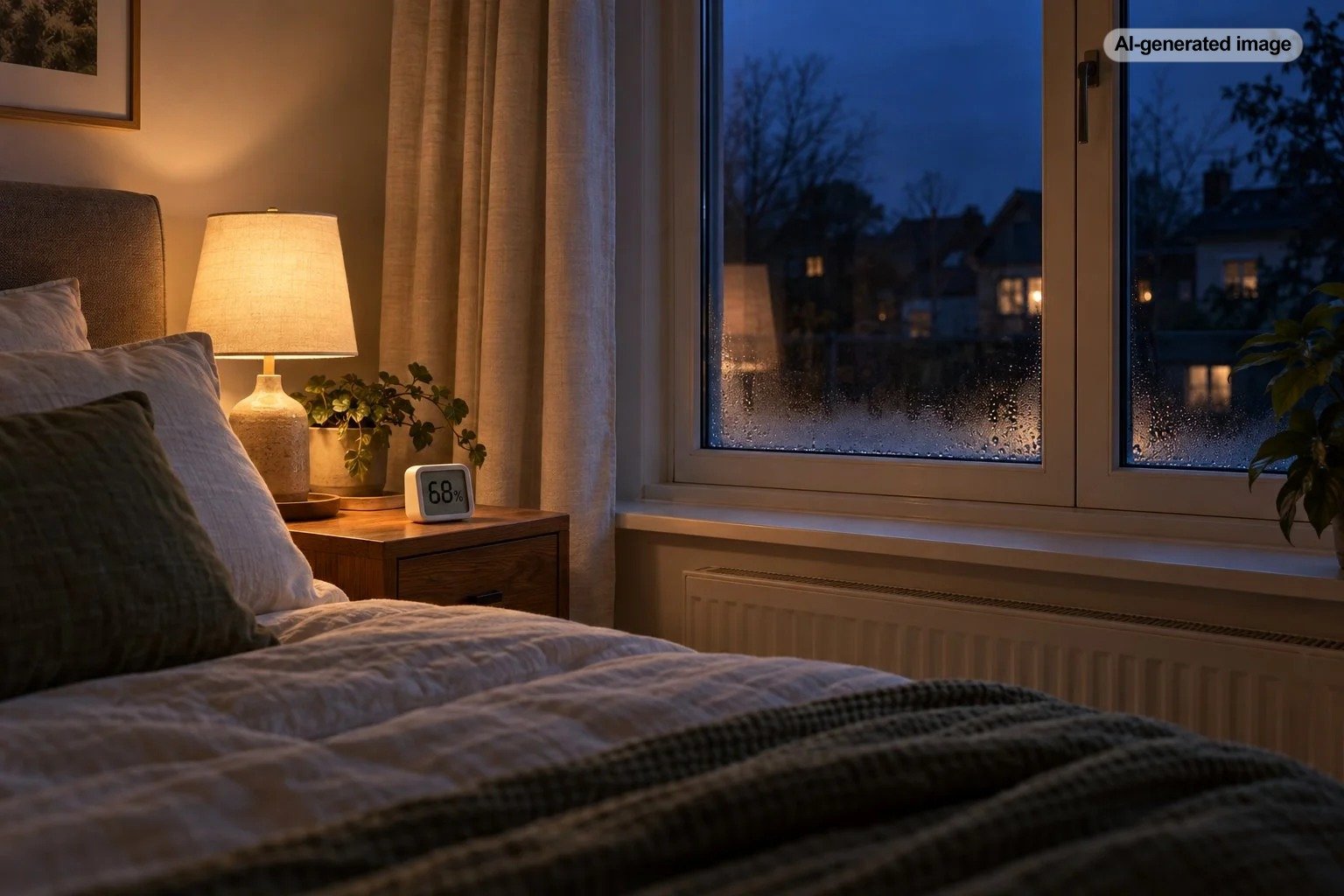
Brief fluctuations should be interpreted differently from moisture that remains elevated for hours or days. A reading of 54% after a shower is less concerning than a bedroom that repeatedly reaches 68% and develops condensation on its windows.
| Relative humidity | How to interpret it | Practical response |
|---|---|---|
| Below 30% | Air may feel uncomfortably dry. | Check heating conditions and avoid unnecessary moisture removal. |
| 30%-50% | EPA’s preferred indoor range. | Maintain ordinary ventilation and moisture control. |
| 51%-59% | Above the ideal range but not automatically a serious problem. | Track the pattern and look for moisture sources. |
| 60% or higher | Above EPA’s recommended upper limit. | Identify causes and reduce persistent excess moisture. |
Cold windows, exterior walls, and other cooler surfaces may develop condensation even when the room’s overall relative humidity is below 60%. Surface temperature matters as much as the room-wide reading when evaluating condensation risk.
How to Find Out Why Your Humidity Is Rising
A simple measurement routine can reveal much more than adjusting thermostat settings at random.
Start by recording temperature and relative humidity in the same location throughout the day. A basic digital hygrometer is sufficient for identifying many household patterns, although consumer devices have measurement tolerances and should not be treated as laboratory instruments.
Affiliate disclosure: CraneManor.com may earn a commission when you purchase through links on this page. This does not affect the price you pay. Learn more.
If your thermostat does not display humidity, a digital hygrometer can help you compare nighttime humidity with daytime readings. Place it away from direct sunlight, supply vents, open windows, and sources of steam so the results better represent the room.
What to do
- Record the evening baseline. Note temperature and relative humidity shortly before bedtime.
- Check the overnight pattern. Record measurements near bedtime, during the night if convenient, and shortly after waking. A device with recording capability can make this easier, but it is not essential.
- Compare another room. Check whether the increase affects the entire house or primarily one bedroom or bathroom.
- Review moisture-producing activities. Note showers, cooking, laundry, humidifier operation, and open windows.
- Observe cooling activity. Determine whether the air conditioner runs frequently or barely operates overnight.
- Look for visible moisture. Inspect windows, bathroom surfaces, closets, and areas around plumbing or air-conditioning equipment.
- Repeat on several nights. Look for consistent relationships between temperature, humidity, weather, and household routines.
What different patterns may indicate
Humidity increases as temperature decreases: This may primarily be a relative humidity effect, especially if the room’s dew point stays similar.
Temperature stays steady while humidity rises: Moisture may be accumulating through occupant activity, outdoor-air entry, damp materials, or reduced dehumidification.
Only one room becomes humid: Investigate localized moisture sources, ventilation, air circulation, exterior-wall conditions, and whether the room receives adequate conditioned air.
The entire house becomes humid overnight: Consider changing HVAC runtime, outdoor moisture conditions, ventilation practices, and whole-home moisture sources.
These patterns narrow the possibilities, but they are not definitive diagnoses. A hygrometer measures air conditions, not the exact source of moisture.
How to Lower Indoor Humidity Overnight
The best solution depends on which factor is responsible for the increase. Lowering the thermostat is not always the most effective response.
Use bathroom and kitchen exhaust ventilation
Run properly installed exhaust fans when showering or cooking, and allow them to continue long enough to remove lingering moisture.
Confirm that fans actually exhaust outdoors. A recirculating kitchen hood may capture some grease and odors, but it does not remove cooking moisture from the house the way an externally vented hood can.
If a bathroom remains damp long after use, its ventilation may need evaluation.
Keep humid outdoor air outside when appropriate
During humid weather, avoid opening windows merely because the outdoor temperature feels cooler. Compare outdoor dew point with indoor conditions before relying on nighttime ventilation for drying.
Keep exterior doors and windows properly closed when air conditioning or dehumidification is being used. Necessary ventilation should still be maintained; sealing a home completely without considering indoor air quality is not the goal.
Check thermostat and HVAC settings
Review whether the thermostat’s overnight temperature schedule reduces cooling runtime. If your system offers a humidity-control mode, consult its documentation to understand how it operates.
Some systems can increase dehumidification under certain conditions. Others rely mainly on cooling demand.
Where compatible with the equipment manufacturer’s instructions, using the thermostat’s automatic fan setting rather than continuous fan operation may help avoid returning moisture from a wet cooling coil to the living space. Actual results depend on equipment design and controls.
Do not make refrigerant, electrical, duct, or internal HVAC adjustments without appropriate professional expertise.
Consider dedicated dehumidification
In a home where moisture remains excessive despite adequate temperature control, a portable or whole-home dehumidifier may be more appropriate than forcing additional air-conditioning cycles.
A portable unit can be useful for a persistently humid room, provided it is suitable for the space and used according to its instructions. Whole-home equipment may be worth evaluating when the problem is widespread or persistent.
Dehumidifiers consume electricity and can add heat to the space. They also require appropriate drainage or regular tank emptying, along with maintenance.
Reduce unnecessary indoor moisture
Dry wet towels promptly, avoid leaving damp laundry in closed rooms, check dryer venting, and use humidifiers only when conditions call for additional moisture.
If a humidifier is operating, reduce its setting or stop using it when measured humidity is already elevated.
When Nighttime Humidity Signals a Larger Problem
A modest overnight change is often normal. Persistent dampness, however, deserves investigation because it can affect building materials and create conditions favorable to mold.
Potential causes include plumbing leaks, roof or exterior-wall water intrusion, drainage problems, an obstructed condensate line, inadequate ventilation, or cooling equipment that is not controlling moisture effectively.
A localized damp patch that remains wet while the rest of the room is dry may indicate a leak rather than a general humidity issue.
When there is visible water damage, persistent mold, or an unexplained damp area, address the water source promptly and seek qualified assessment as appropriate. Significant or recurring mold problems may require professional remediation rather than ordinary surface cleaning.
If the house stays humid while the air conditioner appears to run normally, a qualified HVAC technician can check system operation and moisture removal without assuming that replacing the equipment is necessary.
Frequently Asked Questions About Nighttime Humidity
Why does my bedroom humidity rise when I sleep?
Breathing and perspiration add moisture to bedroom air throughout the night. A closed door, limited air mixing, falling room temperature, and reduced air-conditioning operation can make the increase more noticeable. Compare the bedroom with another room to determine whether the pattern is localized.
Why is humidity higher at night even with the AC on?
The air conditioner may be running fewer cycles because nighttime cooling demand is lower. It can maintain the desired temperature without removing enough moisture to keep relative humidity steady. A poorly performing or improperly configured system can also contribute, but equipment problems should not be assumed from humidity alone.
Does lowering the thermostat reduce humidity?
Sometimes. A lower temperature setting may increase air-conditioning runtime and remove additional water vapor. However, cooling the air also raises its relative humidity if moisture is not removed. Additional cooling can therefore waste energy or make a room uncomfortably cold without resolving the underlying issue.
Should I open my windows at night to reduce humidity?
Only when outdoor conditions are favorable. Outdoor air with a lower dew point may help remove indoor moisture through ventilation. Warm, humid outdoor air can make the problem worse, particularly in coastal and subtropical climates.
Can nighttime humidity cause condensation even below 60%?
Yes. When a window, wall, or pipe is sufficiently cool, moisture can condense on that surface even though a room-wide hygrometer shows less than 60% relative humidity. Reduce the moisture source and investigate repeatedly damp surfaces.
The Bottom Line
Indoor humidity frequently rises at night because the temperature falls, cooling equipment removes less moisture, and ordinary evening or overnight activities continue adding water vapor to the air.
The important question is whether relative humidity is merely increasing because the room is cooler or whether excess moisture is accumulating. Track temperature and humidity together, compare rooms, and consider outdoor weather and HVAC runtime before choosing a solution.
For most households, consistent measurement, effective exhaust ventilation, appropriate cooling operation, and targeted dehumidification are better first steps than repeatedly adjusting the thermostat. If dampness persists or visible moisture appears, identify the source rather than treating the humidity reading as the entire problem.
Sources & Further Reading
- U.S. Environmental Protection Agency: A Brief Guide to Mold, Moisture and Your Home – Indoor humidity guidance, condensation, mold prevention, and moisture control.
- U.S. Department of Energy: Consumer Guide to Home Ventilation – Household moisture sources, ventilation practices, and dehumidification.
- U.S. Department of Energy: Spot Ventilation – Source Control to Improve Indoor Air Quality – Kitchen and bathroom exhaust ventilation and moisture removal.