Why Is My House Humid Even Though the Air Conditioner Is Running?
Your air conditioner can be running, cooling the rooms, and still leave your house feeling sticky or clammy. That happens because lowering the air temperature and removing moisture are related but separate jobs. If your house feels humid despite the AC running, the system may be cooling too quickly, operating with unsuitable fan settings, struggling with an airflow or drainage problem, or simply facing more incoming moisture than it can remove.
The important question is whether the house is actually too humid or merely feels uncomfortable. A humidity measurement, a few thermostat checks, and some observations about how the cooling system operates can help narrow down the possibilities without guessing at expensive repairs.
How Humid Is Too Humid for a House?
Relative humidity describes how much moisture the air contains compared with the amount it could hold at its current temperature. Because that capacity changes with temperature, a comfortable thermostat reading does not guarantee comfortable humidity.
The U.S. Environmental Protection Agency recommends keeping indoor relative humidity below 60%, ideally between 30% and 50% when possible. In a humid climate, maintaining the lower end of that range may require additional moisture control.
| Indoor humidity reading | What it generally suggests |
|---|---|
| 30% to 50% | Within the EPA’s preferred indoor range |
| 51% to 59% | Above the preferred range; investigate if persistent |
| 60% or higher | Too humid for a sustained indoor condition; moisture control deserves attention |
One brief reading is not a diagnosis. Humidity can rise temporarily after a shower, cooking, or a frequently opened exterior door. A pattern of elevated readings across multiple rooms is more informative than a single measurement beside a bathroom.
Why Your Air Conditioner May Cool Without Removing Enough Moisture
The AC runs in short cycles
Air conditioners remove moisture as water vapor condenses on the cold indoor coil. That water collects and leaves through the condensate drainage system. The process needs sufficient operating time, not merely a burst of cold air.
An oversized air conditioner may lower the indoor temperature quickly and shut off before removing enough moisture. This is one reason a house can reach the thermostat setting but still feel damp. Equipment that repeatedly switches on and off because of a control or mechanical problem can produce a similar symptom.
Short cycling is especially noticeable during mild but humid weather. When outdoor temperatures are not particularly high, the house may need little cooling even though the air still contains substantial moisture.
Do not assume a system is oversized based on cycle length alone. Thermostat placement, equipment staging, weather, insulation, and system faults all affect runtime. A qualified HVAC technician can evaluate the operating pattern and determine whether equipment sizing is involved.
The thermostat fan is set to On instead of Auto
A thermostat usually separates the cooling setting from the indoor fan setting. With the fan set to Auto, it generally runs according to the system’s cooling and control sequence. With the fan set to On, it can continue circulating air even when active cooling has stopped.
In some systems, continuous fan operation passes air over a still-wet cooling coil after the compressor shuts off. Some of that collected moisture can evaporate back into the house rather than draining away.
For a conventional residential cooling system, switching the fan from On to Auto is a reasonable early troubleshooting step. However, equipment with specialized ventilation, dehumidification, or variable-speed controls may operate differently. Follow the manufacturer’s instructions rather than changing advanced settings at random.
The filter or airflow system needs attention
A dirty air filter can restrict airflow through the cooling equipment. Blocked returns, obstructed supply vents, blower problems, or duct restrictions can also affect system performance.
Airflow problems do not always cause high humidity in a predictable way. They can interfere with cooling and moisture removal, and severe restrictions may contribute to coil icing. A system with ice on its refrigerant lines or indoor coil needs professional attention rather than repeated thermostat adjustments.
Check the accessible filter according to the equipment instructions. Replace or clean it when appropriate, and make sure furniture, rugs, and stored items are not blocking major air returns. Avoid assuming that installing the densest available filter will improve the situation; filter compatibility and airflow requirements matter.
The cooling system has a mechanical or drainage problem
Low refrigerant charge, faulty controls, dirty coils, or blower issues can compromise cooling performance. Condensate drainage problems may also allow water to accumulate where it should not.
In many cases, a clogged drain reveals itself through water near the indoor equipment, a full emergency drain pan, a triggered safety shutoff, or visible moisture damage. A drainage problem does not automatically explain every high humidity reading, but it deserves prompt attention.
If the house is cooling poorly, the system is icing, or water is accumulating around the unit, arrange professional service. Refrigerant work, internal electrical repairs, and complex airflow adjustments are not suitable trial-and-error homeowner projects.
Sometimes the House Is Introducing Moisture Faster Than the AC Can Remove It
Even a properly functioning air conditioner has practical limits. The amount of moisture entering the house matters just as much as the cooling equipment itself.
Humid outdoor air is getting inside
Exterior doors opening repeatedly, poorly sealed windows, attic bypasses, and gaps around penetrations can bring moist outdoor air into conditioned spaces. Leaky ductwork in an unconditioned attic or crawl space may also contribute to unwanted air exchange, depending on the duct layout and pressure relationships.
These issues often become more noticeable in coastal regions, during rainy stretches, and in places with persistently humid summers.
Weatherstripping and appropriate air sealing can help, but a home still needs its intended ventilation. Do not block dedicated outdoor-air intakes or disable mechanical ventilation systems without professional guidance.
Daily activities are creating additional humidity
Showers, cooking, washing dishes, wet laundry, and indoor clothes drying release moisture into the air. A bathroom exhaust fan that does not work properly, or a kitchen exhaust system that recirculates air rather than exhausting outdoors, may allow that moisture to linger.
Running suitable exhaust ventilation during moisture-producing activities helps reduce the load on the AC. Clothes dryers should vent according to their installation requirements, and a dryer that is intended to exhaust outdoors should not discharge moist air into the home.
A hidden water problem is adding moisture
Persistent humidity can also originate from plumbing leaks, roof intrusion, damp crawl spaces, foundation moisture, or water entering around windows. This is especially important when one room consistently has a higher humidity reading than the rest of the house.
Look for recurring condensation, discolored walls, damp flooring, peeling finishes, or a persistent musty odor. The absence of visible water does not completely rule out a moisture problem.
How to Figure Out Where the Humidity Is Coming From
A systematic check can distinguish a straightforward household moisture issue from a cooling-system problem.
What to check first
- Measure the humidity. Record the temperature and relative humidity in a central living area, away from direct sunlight, vents, and bathrooms.
- Compare rooms. Check a bedroom, basement, or other problem area under similar conditions. Note any major differences.
- Review thermostat settings. Confirm cooling mode is selected and, for a conventional system, try the fan setting on Auto.
- Observe normal operation. Notice whether the AC runs long enough to cool the house, shuts off unusually quickly, or seems to run constantly without reaching its setting.
- Check accessible maintenance items. Inspect the filter, accessible vents, and visible areas around the indoor equipment for water or icing without opening electrical or refrigerant components.
- Review moisture sources. Consider recent showers, cooking, laundry, rainy weather, open doors, and any signs of leaks.
- Track the pattern. Record readings at roughly the same times over several days, then share the observations with an HVAC professional if the problem continues.
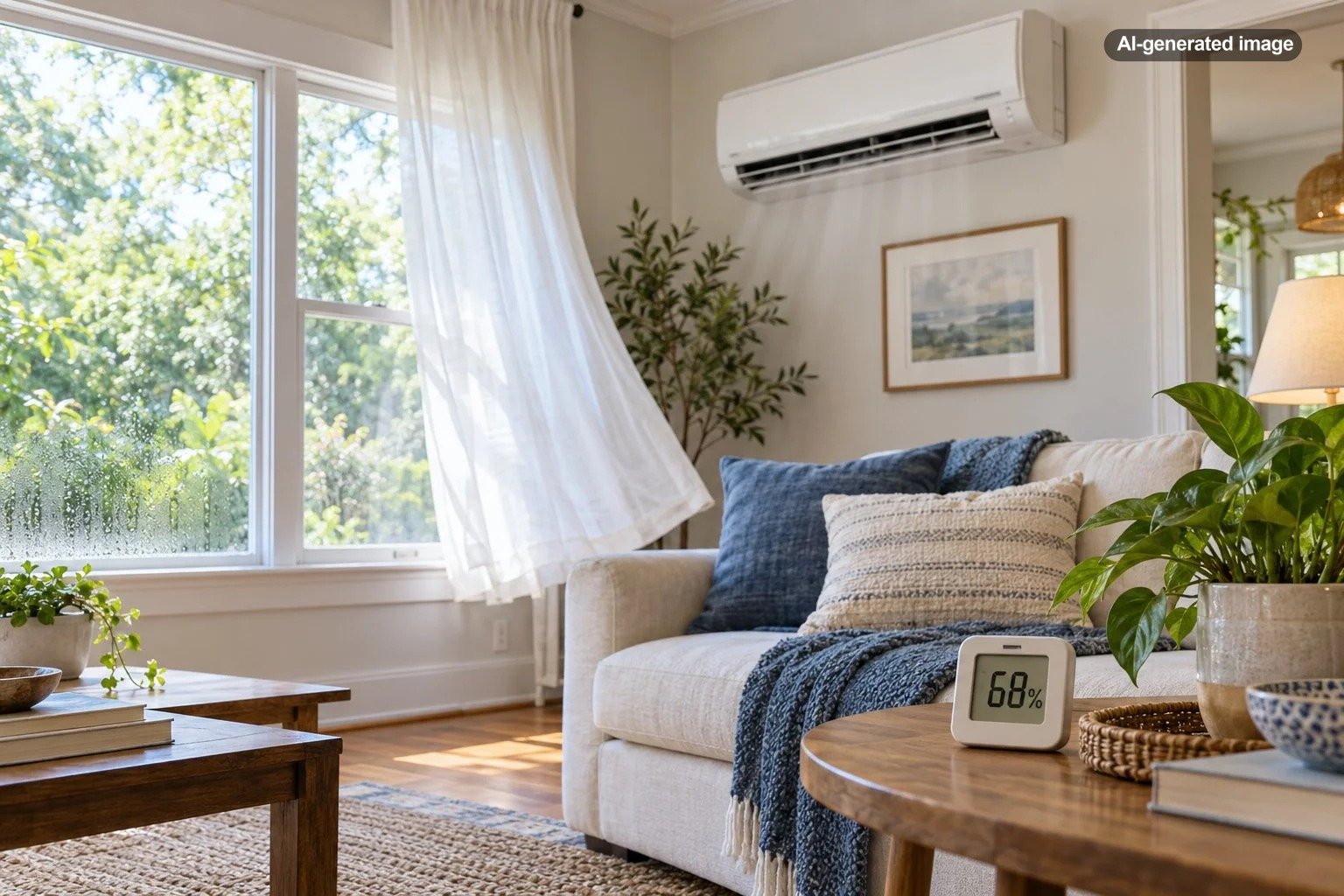
A separate humidity meter can be useful when the thermostat does not show relative humidity or when you want readings from different rooms.
Affiliate disclosure: CraneManor.com may earn a commission when you purchase through links on this page. This does not affect the price you pay. Learn more.
For basic monitoring, a digital hygrometer, such as the TempPro TP49, can display indoor temperature and relative humidity. A simple meter cannot identify the source of a moisture problem, but it can help distinguish an occasional humid afternoon from a persistent indoor condition.
Would a Dehumidifier Help Even If You Have Central Air?
It can. Air conditioning and dedicated dehumidification overlap, but they are not identical. An air conditioner normally runs in response to cooling demand. A dehumidifier runs primarily in response to a humidity setting.
A portable dehumidifier may be appropriate for an enclosed basement, a persistently damp room, or a limited area that needs additional moisture control. However, it requires attention to drainage and maintenance, adds some heat to the space, and should not be used as a substitute for repairing a water leak.
A whole-house dehumidifier may be worth discussing with a qualified contractor when humidity is consistently elevated across the home, particularly in a warm, humid climate. It can provide moisture control independent of normal cooling cycles, but equipment selection, installation, drainage, and ongoing operation need consideration.
Before purchasing either option, establish whether the air conditioner is functioning properly. Buying additional equipment to compensate for a correctable HVAC fault can leave the underlying problem unresolved.
Why Humidity Can Be Worse at Night or on Rainy Days
Nighttime and rainy conditions can create an awkward mismatch between cooling demand and moisture load.
When outdoor temperatures fall, the house may reach its cooling setting quickly. The AC then runs less frequently, even if moisture is entering through outdoor air leakage, ventilation, or normal household activities. Indoor relative humidity may also rise as room temperature falls, even without a corresponding increase in the actual amount of water vapor.
This helps explain why a bedroom can feel clammy at night despite feeling cool. It also explains why humid spring and fall weather can sometimes create more obvious moisture-control problems than a hot afternoon.
Opening windows during rainy or muggy weather is not automatically helpful. Outdoor air may add moisture instead of removing it. Ventilation is most useful for drying when outdoor conditions are genuinely favorable or when localized moisture needs to be exhausted.
When High Indoor Humidity Needs Professional Attention
Occasional humidity spikes are common. Persistently elevated humidity, particularly when accompanied by water damage or equipment symptoms, deserves closer attention.
For a persistent AC-related problem, a qualified technician may need to evaluate refrigerant and coil operation, system airflow, thermostat controls, condensate management, duct leakage, and the home’s cooling and moisture loads.
If replacement equipment is being considered, request an appropriate heating and cooling load calculation rather than choosing a larger unit simply because the existing system struggles. Larger cooling capacity does not automatically mean better humidity removal.
Frequently Asked Questions
Can my air conditioner make the house cold but still humid?
Yes. The system may satisfy the thermostat’s temperature setting before removing enough moisture. Short cooling cycles, continuous fan operation, or high indoor moisture loads can contribute to this condition.
Should I turn my AC down to remove more humidity?
Not necessarily. A lower setting may lengthen cooling operation in some circumstances, but it can also make the house uncomfortably cold without addressing the reason humidity remains high. Check the humidity level and underlying causes first.
Does running the AC fan continuously help with humidity?
Not always. In some cooling systems, a continuously operating fan can re-evaporate moisture from the wet cooling coil after the compressor stops. Auto is often preferable for conventional systems, subject to the equipment’s specific controls and ventilation requirements.
Is 60% indoor humidity too high when the AC is running?
It is above the EPA’s preferred 30% to 50% range and at the upper boundary of its general recommendation to remain below 60%. A brief spike is different from a sustained reading. Persistent readings around or above 60% warrant investigation.
Can a new air conditioner still leave a house humid?
Yes. Even new equipment may provide poor humidity control if it is oversized, incorrectly configured, inadequately installed, or operating in a home with substantial moisture infiltration. A newer system is not proof that the entire cooling and moisture-control arrangement is working correctly.
The Best Next Step Is to Measure Before You Adjust
If the house feels damp while the air conditioner is running, resist the temptation to keep lowering the temperature. Check the actual humidity, look at fan settings and cooling behavior, and identify moisture entering from everyday activities or building problems.
If those straightforward checks do not explain the pattern, professional evaluation can help determine whether the issue lies with the HVAC system, the home’s moisture load, or both. A comfortable house needs more than cool air; it needs moisture levels that remain controlled as conditions change.
Sources & Further Reading
- U.S. Environmental Protection Agency: A Brief Guide to Mold, Moisture and Your Home – Indoor humidity targets, condensation, drainage, and moisture prevention.
- U.S. Department of Energy: HVAC Sizing Research – How oversized cooling equipment can contribute to elevated indoor humidity.
- U.S. Department of Energy: Advanced HVAC Humidity Control for Hot-Humid Climates – Why cooling and moisture removal require different considerations.
- U.S. Department of Energy: Energy Saver 101 – Home Cooling – Basic cooling-system components, moisture removal, and filter maintenance.
- U.S. Environmental Protection Agency: Mold Course, Chapter 9 – Building moisture control, HVAC maintenance, and appropriate ventilation.