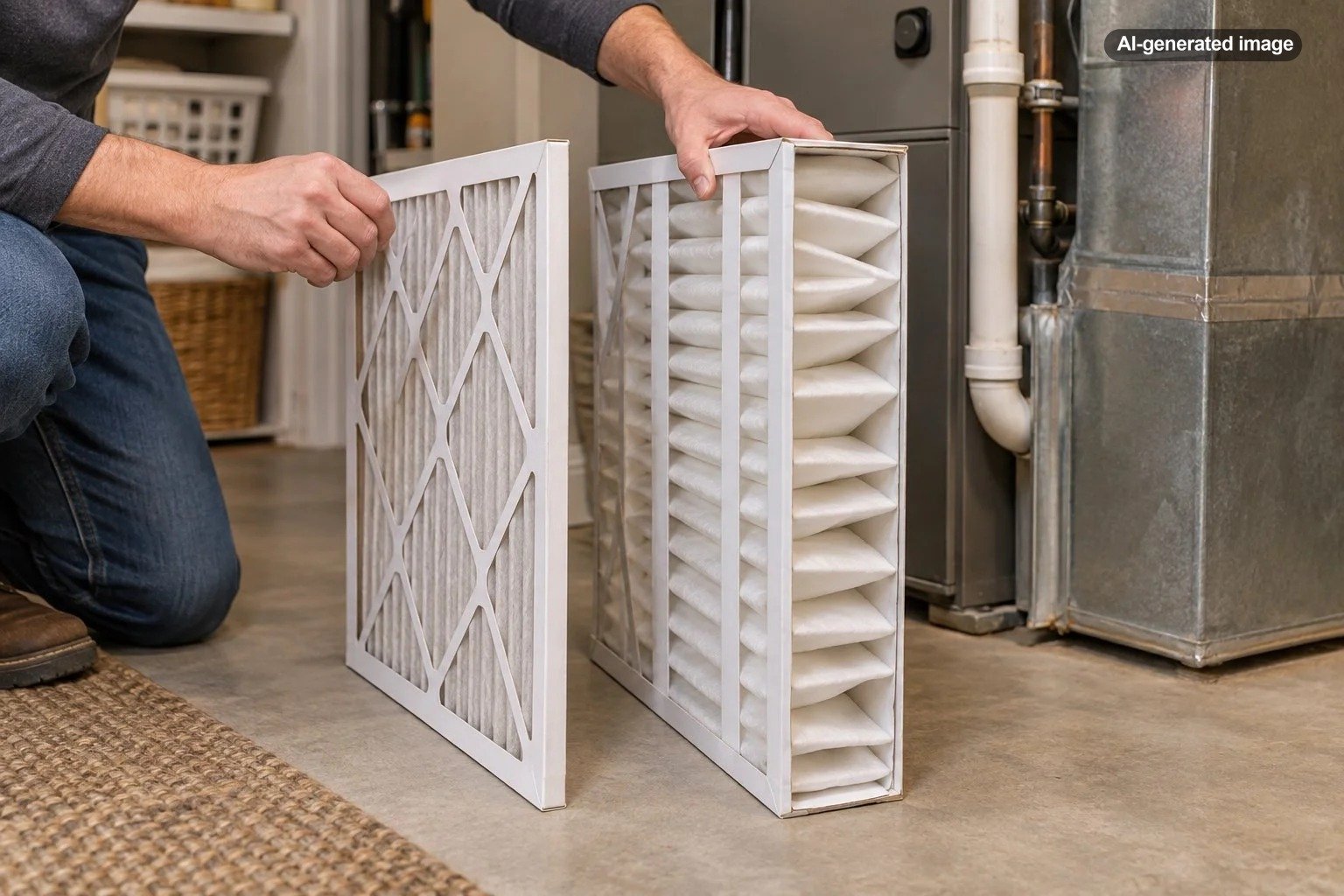
Do Thicker HVAC Filters Last Longer Than One-Inch Filters?
Yes, thicker HVAC filters generally last longer than one-inch filters, provided they are designed for your system and have adequate pleated filter media. A four-inch media filter can often operate for several months before replacement, while a typical one-inch disposable filter may need changing every one to three months. The difference comes primarily from how much usable filtering material each design contains, not simply the thickness of its cardboard frame.
That distinction matters when you are comparing replacement schedules, household dust levels, and the amount of maintenance your heating and cooling system requires. A thicker filter can be convenient, but it is not automatically better for every furnace, air handler, or return-air grille. Compatibility and airflow always come first.
Why Thicker HVAC Filters Can Last Longer
Imagine unfolding the pleated material inside two HVAC filters that have the same face dimensions but different depths. The thicker filter may contain significantly more folded material. That additional surface area provides more room for airborne particles to accumulate before the filter reaches its intended operating limit.
As a filter captures dust, pollen, fibers, and other airborne particles, resistance to airflow generally increases. Eventually, the accumulated material can restrict airflow enough that the filter needs replacement. Filters with greater dust-holding capacity can often remain in service longer before reaching that point.
However, thickness alone does not tell the complete story. Pleat count, pleat spacing, media construction, filtration efficiency, and the manufacturer’s specifications also influence performance. Two filters labeled four inches thick can have different service lives.
More Pleated Material Changes the Equation
In an extended-surface media filter, a larger filtering area allows the same volume of air to pass through more material. Depending on the filter design, that can help manage airflow resistance while providing additional capacity for captured particles.
This is one reason a well-designed, deeper pleated filter can sometimes provide both substantial particle capture and reasonable airflow resistance. It is also why evaluating only the MERV number or the outside dimensions can be misleading.
The U.S. Environmental Protection Agency recognizes that extended-surface filters can offer increased dust-holding capacity and service life. Still, the system must be capable of operating with the filter’s resistance, including as the media becomes dirty.
One-Inch vs. Four-Inch HVAC Filters: What Actually Changes?
One-inch filters are common in residential return grilles and equipment filter slots. Four-inch filters are more commonly associated with dedicated media cabinets or filter housings designed to accommodate deeper filters.
| Consideration | One-inch filter | Four-inch media filter |
|---|---|---|
| Typical replacement guidance | Often every 1-3 months | Often up to 6 months; some models specify longer |
| Filtering surface area | Generally less | Generally more |
| Dust-holding capacity | Usually lower | Often higher |
| Installation | Fits compatible shallow slots | Requires a properly sized deep housing |
| Airflow performance | Depends on media and design | Depends on media and design |
| Maintenance convenience | More frequent replacement | Potentially fewer replacements |
These intervals are general examples rather than universal expiration dates. Carrier, for example, describes replacement guidance of one to three months for one-inch filters and up to six months for thicker four-inch media filters. Other manufacturers may specify different intervals for their systems.
Neither category guarantees better indoor air quality on its own. A properly selected one-inch filter can perform well, while an incorrectly installed four-inch filter can create avoidable problems.
How Often Should You Replace a Thicker HVAC Filter?
Start with the maintenance instructions for the exact filter and equipment you own. Some four-inch media filters have manufacturer guidance around six months, while certain dedicated media air-cleaner systems specify intervals approaching a year under suitable operating conditions.
For comparison, many conventional one-inch filters have replacement guidance within a one-to-three-month window. The EPA advises following manufacturer recommendations and replacing filters sooner when they become heavily soiled.
Rather than treating an advertised lifespan as a promise, consider it a starting point for a maintenance schedule. A filter may need earlier replacement when the household produces more particles or the equipment operates frequently.
Household Conditions That Shorten Filter Life
- Pets: Airborne dander, hair, and particles carried on fur can increase the material a filter collects.
- Renovation dust: Sanding, drywall work, and similar projects can quickly load a filter, especially when dust enters the return-air system.
- Frequent HVAC operation: More hours of airflow generally mean more opportunities for particles to accumulate.
- Outdoor pollution: Smoke, pollen, and other particles entering the home can increase filtration demand.
- Household activities: Cooking, movement, cleaning, and other activities can contribute airborne particles.
Humidity deserves separate consideration. Damp conditions do not simply mean a filter will fill with dust faster, but moisture or visible microbial growth around HVAC components requires investigation. Filters should not become wet during normal operation.
Does a Higher MERV Rating Make a Filter Last Longer?
Not necessarily. MERV stands for Minimum Efficiency Reporting Value, a rating used to describe a filter’s ability to capture particles of specified sizes. It is an efficiency measure, not a lifespan rating.
A higher-MERV filter can capture a greater proportion of certain small particles passing through it. That does not automatically mean it has more dust-holding capacity or will remain suitable for use longer.
For example, a one-inch MERV 13 filter and a four-inch MERV 13 filter may have similar rated particle-capture efficiency while differing substantially in media area, resistance characteristics, and recommended replacement intervals. Their actual performance depends on the specific products.
The EPA recommends choosing a filter rated MERV 13 or as high as the HVAC system’s fan and filter slot can accommodate. It also advises consulting an HVAC professional when system compatibility is uncertain.
Higher filtration efficiency can be beneficial, but it should not come at the expense of inadequate airflow. A filter that is poorly matched to the equipment may contribute to comfort and equipment-performance problems.
Can You Replace a One-Inch Filter With a Four-Inch Filter?
Not simply by pushing a thicker filter into the existing opening. A one-inch return grille or furnace slot is generally not designed to accept a conventional four-inch media filter.
Even when the length and width match, the filter depth and housing configuration matter. A deeper filter must fit correctly, remain securely supported, and provide an appropriate seal so air does not bypass the media.
Some HVAC systems can accommodate an additional or replacement media-filter cabinet. Whether that modification is practical depends on available space, ductwork layout, system airflow requirements, and the manufacturer’s specifications.
Before you choose a thicker filter
- Check the equipment manual for approved filter types, sizes, and performance requirements.
- Identify whether the filter is installed in a return grille, equipment slot, or dedicated media cabinet.
- Confirm the actual dimensions and required filter design rather than relying only on nominal measurements.
- Review the filter’s airflow resistance information when available.
- Ask a qualified HVAC technician whether the existing system can support the proposed filter and housing.
For a homeowner already using a dedicated deep-filter cabinet, choosing the correct replacement may be straightforward. For someone with a shallow return grille, upgrading to a deeper filter may require professional system modifications.
Renters and condo residents should also consider who controls HVAC maintenance and whether equipment changes require property-owner or building-management approval.
Do Thicker Filters Restrict Airflow More?
Not inherently. This is one of the most misunderstood parts of HVAC filter selection.
A physically thicker filter is not automatically more restrictive than a thinner one. A well-designed deep pleated filter may provide a greater media area through which air can pass, potentially reducing resistance compared with another filter of similar efficiency.
What matters is the pressure drop across the particular filter at the system’s operating airflow. This pressure drop can increase as the media collects particles.
Both filter design and the condition of the rest of the HVAC system influence the result. A clogged return grille, undersized ductwork, or inappropriate filter installation can compound airflow problems.
For accurate assessment, an HVAC technician can measure system static pressure and evaluate whether the filter arrangement is suitable for the equipment. The correct answer cannot reliably be determined by thickness or MERV rating alone.
When a Thicker Filter Makes Practical Sense
A deeper media filter can be an appealing choice for a household that wants fewer maintenance appointments and already has compatible equipment. It can also be worth discussing during a planned HVAC replacement or major ductwork project, when the filtration arrangement can be evaluated as part of the overall design.
When Staying With One-Inch Filters Is Reasonable
A one-inch filter can remain the sensible option when it fits the system’s intended design, meets the equipment’s filtration requirements, and is easy to replace on schedule.
There is little benefit in pursuing a thicker filter if doing so requires an impractical modification or creates compatibility concerns. For many households, consistent maintenance with an appropriate filter is more valuable than installing a deeper filter solely to extend the replacement interval.
Filter depth should also be viewed separately from indoor air quality as a whole. Ventilation, moisture management, and reducing pollution at its source remain important regardless of which HVAC filter is installed.
How to Tell When an HVAC Filter Needs Changing
A filter does not need to look completely covered in dust to require replacement. Fine particles can accumulate within the media, and visual appearance alone cannot establish how much airflow resistance has developed.
Use the filter manufacturer’s recommended interval as your baseline, then make practical adjustments based on operating conditions and any applicable equipment indicators.
A simple filter maintenance routine
- Record the installation date. Keep a reminder based on the specified replacement schedule.
- Inspect at appropriate intervals. Follow the equipment instructions for safe access and shut the system off before opening the filter compartment when directed.
- Look for obvious problems. Check for heavy debris, damage, moisture, poor seating, or gaps around the filter.
- Replace when required. Use the exact compatible replacement and follow the airflow-direction marking.
- Evaluate persistent symptoms. If airflow or comfort problems continue with a clean, correctly installed filter, arrange professional assessment.
Most disposable pleated filters are intended to be replaced, not washed. Cleaning or reusing one against its instructions can damage the media and compromise performance.
Frequently Asked Questions
Can a four-inch HVAC filter last an entire year?
Some dedicated media-filter systems have manufacturer-specified service intervals approaching 12 months. Others call for replacement much sooner. The correct interval depends on the particular filter, equipment, and operating conditions. Do not assume every four-inch filter lasts a year.
Are five-inch furnace filters better than four-inch filters?
Not automatically. Five-inch filters may provide substantial media area, but nominal depth alone does not establish superior performance or longer service life. Compare the specific filters’ rated efficiency, pressure drop, maintenance instructions, and housing compatibility.
Can a dirty thick filter damage an HVAC system?
An overloaded filter can create excessive airflow resistance. Depending on the system, inadequate airflow may contribute to comfort problems, reduced performance, or equipment operating faults. Replace filters as directed and have recurring airflow problems evaluated professionally.
Will a thicker filter reduce dust on furniture?
It may help reduce certain airborne particles when appropriately rated and installed, but thickness itself is not an efficiency rating. Dust also settles from activities and sources that HVAC filtration cannot fully control. Regular cleaning and source control remain important.
Is it worth upgrading just to change filters less often?
That depends on the existing system and the modifications required. If a compatible deep-filter cabinet is already installed, the convenience may be meaningful. If installation requires substantial changes, maintenance convenience alone may not justify the project. Ask an HVAC professional to evaluate the practical options.
The Bottom Line on Thicker HVAC Filters
Thicker pleated HVAC filters often last longer than one-inch filters because their larger media area can provide greater dust-holding capacity. A properly matched four-inch filter may offer months of service, making routine filter maintenance less frequent.
But longer life should never be confused with permission to ignore a dirty filter. The best choice is one that fits the equipment correctly, provides suitable particle filtration, maintains adequate airflow, and has a realistic replacement schedule for the household.
If your current one-inch filter works well and you maintain it consistently, there is no need to force an upgrade. If you are already planning HVAC improvements, a properly engineered deeper media-filter arrangement is worth discussing. The goal is not simply the thickest filter available; it is reliable filtration that works with the whole system.
Sources & Further Reading
- U.S. Environmental Protection Agency: Guide to Air Cleaners in the Home – Guidance on HVAC filtration, filter efficiency, replacement, and equipment compatibility.
- Carrier: How to Perform Air Filter Replacement – Manufacturer guidance comparing common one-inch and four-inch filter replacement intervals.
- U.S. Environmental Protection Agency: Choosing an HVAC Filter – Information about MERV ratings and selecting filtration appropriate for an existing HVAC system.
- U.S. Environmental Protection Agency: Residential Air Cleaners Technical Summary – Technical background on extended-surface filters, dust loading, and airflow resistance.