What Size Ceiling Fan Is Best for a Covered Patio?
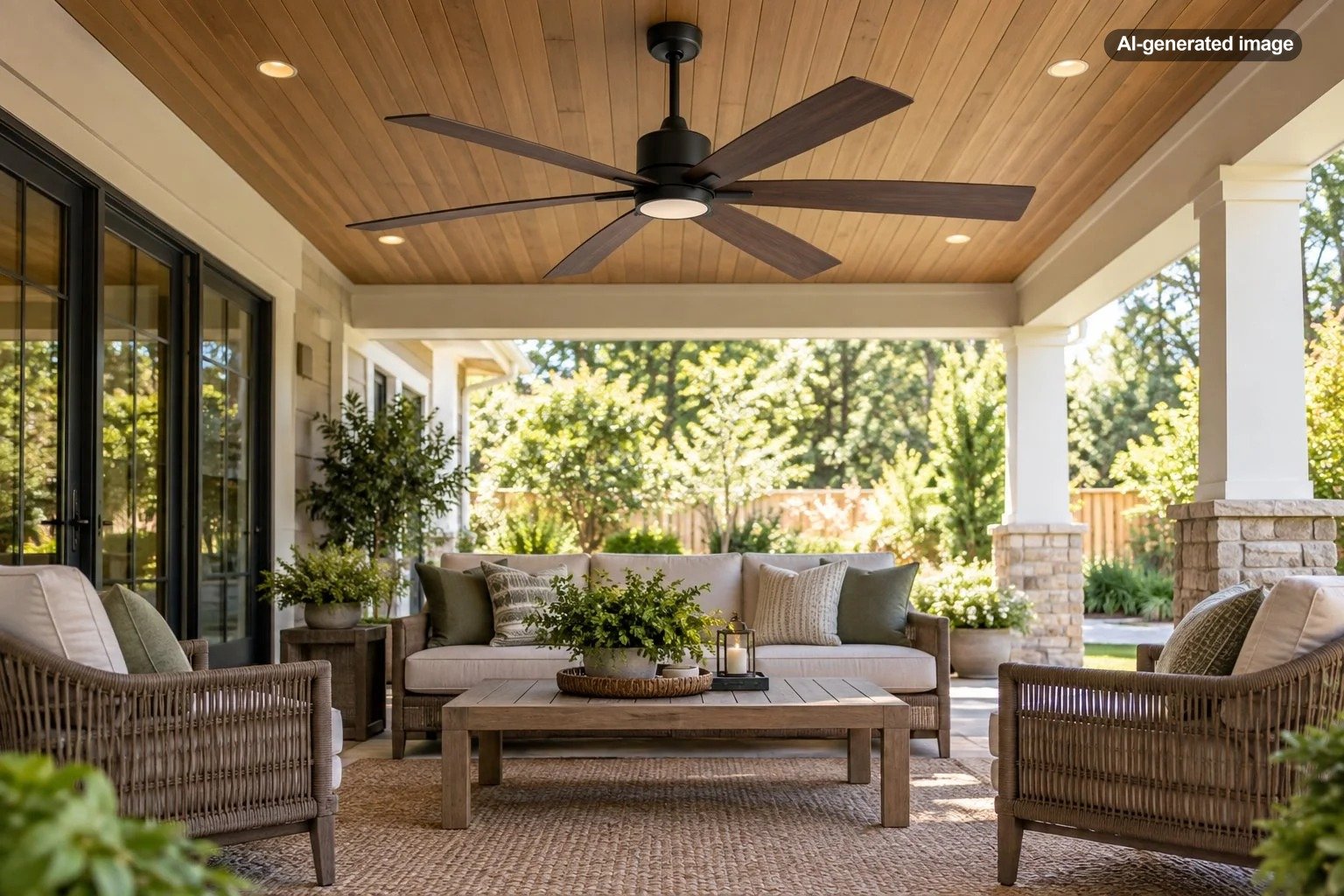
For many covered patios, a ceiling fan in the 44- to 60-inch range is a practical starting point, but square footage alone should not make the decision. A compact seating nook may be comfortable with a fan around 44 inches, while a broad dining-and-lounge patio may need a 52- to 60-inch fan or, in some layouts, more than one fan. Ceiling height, the shape of the patio, where people actually sit, and whether wind-driven rain can reach the fan all matter.
Start With the Patio’s Usable Size
Ceiling-fan dimensions refer to blade span, which is the diameter created by the rotating blades. Larger spans can move air across a broader area, but choosing the largest fan that physically fits is not necessarily the best approach. A fan should feel proportionate to the covered space and should circulate air where people spend time.
Manufacturer sizing recommendations are useful as starting points rather than universal rules. Hunter, for example, describes fans up to about 44 inches as appropriate for smaller porch areas and allows larger blade spans as porch dimensions increase. Its broader sizing guidance also places 52-inch fans in a range commonly used for larger rooms and patio areas.
| Patio situation | Useful starting point | What to consider |
|---|---|---|
| Small covered nook | About 36-44 inches | A compact fan can provide localized airflow without visually overwhelming the space. |
| Medium patio | About 44-54 inches | A 52-inch fan is a common middle-ground choice when one fan serves the primary seating area. |
| Large covered patio | About 56-60 inches or larger | A broader fan may make sense when the patio is open and relatively square. |
| Long or divided patio | Consider multiple fans | Two appropriately placed fans may distribute air more evenly than one oversized fan. |
These ranges are planning references, not installation specifications. The fan manufacturer’s instructions should determine required mounting clearances, compatible ceiling configurations, and other installation details.
Size the Fan for Where People Actually Sit
A covered patio can technically measure 300 square feet while only half of that space contains a dining table or lounge furniture. In that situation, directing comfortable airflow over the occupied zone can matter more than attempting to cover every corner equally.
Think of the patio in functional zones. A dining table might need airflow centered over the table, while a separate conversation area could benefit from a second fan. This becomes especially relevant with long rectangular patios, L-shaped porches, or outdoor rooms divided by structural beams.
Do Not Ignore Ceiling Height
Blade span receives most of the attention when choosing a fan, but mounting height can substantially affect how the fan works within a patio. A fan mounted unusually high may feel less effective at seating level, while a fan mounted too low can create clearance concerns.
Hunter’s porch guidance notes that fan blades should generally be at least 7 feet above the floor and identifies roughly 8 to 9 feet as a common airflow-friendly mounting range. Higher ceilings may call for an appropriate downrod so the fan is not tucked unnecessarily close to the roof structure. The exact mounting configuration should always follow the instructions for the specific fan and applicable local requirements.
A vaulted or sloped patio ceiling introduces another variable because not every mounting system works with every ceiling angle. Before buying a fan based only on blade diameter, confirm that its approved mounting hardware fits the ceiling you actually have.
Choose the Correct Outdoor Rating Before Worrying About Size
A perfectly sized indoor-only fan is still the wrong fan for a covered patio. Outdoor fans are designed for moisture conditions that indoor fixtures may not be built to tolerate.
Damp-rated fans are intended for protected locations that can experience humidity and moisture without direct water exposure. That makes them appropriate for many fully covered patios and porches. If rain, splashing water, or wind-driven moisture can directly reach the fan, a wet-rated model is the more appropriate category.
Do not install a dry-location indoor fan outdoors simply because it is inexpensive or matches the furniture. Use the environmental rating identified by the fan manufacturer and follow its installation documentation.
One Large Fan Is Not Always Better Than Two Smaller Fans
Large-diameter fans make sense in genuinely large, open areas, but patio architecture often complicates airflow. Beams, partial walls, outdoor kitchens, fireplaces, and changes in ceiling height can divide one roofed area into several smaller zones.
Multiple fans can be especially useful on long patios because each fan can serve a distinct seating area. They can also create a more balanced visual rhythm than a single oversized fan centered between unrelated zones. On the other hand, a simple square patio with one centrally positioned dining or conversation area may be well served by one properly sized fan.
There is also a design question. A fan should have enough visual presence to suit the ceiling without making the patio feel crowded. Wide blades beneath a relatively small roof can dominate the view, while a tiny fan suspended from a broad vaulted ceiling can look underscaled even before airflow is considered.
The best patio fan is sized for both the architecture and the people sitting beneath it.
Airflow Matters as Much as Blade Diameter
Two fans with the same blade span do not necessarily provide identical airflow. Motor design, blade geometry, speed settings, mounting configuration, and the manufacturer’s overall design all affect performance. This is why blade diameter should be treated as a first-stage screening tool rather than the only specification worth checking.
When comparing fans of a suitable diameter, review the manufacturer’s published performance information and installation requirements for the exact models under consideration. Avoid assuming that simply adding more inches to the blade span guarantees a proportionate increase in comfort.
How to Measure Before You Shop
What to do
- Measure the length and width of the covered patio and calculate its approximate square footage.
- Mark the primary dining, lounging, or conversation areas where airflow matters most.
- Measure the ceiling height at each proposed fan location.
- Note beams, sloped ceilings, light fixtures, heaters, cabinets, and other elements that may affect placement.
- Determine whether the fan can ever be reached by direct or wind-driven water.
- Use the manufacturer’s sizing guidance to narrow the blade-span range.
- Check the specific fan’s mounting, clearance, outdoor-rating, and installation instructions before purchasing.
A Practical Way to Make the Final Choice
For a small covered patio, begin your search around the 36- to 44-inch category. For a typical medium-size patio with one central seating area, approximately 44 to 54 inches is a useful range to investigate, with 52 inches being a particularly common size. Large open patios may justify fans around 56 to 60 inches or more, while long or multi-zone spaces deserve consideration of two or more appropriately placed fans.
Before you decide
- Measure the patio rather than estimating its size.
- Prioritize airflow over occupied seating and dining zones.
- Account for ceiling height and approved mounting options.
- Use a damp-rated or wet-rated fan appropriate to the actual weather exposure.
- Consider multiple fans for long or divided spaces.
- Review the exact manufacturer’s installation and clearance requirements.
If you keep those variables together, fan sizing becomes much easier. The goal is not to find the biggest fan that fits beneath the patio roof; it is to choose an outdoor-rated fan, or arrangement of fans, that feels proportionate and delivers useful airflow where the patio is actually used.
Frequently Asked Questions
Is a 52-inch ceiling fan big enough for a covered patio?
It can be. A 52-inch fan is a versatile size for many medium-size patios and is listed by Hunter for patio applications. Large, elongated, or divided patios may benefit from a larger fan or multiple fans.
Can a ceiling fan be too large for a patio?
Yes. An oversized fan can look disproportionate, may conflict with surrounding architecture or fixtures, and is not automatically the best way to distribute air. Check the manufacturer’s placement and clearance requirements rather than choosing on diameter alone.
Do I need a wet-rated fan under a covered patio?
Not necessarily. A damp-rated fan can be appropriate in a genuinely protected covered location where direct water does not reach it. If the fan can be exposed to rain or splashing water, choose a model rated for wet locations.
Should a long covered patio have two ceiling fans?
Often it is worth considering. Separate fans positioned over dining and lounge zones can provide more even localized airflow than one fan attempting to serve a long space from the center.