Should You Fill Empty Freezer Space Before a Power Outage?
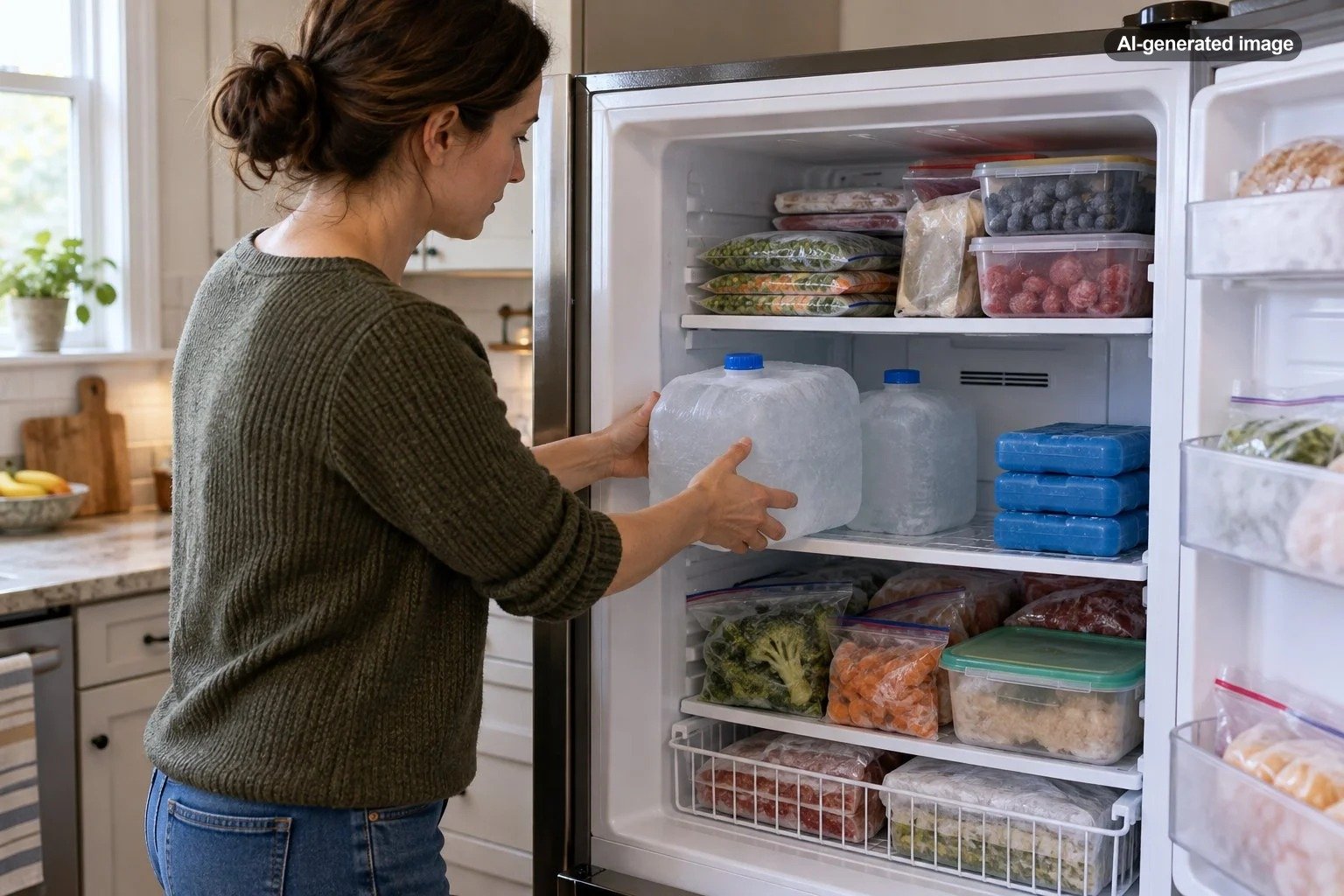
Yes. If you have advance warning of a possible power outage, filling some of the unused space in your freezer with containers of frozen water or frozen gel packs can help the freezer stay cold longer. The goal is not to pack the compartment so tightly that air cannot circulate during normal operation. It is simply to replace empty space with additional frozen mass before the electricity goes out.
This preparation matters because a full freezer generally holds its temperature longer than a half-full one when the door remains closed. The CDC and USDA advise that food in a full freezer can remain safely cold for about 48 hours without power, compared with about 24 hours in a half-full freezer, assuming the door stays shut.
Why a fuller freezer stays cold longer
A freezer does not create cold once the power fails. Instead, everything already frozen inside begins absorbing heat that enters through the insulated cabinet, door seals, and each opening of the door.
A freezer containing more frozen food, ice, and frozen water has more cold thermal mass available to absorb that incoming heat. A mostly empty freezer contains more air and relatively little frozen material. Air changes temperature quickly, while a large quantity of frozen material takes considerably longer to warm and thaw.
This is why official power-outage guidance distinguishes between a full and half-full freezer. USDA guidance also recommends grouping packages together in a freezer that is not full so the frozen items help retain cold more effectively.
The useful part of filling empty freezer space is not the lack of empty air itself; it is the additional frozen mass you create before the outage begins.
What should you use to fill the empty space?
Frozen water is one of the simplest options. The CDC specifically recommends freezing containers of water and gel packs as part of emergency food preparation. The frozen containers can help keep food cold, and once they thaw, the water may also be useful for non-food purposes or drinking if it was stored in a clean, food-safe container with potable water.
You do not need to purchase special equipment simply to make a freezer fuller. Practical options include:
- Food-safe containers partially filled with water and frozen.
- Reusable freezer or gel packs that you already own.
- Ice stored in suitable freezer containers.
- Food that you intend to freeze anyway, provided it is frozen well before the outage begins.
Water expands when it freezes, so containers need room for expansion. Do not fill a rigid container completely to the top before freezing it. Make sure lids, bags, and containers are appropriate for freezer use and positioned so an accidental leak will not soak nearby food.
How full should the freezer be?
You do not need to eliminate every pocket of air. A practical goal is simply to avoid leaving a large freezer mostly empty when you have enough warning to freeze additional water.
For normal operation, do not block vents or interfere with the appliance’s designed airflow. Freezer layouts vary, particularly between upright freezers, chest freezers, and refrigerator-freezer combinations. If your appliance manual specifies clearance around vents, baskets, or air channels, follow those instructions.
If the freezer is already reasonably full of frozen food, adding containers simply for the sake of filling every remaining gap is unlikely to be necessary. The biggest difference is between a freezer containing substantial frozen mass and one that is largely empty.
| Freezer situation | Useful preparation |
|---|---|
| Mostly full | Keep food organized and leave it closed during the outage. |
| About half full | Add frozen water containers or gel packs if time allows. |
| Mostly empty | Freeze additional water ahead of the outage and group frozen items together. |
| Power already out | Stop rearranging the freezer and keep the door closed. |
Do not wait until the power goes out to add water
Once electricity has failed, placing containers of liquid water into the freezer does not create extra cooling capacity. At that point, the priority is preserving the cold that is already there.
If the outage has begun, keep the freezer door closed. Repeatedly opening it to reorganize food, add supplies, or check whether items are still frozen allows warm room air to enter and shortens the time the contents remain cold.
That means freezer preparation is most useful when performed before a storm, utility shutoff, hurricane, or other event that gives you advance notice.
What to do before a possible outage
- Check that the freezer is operating normally and is at 0 degrees F or below.
- Place an appliance thermometer inside if you do not already use one.
- Freeze water containers or gel packs to occupy significant unused space.
- Group frozen food together rather than spreading small packages throughout an otherwise empty compartment.
- Arrange meat and poultry so leaking packages are less likely to contaminate other foods if thawing begins.
- Once the outage starts, leave the freezer closed as much as possible.
An appliance thermometer is more useful than guessing
How long a particular freezer stays cold depends on more than how full it is. Room temperature, insulation, freezer design, starting temperature, door openings, food arrangement, and the duration of the outage can all affect the result.
For that reason, the familiar 48-hour and 24-hour figures should be treated as emergency guidance rather than a timer proving that every package remains safe until a particular minute.
The CDC recommends keeping an appliance thermometer in both the refrigerator and freezer. Before an emergency, a freezer should be at 0 degrees F or below. After an outage, temperature and the condition of the food are more useful safety indicators than assumptions based only on elapsed time.
What about dry ice during a long outage?
For outages expected to last longer than the freezer can remain cold on its own, USDA guidance discusses dry ice or block ice as additional ways to preserve cold temperatures. Dry ice requires special handling because it is extremely cold and can cause injury if touched with bare skin. It also releases carbon dioxide as it sublimates, so appropriate ventilation and handling instructions matter.
For most households preparing for a routine short outage, frozen water and gel packs are simpler measures to arrange in advance. If you plan to use dry ice, follow current USDA guidance and the supplier’s handling instructions rather than improvising.
What people often overlook
Filling freezer space helps only if the freezer starts properly cold and stays closed. A beautifully packed freezer that gets opened every half hour to retrieve drinks will lose its advantage quickly.
It is also worth preparing the refrigerator separately. The CDC states that an unopened refrigerator keeps food safely cold for about four hours during a power outage. A freezer’s longer cold-holding time should not be assumed to apply to refrigerated milk, meat, eggs, leftovers, or other perishable refrigerator foods.
Keeping a cooler and frozen gel packs available can make refrigerator management easier if an outage stretches beyond those first few hours. When advance warning is available, emergency preparation works best as a small system: cold freezer, frozen water, thermometers, coolers, ice packs, and a plan to keep appliance doors shut.
Frequently asked questions
Does an empty freezer use more electricity?
The power-outage reason for filling empty space is primarily about retaining cold after electricity stops, not about promising energy savings during ordinary operation. Energy use varies by appliance design, settings, room conditions, door openings, maintenance, and other factors.
Can I use plastic bottles filled with water?
A freezer-safe container can be used if it is suitable for freezing and has enough empty space for the water to expand. Do not completely fill a rigid container with water before freezing it.
Should I rearrange everything after the power fails?
No. If the outage has already started, minimizing door openings is generally more important than creating a perfect arrangement. Preparation and grouping are best done beforehand.
How long will a full freezer stay cold without electricity?
CDC and USDA guidance says approximately 48 hours for a full freezer and about 24 hours for a half-full freezer when the door remains closed. Actual conditions can vary, so check temperatures and the condition of food when power returns.
Is frozen food automatically unsafe if it starts thawing?
Not necessarily. Official guidance indicates that food may generally be refrozen or cooked if it still contains ice crystals or is at 40 degrees F or below. Food that cannot be determined to be safe should be discarded.