How High Should a Coffee Table Be Compared With a Sectional?
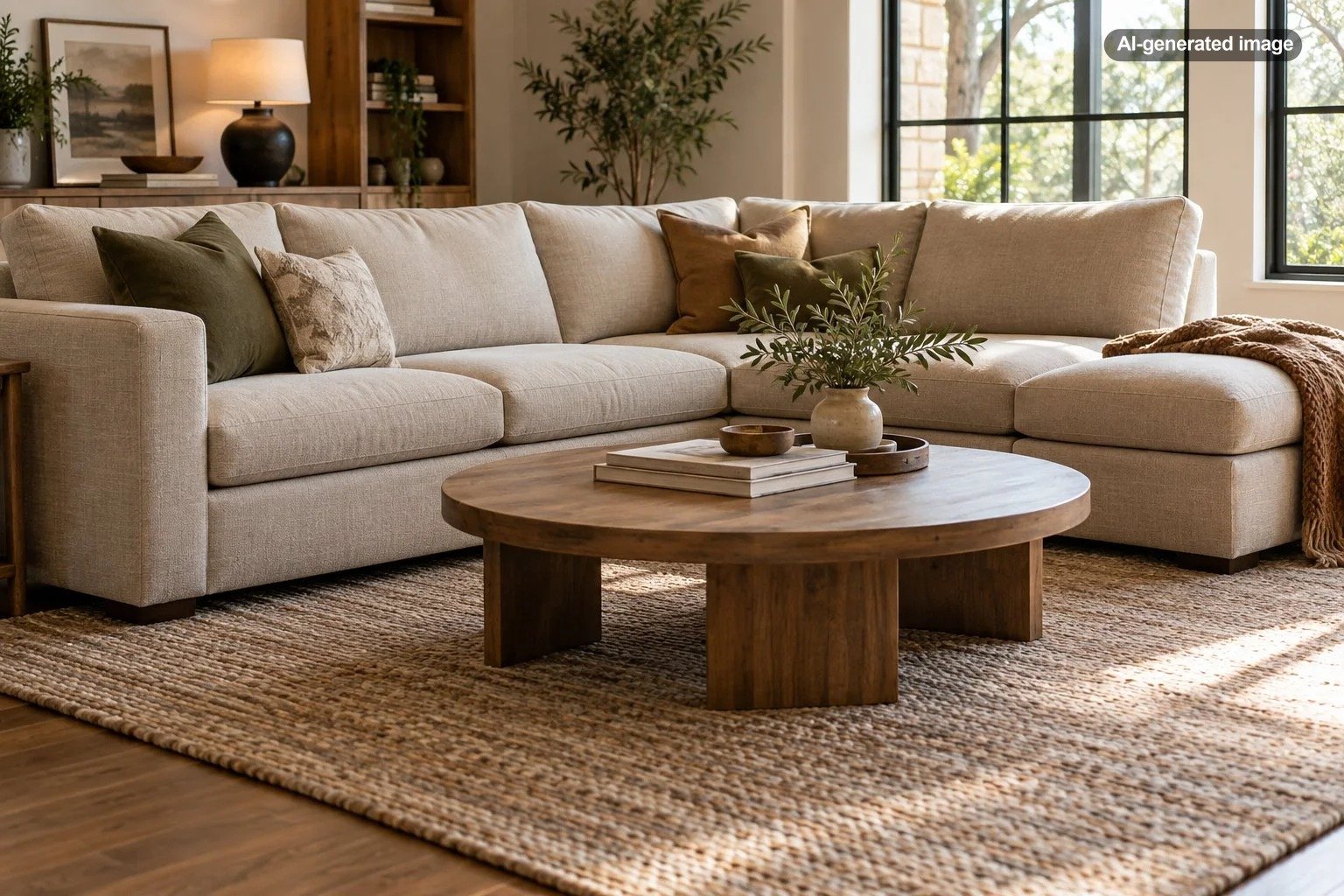
A coffee table generally looks and functions best when its top is about level with the sectional’s seat cushions or slightly lower. A practical target is the same height as the seat or roughly 1 to 2 inches below it. That keeps drinks, books, remotes, and other everyday items within comfortable reach without making the table feel like a second dining surface in the middle of the room.
The sectional matters more than any generic definition of a standard coffee table. Low modern sectionals may pair naturally with a 14- or 15-inch table, while more traditionally proportioned seating may call for something closer to 17 or 18 inches. Measure the furniture you actually own before shopping.
Start With the Sectional’s Seat Height
The most useful measurement is the vertical distance from the floor to the top of the seat cushion. Do not base the decision on the height of the sectional’s arms or back. Those dimensions have little to do with how comfortably you can reach the coffee table.
For example, if the top of the seat cushion is 18 inches from the floor, a table around 16 to 18 inches high is a sensible starting range. If the sectional has a particularly low 16-inch seat, an 18-inch coffee table may technically be only 2 inches taller, but it can still look surprisingly prominent because the entire seating profile is low.
Plush cushions introduce a small complication because they compress when someone sits down. You do not need to calculate cushion compression to the fraction of an inch. Use the unoccupied seat height as the consistent measurement, then consider how you actually use the table. A household that regularly eats casual meals from the coffee table may tolerate a slightly taller surface more readily than one seeking an especially low, streamlined look.
The sectional sets the scale; the coffee table should respond to it rather than obey a standard height in isolation.
What Happens When the Coffee Table Is Too High?
A coffee table that rises noticeably above the seat cushions can make the seating area feel visually crowded. It may interrupt sightlines across a low sectional and can seem more like a worktable than a relaxed living-room surface.
That does not mean a table can never be taller than the seat. A small difference may be perfectly workable when accessibility, eating, hobbies, or laptop use matters more than a textbook furniture proportion. The key is to make the choice intentionally rather than assuming that a taller table will automatically be more convenient.
Pay particular attention to thick tabletops. A chunky stone, wood, or upholstered table can appear visually taller than a slender table at exactly the same measured height. Proportion is partly mathematical and partly visual.
What Happens When the Coffee Table Is Too Low?
Low tables can look excellent with contemporary sectionals, especially when the seating has a deep profile and low back. Problems arise when the height difference becomes large enough that everyone has to lean forward substantially to reach a glass or set something down.
A dramatic low-table look is therefore better suited to rooms where the coffee table serves primarily as a decorative surface. If it functions as the household’s landing zone for drinks, game controllers, snacks, puzzles, or laptops, convenience deserves more weight.
| Table position | How it tends to feel | Best use |
|---|---|---|
| Level with seat | Balanced and easy to reach | Most everyday living rooms |
| 1-2 inches below seat | Relaxed and visually unobtrusive | Low or contemporary sectionals |
| Noticeably below seat | Architectural but less convenient | Decor-focused rooms and very low seating |
| Above seat | More prominent and work-surface-like | Special functional needs rather than conventional styling |
With a Sectional, Shape and Reach Matter Too
A sectional surrounds the coffee table differently from a standard three-seat sofa, so height is only one part of the equation. An L-shaped sectional may place people along two sides of the table. A U-shaped sectional can surround it on three sides. A chaise can extend farther into the coffee-table zone than the main seating portion does.
This is why a perfectly proportioned rectangular table can still feel wrong if it blocks the chaise or sits too far from the corner seat. Round, oval, and square tables can be especially useful when several parts of a sectional need reasonable access to the same surface.
Leave Enough Space Between the Table and Sectional
A useful coffee table cannot require an obstacle course every time someone sits down. Around 14 to 18 inches between the sectional and coffee table is a practical starting point, with some layouts working comfortably near either end of that range.
Smaller clearances make the table easier to reach but can feel cramped, particularly around a chaise or reclining section. Larger gaps improve circulation but may put the tabletop inconveniently far away. In a compact apartment or condo, the answer is often a slightly smaller table rather than squeezing a large one into the correct theoretical position.
Also look beyond the seating side. If the coffee table sits between the sectional and a media console, fireplace, doorway, or major circulation route, preserve enough walking room on that side rather than using every available inch for furniture.
How Long Should a Coffee Table Be With a Sectional?
For a conventional sofa, a table around one-half to two-thirds of the sofa’s length often produces a balanced proportion. With a sectional, however, do not automatically calculate two-thirds of the sectional’s total outside measurement. That can produce an enormous table because the chaise or return adds length that does not necessarily need to be matched.
Instead, identify the main straight seating run facing the table and use that as your visual reference. The table should feel substantial enough for the sectional without stretching into corners, obstructing the chaise, or limiting access to seats.
Large sectionals sometimes work better with two smaller nesting or clustered tables than with one massive rectangular piece. This can improve reach from different seats and make it easier to adjust the arrangement when entertaining.
A Simple Way to Measure Before Buying
What to do
- Measure from the floor to the top of the sectional’s seat cushion.
- Use that measurement, or up to about 2 inches less, as your initial coffee-table height range.
- Measure the usable seating run that will actually face the table rather than the sectional’s entire outside perimeter.
- Mark the proposed tabletop footprint on the floor with painter’s tape.
- Check the gap between the tape and every part of the sectional, especially the chaise and inside corner.
- Walk through the room normally to confirm that the table will not pinch an important circulation path.
The tape test is particularly useful for online furniture shopping. Height can be easy to imagine; tabletop footprint is where mistakes often become obvious. A table that appears modest on a product page may occupy far more floor area than expected once placed inside an L-shaped seating arrangement.
Common Coffee Table and Sectional Mistakes
Choosing from the table’s height alone. A table can be exactly level with the seat and still be too wide, too long, or awkwardly shaped for the sectional.
Matching the sectional’s entire length. Sectionals are large by nature. Trying to make the coffee table equally imposing can leave the room feeling overfurnished.
Ignoring the chaise. The chaise is often where clearance problems happen first. Check whether someone can sit down, stand up, and stretch out without feeling boxed in by the table.
Buying for appearance but using the table for everything. An extremely low sculptural table may look terrific in photographs but prove irritating if the household constantly uses it for drinks, meals, games, and work.
Forgetting visual weight. A solid block table reads differently from a glass table or a piece on slender legs, even when their dimensions are identical. Heavier-looking tables often benefit from slightly more breathing room.
Should a Coffee Table Be Lower Than a Sectional?
It can be, and slightly lower is one of the most reliable choices. A difference of roughly 1 to 2 inches tends to preserve easy reach while allowing the sectional to remain the dominant piece of furniture.
Going substantially lower becomes more of a style decision. It may suit a low-profile modular sectional, but consider the people using the room. Anyone who finds bending or reaching difficult may be happier with the tabletop closer to seat height.
Does a Deep Sectional Need a Taller Coffee Table?
Not necessarily. Seat depth and table height solve different problems. A deep sectional may make reaching forward harder, but raising the coffee table does not eliminate the horizontal distance between the sitter and the tabletop.
In that situation, moving the table slightly closer, choosing a broader shape that reaches more seating positions, or adding small side tables may improve usability more effectively than increasing height.
What Coffee Table Shape Works Best With an L-Shaped Sectional?
There is no single best shape. Rectangular tables suit long seating runs, while round or oval tables can soften the interior angle of an L-shaped layout and make movement around the chaise easier. Square tables can work well when the open area inside the sectional is broad and nearly square.
Choose shape after mapping the available floor space. The table should be easy to reach from the seats that matter most without filling every inch of the sectional’s open center.
The Bottom Line
For most sectionals, start with a coffee table that is approximately the same height as the seat cushions or 1 to 2 inches lower. Then evaluate the table as part of the entire seating arrangement rather than treating height as the only rule.
The most successful pairing balances three things at once: comfortable reach, appropriate scale, and enough open floor space to move around the sectional naturally. When those three work together, the coffee table feels as though it belongs in the room rather than merely fitting inside it.