How Do You Make a Living Room Feel Less Empty Behind a Floating Sofa?
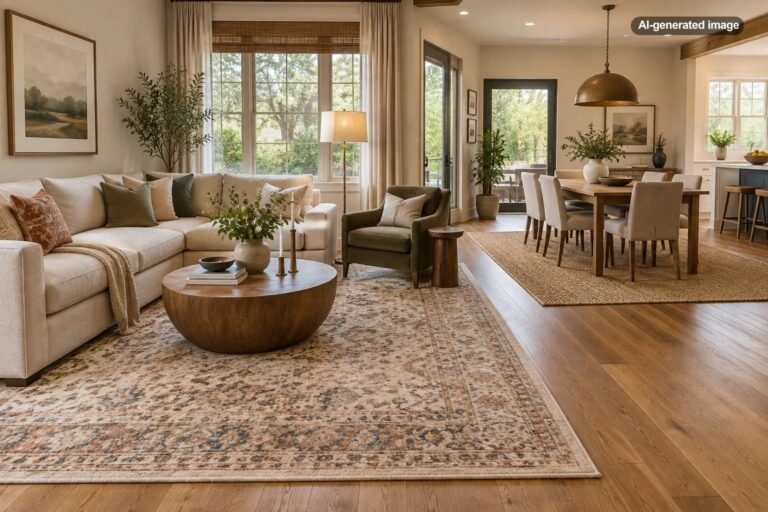
A floating sofa can make a living room feel more spacious, conversational, and thoughtfully planned, but it can also expose a broad stretch of floor that looks strangely unfinished. The solution is usually not to fill every inch behind the sofa. It is to give that space a clear visual or practical purpose.
In many rooms, the most effective fix is a narrow console table, layered lighting, a properly scaled area rug, or a secondary zone such as a walkway, reading corner, or small workspace. The right choice depends on how much room you actually have and what happens on the other side of the sofa.
Start by deciding what the space behind the sofa is supposed to do
An empty-looking area is often a planning problem before it is a decorating problem. Look at the sofa from the direction people normally enter the room. Is the space behind it primarily a walkway? Is it part of a dining area? Does it face an entryway? Is there enough depth for furniture, or would another piece simply create an obstacle?
If people regularly walk behind the sofa, preserving a comfortable path matters more than filling the view. If the sofa divides a large open room, however, the back can become a useful boundary between zones. That distinction should guide everything that follows.
Before you decide
- Measure the open depth behind the sofa rather than judging it by eye.
- Identify the route people naturally use to cross the room.
- Consider what you see when entering from the main doorway.
- Check whether the sofa already sits securely within the area rug.
- Decide whether you need function, visual balance, or both.
Add a console table when the sofa needs a stronger visual back
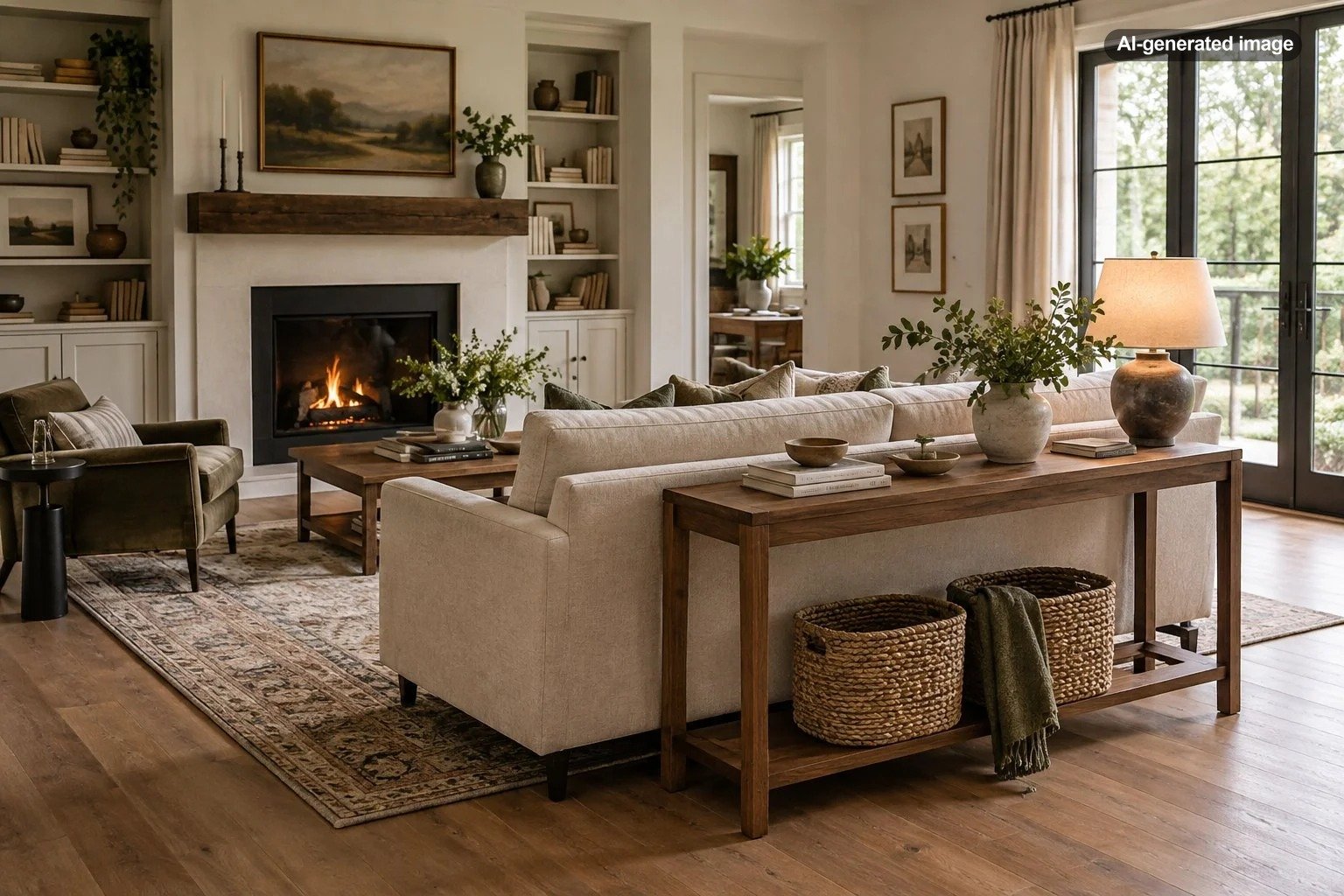
A console is one of the most useful ways to make a floating sofa look intentional. It turns an exposed upholstered back into part of a composed furniture arrangement and creates a surface for lamps, books, a small tray, or a restrained grouping of decorative objects.
Proportion matters more than ornament. In most rooms, a sofa console looks calmer when it is no taller than the sofa back and does not extend awkwardly beyond the sofa on either side. Very deep consoles can consume circulation space, so narrow profiles are particularly useful behind seating.
The surface does not need to be covered. One lamp, a low stack of books, and a sculptural object can create more presence than a row of unrelated accessories. Because the table may be viewed from several directions, choose pieces that look finished from the back as well as the front.
Use the area rug to connect the floating sofa to the seating group
Sometimes the space behind the sofa is not actually the problem. The sofa simply looks detached from everything in front of it. A rug that is too small can exaggerate that effect by visually isolating the sofa from the coffee table and chairs.
Ideally, the main seating pieces should have a visible relationship with the rug. Depending on the room and rug size, that may mean placing the sofa fully on the rug or allowing at least its front legs to rest on it. The goal is not to follow a rigid formula. The goal is to make the seating read as one group instead of several unrelated objects sitting on the floor.
If the rug currently ends well before the sofa, test a larger footprint before buying additional furniture for the area behind it. Sometimes correcting the foreground eliminates the sense of emptiness at the back.
Layer lighting instead of filling every open patch with furniture
Height is particularly helpful when the sofa back creates a long, low horizontal line. A floor lamp near one end of the sofa can break that line while also improving reading light and evening atmosphere. If you have a console, one or two appropriately scaled table lamps can create the same effect.
This is especially useful in living rooms that depend heavily on ceiling lights. Lamps make different parts of the room visually active after dark, which can prevent the floating sofa from appearing stranded in the center.
A tall plant can perform a similar compositional role in a well-lit location. Rather than placing several small plants behind the sofa, one substantial plant generally creates a cleaner focal point and leaves more usable floor space.
Create a second zone if there is genuinely enough room
In a large living room, the empty area may be telling you that the room can support another function. A slim desk, reading chair, pair of occasional chairs, game table, or small library area can make sense when there is enough space to create a distinct zone without crowding the main seating area.
This approach is especially effective in open-plan rooms. The sofa becomes a soft boundary: conversation happens on one side, while dining, reading, working, or circulation happens on the other. That makes the sofa placement feel purposeful rather than arbitrary.
| Situation behind sofa | Useful approach | Why it works |
|---|---|---|
| Narrow open strip | Leave it open or add a floor lamp | Preserves circulation without visual clutter |
| Moderate unused depth | Narrow console table | Gives the sofa a finished back and useful surface |
| Large open-plan area | Create a secondary zone | Turns unused floor space into a defined function |
| Sofa feels visually detached | Reconsider rug size and placement | Connects the sofa to the main seating group |
| Room feels low and flat | Add a lamp or tall plant | Introduces height without adding bulky furniture |
Let a walkway look like a walkway
One common mistake is treating every visible patch of floor as a decorating opportunity. If the area behind the floating sofa is the natural route between a doorway, kitchen, dining area, patio door, or hallway, that openness may be doing important work.
A clear path can make the room feel calmer and larger. Instead of filling it, strengthen the edges of the path. A console tucked close to the sofa, a lamp at one end, or a clearly defined rug boundary may be enough to signal that the open area is intentional.
Be particularly cautious about placing stools, baskets, plant stands, or small tables in a route people use every day. These pieces can look appealing in a still photograph while becoming annoying obstacles in actual life.
Avoid the collection-of-small-things problem
When a space feels empty, it is tempting to keep adding objects until it feels occupied. That can produce the opposite problem: a sofa backed by a console, baskets, stools, plants, lamps, and decorative objects that all compete for attention.
Choose the largest useful move first. If a console solves the problem, let it do the work. If a rug establishes the seating area, you may not need anything behind the sofa at all. If a large plant balances one corner, resist automatically matching it on the other side.
The goal is not to eliminate empty space; it is to make the empty space look deliberate.
Match the solution to the size and style of the room
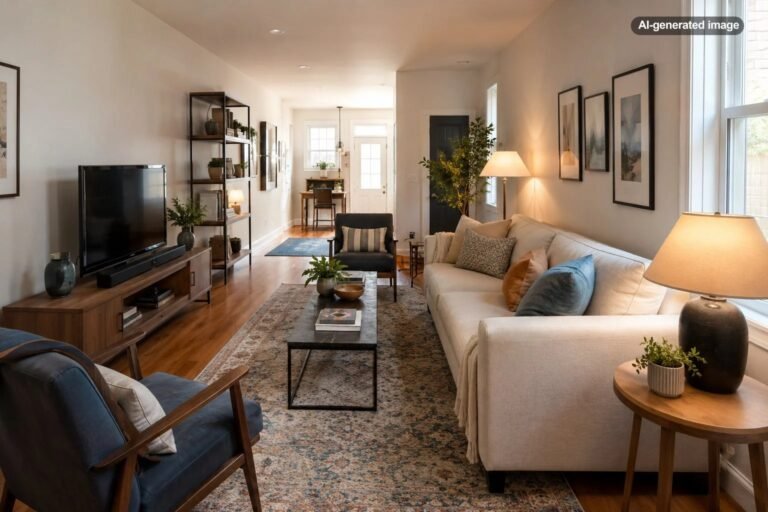
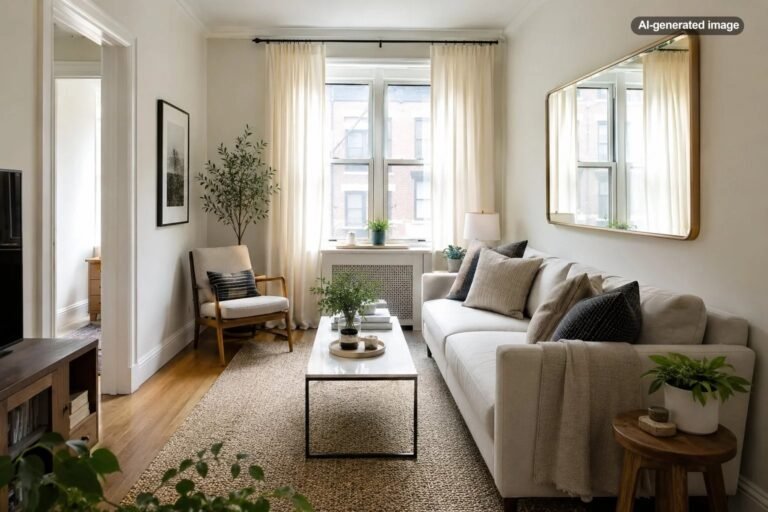
In a compact apartment, keeping the area behind a sofa relatively open can preserve valuable visual breathing room. A narrow console, wall-mounted element elsewhere in the sightline, or single floor lamp may be enough.
In a larger traditional room, a substantial console with lamps can give the floating sofa greater architectural presence. In a minimalist room, the better choice may be no console at all, relying instead on a generous rug and disciplined furniture placement. In a casual family room, function may matter most, making a durable sofa table useful for lamps, chargers, books, or everyday items.
The same principle applies to color and material. A heavy dark wood console behind a visually light sofa can create a strong contrast, while an airy table with slender legs keeps the composition open. There is no universal formula; the useful question is whether the addition supports the visual weight already present in the room.
What should you try first?
What to do
- Stand at the room’s main entrance and identify exactly what feels unfinished.
- Measure the space behind the sofa and protect the routes people actually use.
- Check whether the sofa is visually connected to the rug and other seating.
- Test one anchoring element, such as a narrow console, lamp, or tall plant.
- Add a secondary furniture zone only if the room has enough depth to support it comfortably.
- Remove anything that makes circulation awkward or turns the area into visual clutter.
A floating sofa does not need something behind it simply because the floor is visible. The best living rooms balance furnished areas with deliberate negative space. Once the sofa is connected to the rug, lighting, nearby furniture, and traffic pattern, the area behind it can feel finished even when relatively little is there.