Can You Put a Fire Pit on Artificial Grass?
You should not place a fire pit directly on artificial grass unless the fire pit and turf manufacturers explicitly approve that arrangement. Synthetic turf may resist spreading flames, depending on the product, but concentrated heat, hot metal, sparks, and embers can still melt or permanently deform its fibers. The safer plan is to place the fire pit on a stable, level, noncombustible surface that separates the entire unit from the turf.
The details matter. A low wood-burning bowl that drops embers presents a different risk from a properly installed gas fire table with substantial ground clearance. Even so, neither style should be assumed safe for direct placement on synthetic grass simply because the lawn is labeled fire-resistant.
Why artificial grass and fire pits are a difficult pairing
Artificial grass is generally made with synthetic fibers attached to a backing system. Heat can soften, curl, flatten, discolor, or melt those fibers even when the material does not sustain an open flame. The infill, seams, underlayment, nearby leaves, and other components of the installation may also respond differently to heat.
A fire rating does not make turf heatproof. It describes performance under specified test conditions, which may bear little resemblance to hours of radiant heat beneath a fire bowl or repeated contact with falling embers. SYNLawn, for example, advises against placing grills, fire pits, or outdoor heaters directly on artificial grass because heat can melt or deform the fibers.
Damage may also appear gradually. The lawn directly beneath a fire pit can become flattened or glossy, while fibers around the perimeter may curl from radiant heat. With a wood-burning pit, one escaped ember can leave a small melted spot that cannot be brushed back into shape.
The safest way to place a fire pit near artificial turf
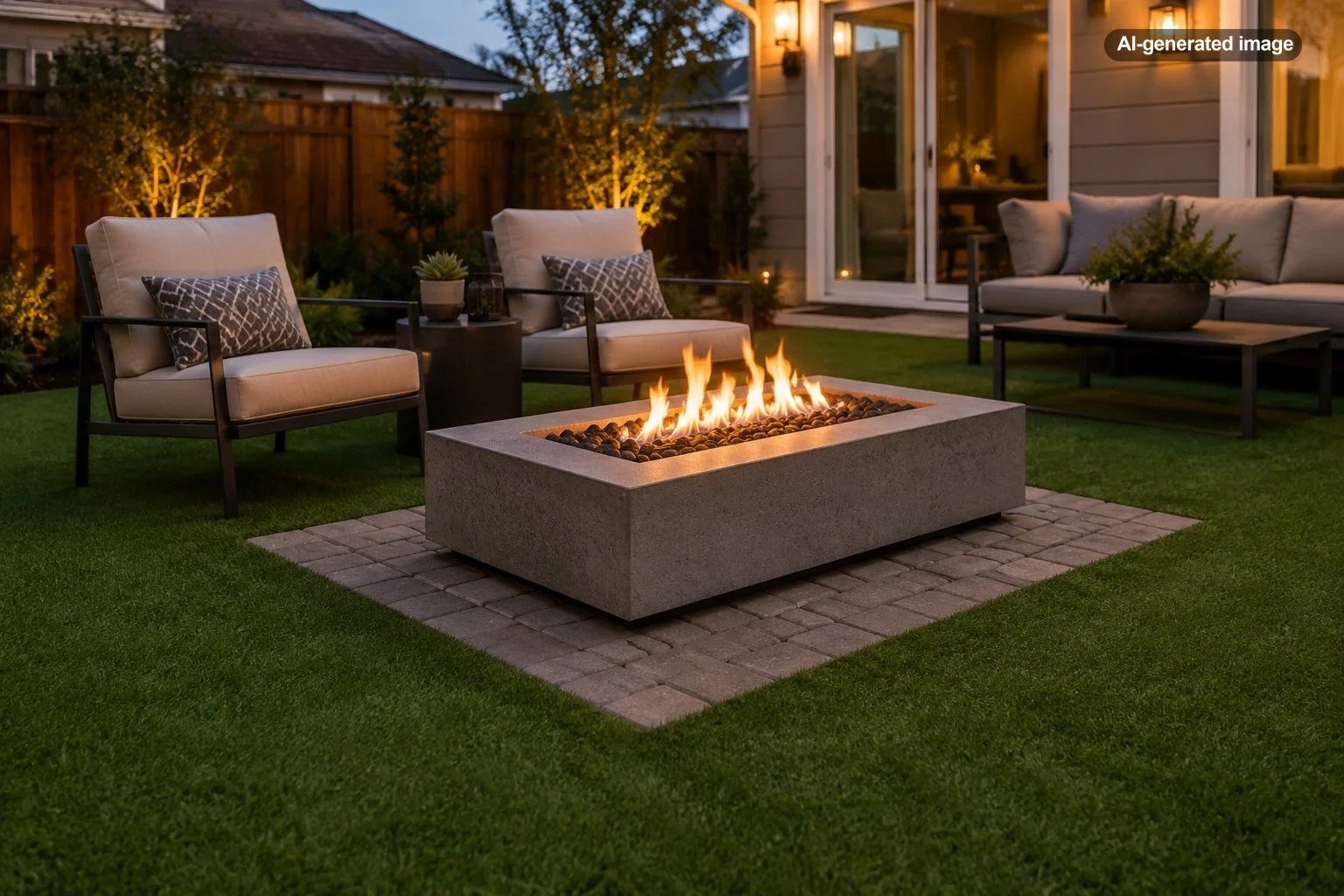
A dedicated hardscape pad is the most dependable arrangement. Concrete, properly installed masonry pavers, brick, or suitable natural stone can create a stable surface while visually defining the fire area. The pad should extend beyond the fire pit rather than ending precisely beneath its feet.
How far it should extend depends on the appliance, its heat output, whether it produces embers, and the manufacturer’s instructions. A wood-burning pit generally deserves a more generous noncombustible zone because sparks and burning material can escape beyond the bowl. A qualified landscape professional or fire-feature installer can help integrate the pad without damaging the turf base or drainage system.
What to do
- Find the exact model manual. Confirm whether the fire pit requires a nonflammable surface and note every clearance listed for walls, furniture, ceilings, overhangs, and combustible materials.
- Check the turf documentation. Identify the turf product, backing, infill, fire classification, heat restrictions, and warranty exclusions. Ask the installer if records are incomplete.
- Select an open location. Keep the fire away from structures, fences, branches, umbrellas, shade sails, and stored materials. Do not use an outdoor fire pit in an enclosed or poorly ventilated area.
- Create a level noncombustible base. Use a permanent hardscape pad when possible. Account for drainage, settlement, and the weight of the fire pit.
- Plan for operation. Keep an appropriate extinguisher or a connected garden hose nearby, supervise the fire continuously, and prevent children or pets from entering the hot zone.
Can a fire-resistant mat protect artificial grass?
A purpose-made fire mat or heat shield may provide additional protection, but it is not automatically a substitute for a hardscape base. Products vary in the temperatures they tolerate, the type of heat they address, their required air gap, and whether they are intended for wood, charcoal, propane, or natural gas appliances.
Before relying on one, verify that the mat manufacturer approves both the fire pit type and the underlying synthetic surface. It must be large enough to address heat and possible falling material, lie flat without becoming a trip hazard, and remain stable in wind. A small grill mat under a much wider fire bowl is not meaningful protection.
Portable shields also introduce a maintenance issue: moisture and debris can become trapped beneath them. Lift and clean the area after the fire pit has cooled, and inspect the turf for discoloration, flattened fibers, or softened backing.
Wood-burning, propane, and natural gas fire pits
| Fire pit type | Main concern near turf | Practical placement approach |
|---|---|---|
| Wood-burning | Sparks, embers, ash, radiant heat, and falling fuel | Use a generous permanent noncombustible zone and any screen or spark-control equipment specified by the manufacturer. |
| Portable propane | Heat beneath the bowl, unstable footing, hose damage, and gas leaks | Place it on a level nonflammable base and route the hose exactly as the manual directs. |
| Built-in gas | Installation clearances, ventilation, fuel connections, and service access | Use qualified professionals and coordinate the fire feature, hardscape, drainage, and turf installation. |
Gas models avoid flying wood embers during normal operation, but that does not make every gas fire pit suitable for turf. Manufacturer requirements control. Solo Stove, for example, directs users of its propane fire pit to operate it outdoors on a stable, nonflammable surface away from overhangs and combustible materials.
Built-in gas fire features require more than a visually pleasing border. Fuel connections, ventilation, burner components, shutoffs, drainage, and clearances must be properly designed. This is not an appropriate place for improvised connections or assumptions based on a different model.
Clearances, weather, and local restrictions
There is no single clearance number that applies to every fire pit. Use the greater requirement established by the appliance manual, the installation design, and applicable local rules. Conditions on the day of use matter as well: wind can push flames, sparks, and heat toward turf, furniture, fencing, or vegetation.
Do not light the fire during high wildfire risk, prohibited burn conditions, or weather that makes flame control uncertain. The U.S. Consumer Product Safety Commission also advises keeping a hose or fire extinguisher nearby, never using gasoline to start or restart a fire, and never adding liquid fuel after an ignition attempt.
Rules can vary among municipalities, fire districts, homeowners associations, condominium communities, and rental properties. They may distinguish between recreational wood fires and listed gas appliances. Confirm the requirements that apply to the address rather than treating a neighbor’s setup as permission.
A better design solution
If the yard is being planned from scratch, treat the fire area as a small outdoor room. Create a stone, brick, paver, or concrete island within or beside the synthetic lawn, then arrange seating around it with the required clearances. The contrast can look intentional, and the hardscape provides a practical place for chairs without their legs pressing unevenly into turf.
Allow the turf installer and fire-feature professional to coordinate edges, drainage, access, and any required separation. Avoid loose decorative materials that can migrate into burners or create unstable footing. In compact yards, an approved gas fire table on an existing noncombustible patio may be a more workable choice than placing an open wood fire in the middle of the lawn.
Before you decide
- Does the fire pit manual approve the proposed surface?
- Does the turf manufacturer permit the intended arrangement?
- Is the base level, stable, noncombustible, and adequately sized?
- Are overhead and horizontal clearances satisfied?
- Can people move around the fire without stepping over hoses or crowding hot surfaces?
- Are local fire restrictions, property rules, and current weather conditions favorable?
Frequently asked questions
Will artificial grass catch fire?
Performance varies by product. Some fire-rated turf is designed to resist ignition or limit flame spread, but synthetic fibers can still melt or deform under concentrated heat. Obtain documentation for the exact turf rather than relying on a general claim about artificial grass.
Can I put pavers over artificial grass for a fire pit?
Simply laying a few pavers on top of the grass may produce an unstable, undersized platform and may trap heat. A properly designed hardscape section should have a suitable base, level surface, secure edges, and dimensions appropriate for the fire pit and its manual.
Is a propane fire pit safer for synthetic turf than a wood-burning pit?
Propane eliminates the routine sparks and embers associated with wood, but the appliance still produces substantial heat and has fuel-system risks. It belongs on a stable, nonflammable surface unless its manufacturer provides different explicit instructions.
What if the artificial grass is labeled fire-resistant?
Fire resistance is useful, but it is not permission to place a heat source directly on the lawn. Review the test classification, installation instructions, heat limitations, and warranty terms for that exact product.
Can I repair melted artificial grass?
A turf professional may be able to cut out and patch a damaged section. The repair is more likely to blend well when matching remnants from the original installation are available, although seams and color differences may remain visible.