
Why Does My Bedroom Smell Different With the Door Closed?
If your bedroom smells noticeably different after the door has been closed for several hours, the door itself usually is not creating the odor. More often, closing the room reduces air exchange and allows ordinary smells, humidity, and airborne compounds to become more concentrated. Bedding, carpet, laundry, furniture, pets, a closed closet, or a moisture problem can all become much easier to notice once fresh air is no longer diluting the room.
The useful question is not simply, “How do I make the room smell better?” It is, “What changes when the room is closed?” That distinction helps separate an ordinary ventilation issue from a source that deserves cleaning, maintenance, or further investigation.
Why closing the door can make a bedroom smell different
A closed room has less opportunity to exchange its indoor air with air from the rest of the home. The U.S. Environmental Protection Agency notes that increasing outdoor air entering a building can help control odors, humidity, temperature, and indoor pollutant levels. In practical terms, a bedroom with limited air movement can reveal smells that seemed almost invisible while the door was open. See the EPA’s guidance on residential ventilation and indoor air quality.
This effect can be especially noticeable overnight. A bedroom may contain one or two sleeping people for many hours, along with closed windows, upholstered furniture, rugs, mattresses, pillows, clothing, and perhaps pets. None of these automatically indicates a problem. They simply create a room with many materials capable of holding odors while the available air volume stays relatively small.
A closed door often reveals an odor that was already present; it does not necessarily create a new one.
Start with the ordinary odor sources
Before assuming there is a problem inside a wall or ventilation system, check the things that actually live in the bedroom. Fabrics are particularly good at holding onto body oils, perspiration, cooking odors carried through the home, pet smells, smoke, fragrance, and general household dust.
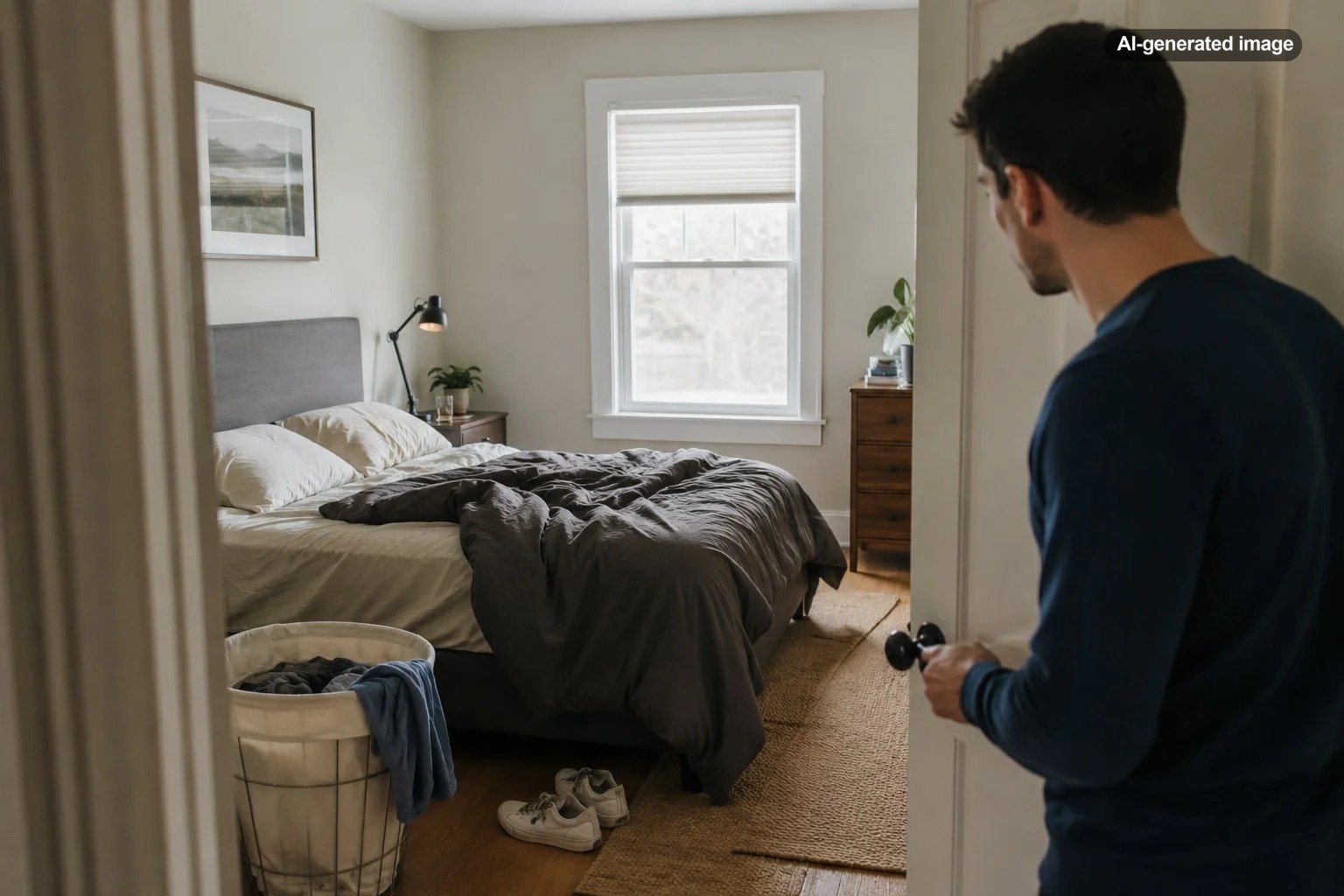
Strip the bed and smell the mattress, pillows, comforter or duvet, and upholstered headboard separately. Check the laundry hamper, shoes, gym bags, bath towels, throw blankets, curtains, area rugs, pet bedding, and any clothing draped over furniture. A hamper that seems harmless in an open room can become surprisingly obvious after eight hours behind a closed door.
Then open the closet. Closets often receive less air movement than the bedroom itself. Shoes, stored linens, infrequently worn clothes, cardboard boxes, luggage, and damp items can create an odor that gradually moves into the room.
What to do
- Air out the room and note what the bedroom smells like when it is fresh.
- Close the door for several hours under normal conditions.
- Re-enter and identify whether the smell is strongest near the bed, closet, hamper, carpet, window, vent, or one particular wall.
- Remove or clean one likely source at a time rather than masking everything with fragrance.
- Repeat the closed-door test to see whether the odor changes.
Check whether humidity is part of the problem
Humidity can make a room feel and smell different even when nothing is visibly wet. Moist air can make textiles, carpets, and upholstered furniture smell more noticeable, and persistent excess moisture can create conditions in which mold grows.
Look for condensation on windows, damp-feeling carpet near exterior walls, water staining, peeling paint, swollen trim, damp closet corners, or evidence of an old roof, plumbing, window, or air-conditioning leak. A small humidity meter can also help you compare the bedroom with the rest of the home instead of judging moisture entirely by feel.
The EPA advises controlling indoor moisture and notes that keeping relative humidity generally between 30 and 50 percent can help reduce conditions favorable to mold. The right level can vary with climate and season, so the useful clue is often whether one room remains unusually damp compared with nearby spaces.
A musty smell deserves a closer look
A stale bedroom and a persistently musty bedroom are not quite the same problem. The EPA states that compounds produced by molds can create the familiar moldy or musty odor and that a moldy odor suggests possible growth that should be investigated. More information is available in the EPA’s explanation of what mold can smell like.
That does not mean every earthy or musty bedroom odor proves mold is hidden in the walls. Damp towels, old carpet, stored cardboard, a neglected humidifier, wet shoes, or an air-conditioning condensate problem can produce similar clues. The important step is to look for moisture and identify the actual source instead of diagnosing the room by smell alone.
The CDC likewise explains that mold grows where moisture is present and recommends correcting the moisture problem when mold is found. Its current guidance is available at CDC: About Mold.
Do not overlook airflow through the HVAC system
If the bedroom smells normal with the door open but stale with it closed, pay attention to how air enters and leaves the room. A supply register may deliver conditioned air, but the room still needs a reasonable path for air to circulate back through the home. Furniture blocking a register, a closed or obstructed vent, a heavily clogged filter elsewhere in the system, or a room that has always had poor circulation can make the difference more noticeable.
A simple observation can be useful: compare the room while the heating or cooling system is running with the room while it is off. Also compare the bedroom with another closed room of similar size. If one room consistently feels stuffier, more humid, or more odorous than the others, the pattern may justify having the ventilation or HVAC setup evaluated rather than endlessly changing cleaning products.
Do not alter ductwork, cut doors, or modify HVAC components based solely on an odor. Airflow problems can depend on the home’s particular system and layout.
Cleaning helps only when you clean the source
Fragrance can make a bedroom more pleasant, but it is poor troubleshooting equipment. Scented sprays, candles, diffusers, and strongly perfumed laundry products can temporarily compete with an odor without explaining why it appears when the door closes.
For a room that simply smells lived-in, focus on washable fabrics and dust reservoirs. Launder bedding according to its care instructions, empty the hamper, vacuum carpet and upholstered surfaces, clean beneath the bed, dust accessible surfaces, and wash pet bedding if applicable. If the mattress or rug has been exposed to moisture, investigate why before assuming deodorizing alone will solve it.
When the smell may be coming from somewhere else
Bedrooms do not exist in isolation. Odors can travel through gaps around doors, shared walls, ductwork, hallways, plumbing chases, attached bathrooms, or adjacent closets. A bedroom may therefore seem like the source even when the strongest origin is nearby.
If the odor resembles sewage, burning, overheating electrical material, fuel, or another sharp and unusual smell, do not treat it as a decorating or housekeeping problem. Leave the affected area when appropriate and contact the relevant qualified professional or emergency service based on the suspected hazard. An article about bedroom freshness cannot diagnose a potentially hazardous building condition.
A practical way to narrow it down
The most efficient approach is controlled elimination. Start with the common, reversible causes: laundry, bedding, shoes, pet items, trash, food or drink containers, stagnant air, and dirty textiles. Then check humidity and visible signs of moisture. Finally, consider room airflow and building-related sources if the smell persists.
A room that smells merely warmer, more human, or slightly stale after being closed may need nothing more dramatic than better air circulation and a more consistent cleaning routine. A smell that is sharply localized, persistently musty, associated with dampness, or accompanied by visible deterioration deserves more investigation.
Frequently asked questions
Why does my bedroom smell fine with the door open but stale when it is closed?
Opening the door increases air exchange with the rest of the home, which can dilute odors and humidity. With the door closed, smells from fabrics, people, pets, laundry, closets, and furnishings can become more concentrated.
Can a mattress make the whole room smell?
Yes. Mattresses and other large textile surfaces can hold body oils, perspiration, moisture, and household odors. Check the mattress separately from the sheets and bedding, especially if the smell is strongest near the bed.
Does a musty smell always mean mold?
No. Several damp or stale materials can smell musty. However, the EPA advises investigating a moldy odor, particularly when there are signs of moisture. Look for the source rather than trying to identify mold by smell alone.
Should I use an air purifier to fix the smell?
An air cleaner may help with some airborne particles or odors, but it does not remove the underlying source of dirty laundry, damp materials, a moisture problem, or inadequate room maintenance. Source control should come first.