

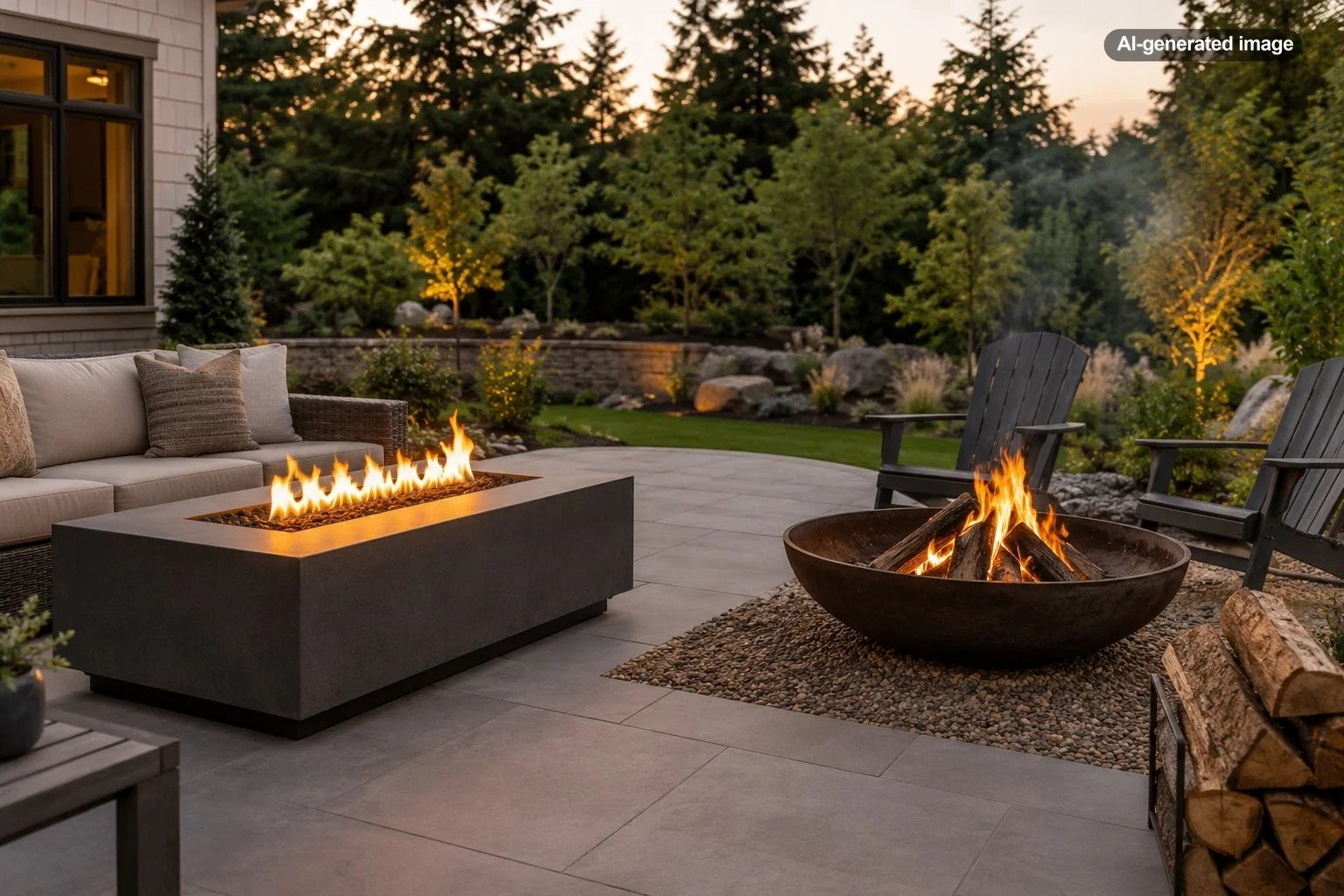
Gas Fire Pit Versus Wood-Burning Fire Pit: Which Is Better?
A gas fire pit is usually the better choice if you want quick ignition, easier cleanup, predictable operation, and less smoke. A wood-burning fire pit is usually better if the crackle, aroma, larger natural flame, and ritual of building a real fire are central to what you want from your backyard.
Neither is automatically better for every patio. Your best choice depends on how often you expect to use it, how much maintenance you tolerate, whether smoke is an issue for your household or neighbors, and what local fire restrictions allow.
Gas fire pit vs. wood-burning fire pit at a glance
| Consideration | Gas fire pit | Wood-burning fire pit |
|---|---|---|
| Starting the fire | Typically quick and controlled | Requires kindling, dry wood, and fire-building |
| Ambiance | Neat, steady flame | Natural crackle, changing flame, wood aroma |
| Smoke | Generally much less than wood | Produces wood smoke and fine particles |
| Cleanup | Usually minimal | Ash and partially burned material require attention |
| Fuel handling | Propane cylinder or permanent gas supply, depending on the unit | Firewood must be purchased, moved, stored, and kept dry |
| Control | Flame can usually be adjusted | Heat and flame depend on fuel load and fire conditions |
| Experience | Convenient outdoor gathering feature | More traditional campfire experience |
Gas wins when convenience matters most
The strongest argument for gas is simple: it removes much of the preparation surrounding a wood fire. With an appropriately installed and maintained gas fire pit, you do not need to stack kindling, coax damp logs into burning, manage a woodpile, or shovel ash after every few fires.
That difference can change how often a fire pit actually gets used. A household that wants an hour outside after dinner may appreciate a fire feature that can be started without turning the evening into a small project. It is particularly useful when the fire pit is part of a polished patio, outdoor kitchen, or conversation area where convenience matters as much as atmosphere.
Gas also provides a more predictable visual effect. Instead of waiting for logs to catch and periodically rearranging them, you generally get a steady flame that can be adjusted within the operating range of the specific appliance.
Wood wins when the fire itself is the event
Wood has an experiential advantage that gas does not perfectly imitate. A wood fire changes constantly. Logs settle, embers glow, flames rise and fall, and the familiar crackle becomes part of the evening.
If your idea of a fire pit involves gathering around it for several hours, tending the fire, roasting suitable foods where permitted, or recreating a campsite feeling at home, the additional work may not feel like a disadvantage at all. It may be the point.
Gas makes a fire easier to have; wood makes building the fire part of the evening.
That distinction is worth considering before focusing on finishes, shapes, or burner styles. A beautifully designed gas table can still disappoint someone who really wanted a campfire. Likewise, a rustic wood pit can become an unused patio ornament for someone who wanted ten-minute setup and ten-minute shutdown.
Smoke may be the deciding factor
Wood-burning fire pits create smoke containing gases and fine particles. The U.S. Environmental Protection Agency notes that children and teenagers, older adults, and people with heart or lung conditions can be particularly sensitive to particle pollution from wood smoke. The EPA also recommends considering neighbors and wind direction when using recreational wood fires.
The agency identifies natural gas and propane as cleaner alternatives to backyard wood burning because they reduce harmful air pollutants. That does not make an open gas flame risk-free, but it does give gas a significant advantage when the question is smoke rather than fire safety generally.
For a small urban backyard, closely spaced homes, or a patio frequently used by someone sensitive to smoke, this difference can outweigh the romance of burning logs.
Wood requires more fuel storage and cleanup
A wood-burning pit creates an entire small logistics system around itself. Firewood needs to stay reasonably dry, with enough air circulation to season properly. You need suitable kindling or an appropriate fire starter, somewhere to store the fuel, and a plan for dealing with cooled ash.
Gas avoids the woodpile and ash, but it has its own fuel considerations. Portable propane models require proper cylinder handling and storage, while permanently supplied natural-gas installations involve equipment and installation requirements that should follow the appliance manufacturer’s instructions and applicable local rules.
In other words, gas is lower maintenance at the moment of use, but it is not maintenance-free. Burners, hoses, regulators, valves, connections, enclosures, and other components should be kept in the condition required by the manufacturer.
Think about how the fire pit fits the patio
Gas fire pits tend to integrate easily into furniture-style layouts. Many are designed as tables, linear features, masonry installations, or built-in focal points that visually belong with seating and outdoor kitchens. Because there is no woodpile beside the seating area and no ash to manage afterward, the surrounding space can feel tidier.
Wood pits can look equally intentional, but their best settings often allow a little more visual looseness. A gravel gathering area, broad lawn edge, rustic stone patio, or generous backyard can make the firewood and fire-building ritual feel natural rather than inconvenient.
Safety should come before ambiance
Both options involve open flame, hot surfaces, and combustible fuel. The U.S. Consumer Product Safety Commission advises keeping a hose or fire extinguisher nearby for backyard fires and never using gasoline to start or restart a fire. It also advises against burning when wildfire risk is high.
Gas appliances introduce different hazards, including the possibility of problems involving fuel supply components. CPSC identifies outdoor decorative gas appliances such as fire pits within established gas-appliance safety standards. Follow the instructions for the exact appliance rather than assuming every gas fire pit can be installed or operated the same way.
Placement is equally important. Manufacturer-specified clearances, ventilation requirements, surface requirements, overhead restrictions, and fuel-storage instructions should determine where a fire pit goes. Do not assume that an open patio, covered porch, deck, pergola, or screened space is automatically suitable simply because the unit physically fits there.
Which type is better for you?
Before you decide
- Choose gas if you expect frequent short fires and want fast startup and minimal cleanup.
- Choose gas if reducing wood smoke around the patio is a major priority.
- Choose wood if crackling logs and the traditional campfire experience are important to you.
- Choose wood if tending the fire sounds enjoyable rather than inconvenient.
- Check local rules first if wildfire restrictions, neighborhood density, an HOA, or condo rules could affect either option.
- Check the installation requirements for the specific appliance before deciding that it will work in your intended location.
For many homeowners who simply want an attractive fire feature to use regularly, gas is the more practical choice. It asks less of you before and after each evening and avoids the smoke associated with burning wood.
For homeowners who consider the sound, scent, embers, and fire-building ritual essential, wood remains difficult to replace. The extra effort is worthwhile precisely because the fire is not merely another outdoor appliance.
Frequently asked questions
Does a gas fire pit give off as much heat as a wood fire pit?
There is no universal answer because heat output depends on the individual appliance, fuel input, design, weather, and how people are positioned around the flame. Compare verified specifications for the exact models you are considering rather than assuming one fuel type always produces more usable warmth.
Is a gas fire pit completely smokeless?
Gas avoids the wood smoke produced by burning logs, but an outdoor gas flame still produces combustion byproducts. Operate gas appliances only in locations and conditions allowed by the manufacturer and applicable rules.
Can I put either type of fire pit on a deck?
Do not decide based on fuel type alone. Deck suitability depends on the specific fire pit, the deck material and construction, clearances, heat protection requirements, overhead conditions, and manufacturer instructions, along with applicable local rules.
Can I burn any wood in a wood fire pit?
No. EPA guidance recommends dry, seasoned wood and advises against burning garbage, plastic, construction waste, pressure-treated wood, and similar materials that can create excessive or harmful smoke.
Which fire pit is easier to live with long term?
Gas generally requires less routine work because there is no firewood to season and move and no ash to remove. Wood can still be the better long-term choice for someone who genuinely enjoys the process of maintaining and building traditional fires.