
Is a Whole-House Dehumidifier Worth It in Florida?
For many Florida homes, a whole-house dehumidifier is worth considering, but it is not automatically the right first purchase. It makes the most sense when indoor relative humidity remains consistently high throughout the house even after the air-conditioning system, ductwork, drainage, ventilation, and building envelope have been checked.
The practical question is not simply whether Florida is humid. It is whether your particular home has a persistent, house-wide moisture load that the air conditioner cannot manage comfortably or consistently.
What a whole-house dehumidifier actually does
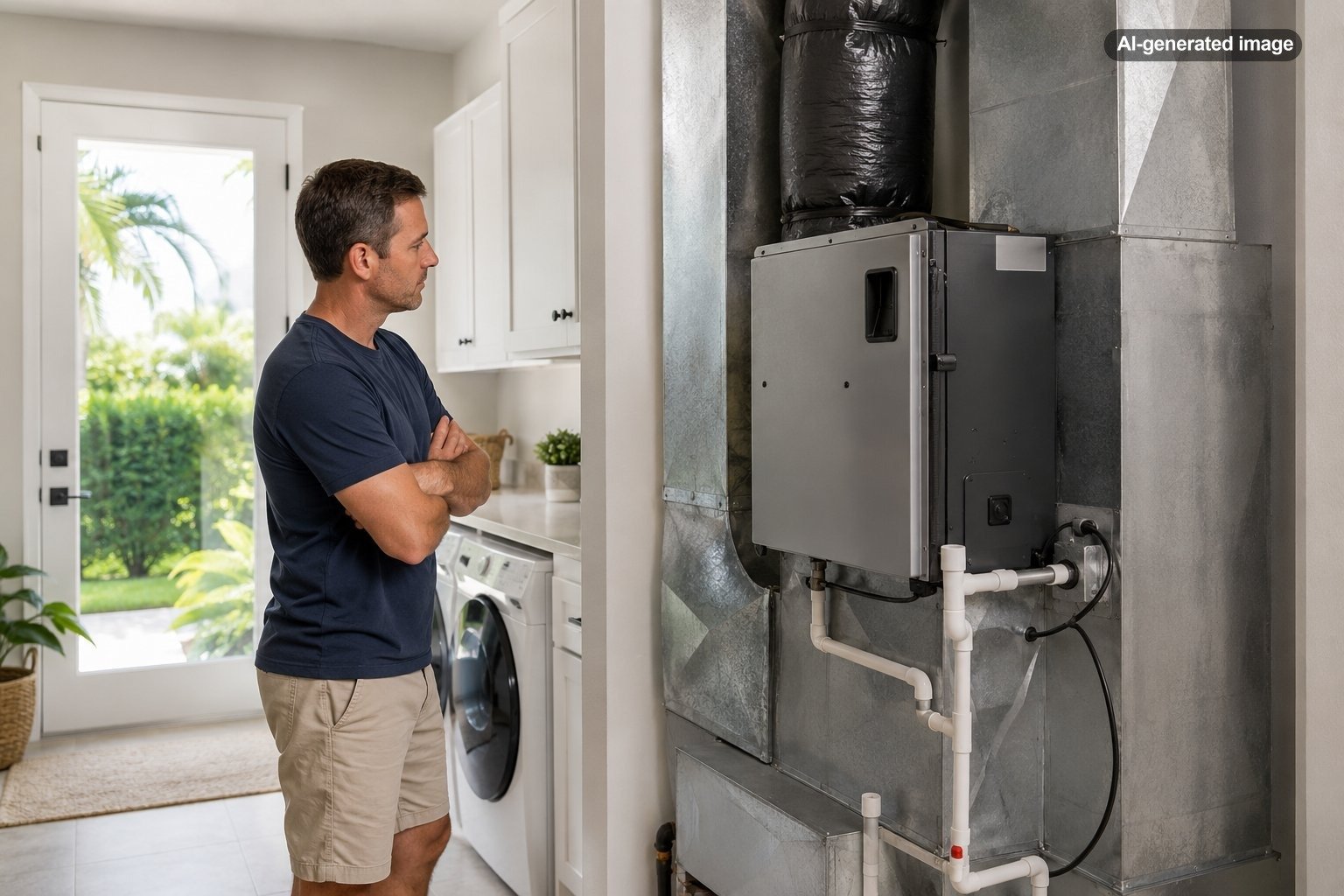
A whole-house dehumidifier removes water vapor from indoor air and usually connects to a home’s duct system or operates alongside the central HVAC equipment. Unlike a portable unit that treats one room, a properly designed whole-home system can address several rooms or most of the conditioned space.
The unit draws in humid air, cools it so moisture condenses, drains the collected water away, and returns drier air to the home. It can operate independently of the air conditioner’s normal cooling cycle, which matters during warm, muggy periods when the home needs moisture removal but very little additional cooling.
That last point is especially relevant in Florida’s shoulder seasons and during rainy weather. A house can feel sticky even when the thermostat temperature looks perfectly reasonable. Lowering the thermostat may force the air conditioner to run longer, but it can also make the rooms uncomfortably cold without solving the underlying control problem efficiently.
Why Florida homes can struggle with humidity
Air conditioners remove moisture while they cool, but their primary job is temperature control. Several common conditions can leave a Florida home cool enough yet still too humid.
- An oversized air conditioner: A unit that cools the house too quickly may shut off before completing a long enough cycle to remove adequate moisture.
- Air leakage: Gaps around doors, attic penetrations, recessed fixtures, utility openings, or poorly sealed return paths can pull humid outdoor air into the house.
- Leaky ducts: Duct leakage in an attic, garage, or other unconditioned area can introduce humid air or disrupt pressure balance.
- Ventilation problems: Bathroom fans that do not exhaust outdoors, heavy cooking moisture, or an improperly configured outdoor-air system can raise indoor humidity.
- Water intrusion: Roof leaks, plumbing leaks, wet crawl spaces, clogged condensate drains, and rainwater entry cannot be fixed by dehumidification alone.
- Low cooling demand: During mild but humid weather, the air conditioner may not run long enough to control moisture.
Signs that a whole-house system may be worthwhile
The strongest case is based on repeated measurements, not a vague sense that Florida feels humid. Place separate hygrometers in several representative areas, such as the main living space, primary bedroom, and a room farthest from the air handler. Check readings at different times of day for at least a week, including rainy days.
A professional evaluation becomes reasonable when several of the following conditions occur together:
- Relative humidity remains above about 55 percent for long periods in multiple rooms.
- The house feels clammy even when the thermostat is set to a comfortable temperature.
- Musty odors return after cleaning and no active leak is visible.
- Closets, cabinets, or rooms with limited airflow feel noticeably damper than the rest of the home.
- Condensation repeatedly appears on supply registers, cold pipes, windows, or other cool surfaces.
- The air conditioner reaches the thermostat setting quickly but humidity remains elevated.
- A portable dehumidifier collects substantial water every day and the problem is clearly not confined to one room.
ENERGY STAR notes that whole-home systems can be a strong fit for relatively well-sealed homes with central air when humidity readings remain consistently above 55 percent throughout the house. That is a useful screening threshold, not a substitute for an HVAC assessment.
When it may not be worth the expense
A whole-house unit is probably excessive when the moisture problem is small, localized, temporary, or caused by an obvious defect. A portable dehumidifier, exhaust fan improvement, air-sealing work, or straightforward repair may solve the issue with less equipment and complexity.
| Situation | More sensible first step |
|---|---|
| One damp bathroom | Verify that the exhaust fan is effective and vents outdoors |
| Humidity near one supply vent | Inspect duct insulation, air leakage, and condensation |
| Musty odor after a plumbing leak | Repair the leak and evaluate wet materials |
| Dampness only in a garage or storage room | Consider a properly sized portable unit for that space |
| High humidity throughout the conditioned house | Evaluate HVAC sizing, ducts, envelope leakage, and whole-home dehumidification |
| Humidity increased after HVAC replacement | Have system sizing, airflow, controls, and setup reviewed |
A dehumidifier should also not be treated as the automatic cure for visible mold. Florida health guidance emphasizes controlling the moisture source and inspecting for leaks, standing water, condensation, drain problems, and other causes. When visible growth is extensive, returns quickly, involves contaminated water, or appears inside HVAC components, qualified professional help may be appropriate.
The main advantages
Advantages
- More even humidity control across multiple rooms
- Moisture removal without substantially lowering the thermostat
- Automatic drainage instead of routinely emptying a bucket
- Potentially better comfort during mild, rainy, or low-cooling periods
- Can help reduce conditions that support mildew and moisture-related odors
Tradeoffs
- Requires professional sizing and installation
- Adds electrical use, filters, drainage, controls, and maintenance
- May expose or complicate existing duct-design problems
- Does not replace leak repair, drainage correction, or mold remediation
- Can be unnecessary if the central system is incorrectly configured or poorly maintained
Comfort is often the clearest benefit. Drier air can feel more comfortable at a slightly higher thermostat setting, but actual energy use depends on the house, equipment, controls, climate conditions, and occupant preferences. It would be unwise to assume a guaranteed utility-bill reduction without a home-specific analysis.
What to evaluate before installing one
What to do
- Measure humidity independently. Use more than one hygrometer and record readings in several rooms.
- Check for active water sources. Inspect plumbing, roof areas, windows, exterior walls, condensate drains, and the air handler.
- Have the HVAC system assessed. Ask about equipment sizing, runtime, airflow, refrigerant performance, coil condition, fan settings, and thermostat controls.
- Inspect the ducts. Leakage, poor insulation, restricted returns, and pressure imbalance can all contribute to moisture trouble.
- Review exhaust and ventilation. Confirm that bathrooms, dryers, and kitchen systems discharge as intended.
- Consider the building envelope. Air sealing may reduce the amount of humid outdoor air entering the house.
- Size the dehumidifier for the moisture load. Square footage alone is not enough. Layout, air leakage, occupancy, outdoor-air ventilation, and existing HVAC performance matter.
Questions to ask an HVAC contractor
Before you decide
- What indoor humidity readings were measured, and in which rooms?
- Has the existing air conditioner been checked for proper sizing and operation?
- Were the ducts tested or inspected for leakage and insulation problems?
- How was the dehumidifier capacity selected?
- Will it use dedicated ducts, connect to existing ducts, or operate in another configuration?
- Where will condensate drain, and what protects against a clogged drain or pump failure?
- How will the system be controlled and monitored?
- What filters and routine maintenance will the homeowner need to handle?
- Will the installation provide adequate access for future service?
- Could air sealing or ventilation corrections reduce the required capacity?
What indoor humidity should you aim for?
The U.S. Environmental Protection Agency advises keeping indoor relative humidity below 60 percent and ideally between 30 and 50 percent when possible. ENERGY STAR also describes 30 to 50 percent as a generally desirable range and warns that levels above that range may promote mold growth.
In a Florida home, the exact practical target may vary with comfort, equipment operation, outdoor conditions, and the risk of condensation on cool surfaces. Many homeowners find that maintaining readings around the upper 40s to low 50s provides a reasonable balance. Aggressively driving humidity lower is not always necessary and can increase equipment runtime.
Use the number as a control target, not as the only diagnostic clue. A room can display an acceptable reading while a concealed roof leak, wet wall cavity, clogged drain pan, or cold duct surface creates a localized moisture problem.
The best dehumidifier is the one installed after the house has been evaluated, not the one asked to hide a moisture problem.
So, is it worth it?
A whole-house dehumidifier can be a worthwhile improvement for a Florida home with persistent, verified, house-wide humidity that remains after the central air system and moisture sources have been properly evaluated. It is particularly useful when the home feels damp during periods when little cooling is needed.
It is not worth using as an expensive patch for an oversized air conditioner, leaking ducts, poor ventilation, water intrusion, or neglected maintenance. Start with measurements and diagnosis. When the evidence shows a genuine whole-home latent-moisture problem, a properly sized and integrated dehumidifier can provide steadier comfort and more reliable humidity control than a collection of portable machines.
Frequently asked questions
Can an air conditioner dehumidify a Florida home by itself?
Often, yes. A correctly sized and properly operating air conditioner removes moisture while cooling. Problems arise when cooling cycles are too short, airflow or controls are wrong, ducts leak, outdoor air enters excessively, or the house needs dehumidification when it needs little cooling.
Should I lower the thermostat to reduce humidity?
Lowering the temperature may lengthen air-conditioner runtime, but it can make the home too cold and does not correct system, duct, ventilation, or water-intrusion problems. Persistent humidity deserves diagnosis rather than an increasingly chilly thermostat setting.
Can a whole-house dehumidifier prevent mold?
It can reduce humidity conditions that support mold growth, but it cannot guarantee prevention. Leaks, wet materials, condensation, drainage problems, and hidden water intrusion must still be corrected.
Is a portable dehumidifier enough?
A portable unit may be sufficient for one room, a small enclosed area, or a temporary moisture problem. A whole-home system becomes more relevant when elevated humidity is measured throughout the conditioned space.
Does a whole-house dehumidifier need maintenance?
Yes. Maintenance commonly includes filter attention, drain inspection, keeping air pathways clear, and periodic professional service. Follow the installed equipment manufacturer’s instructions and include the dehumidifier in routine HVAC maintenance.