How Do You Stop a Pocket Door From Scraping?
A pocket door should slide into the wall with little effort, not announce every trip with a scrape or grinding sound. When a pocket door starts rubbing against the floor, door frame, or inside of its wall cavity, the problem is often related to alignment, a loose guide, or worn sliding hardware. Fortunately, several common causes can be identified without opening the wall or dismantling the entire door.
To stop a pocket door from scraping, first locate exactly where the door is making contact. Check for loose floor guides and visible obstructions, then inspect the door’s alignment and adjustable overhead hangers if they are accessible. The correct repair depends on whether the door is dragging underneath, rubbing sideways, or making noise inside the pocket.
First, Find Out Where the Pocket Door Is Scraping
The location of the scraping is the most useful clue. Pocket doors hang from an overhead track on rolling carriages, while guides near the floor help keep the panel centered. A problem in either area can make the door rub against a surface it was never meant to touch.
Open and close the door slowly while watching its edges. Use a flashlight to inspect the accessible opening, and stop if the door jams or requires unusual force.
| Where it scrapes | Likely explanation | First thing to check |
|---|---|---|
| Bottom edge against flooring | Door hangs too low or has tilted | Overhead hanger height and floor clearance |
| Side against the doorway trim | Door is off-center or trim has shifted | Bottom guides and visible trim |
| Inside the wall pocket | Obstruction, misalignment, or concealed hardware problem | Visible pocket opening and where resistance begins |
| Near the top of the opening | Hanger, track, or head clearance problem | Accessible overhead hardware |
| Only in certain weather | Possible moisture-related wood movement | Humidity, swelling, and sticking patterns |
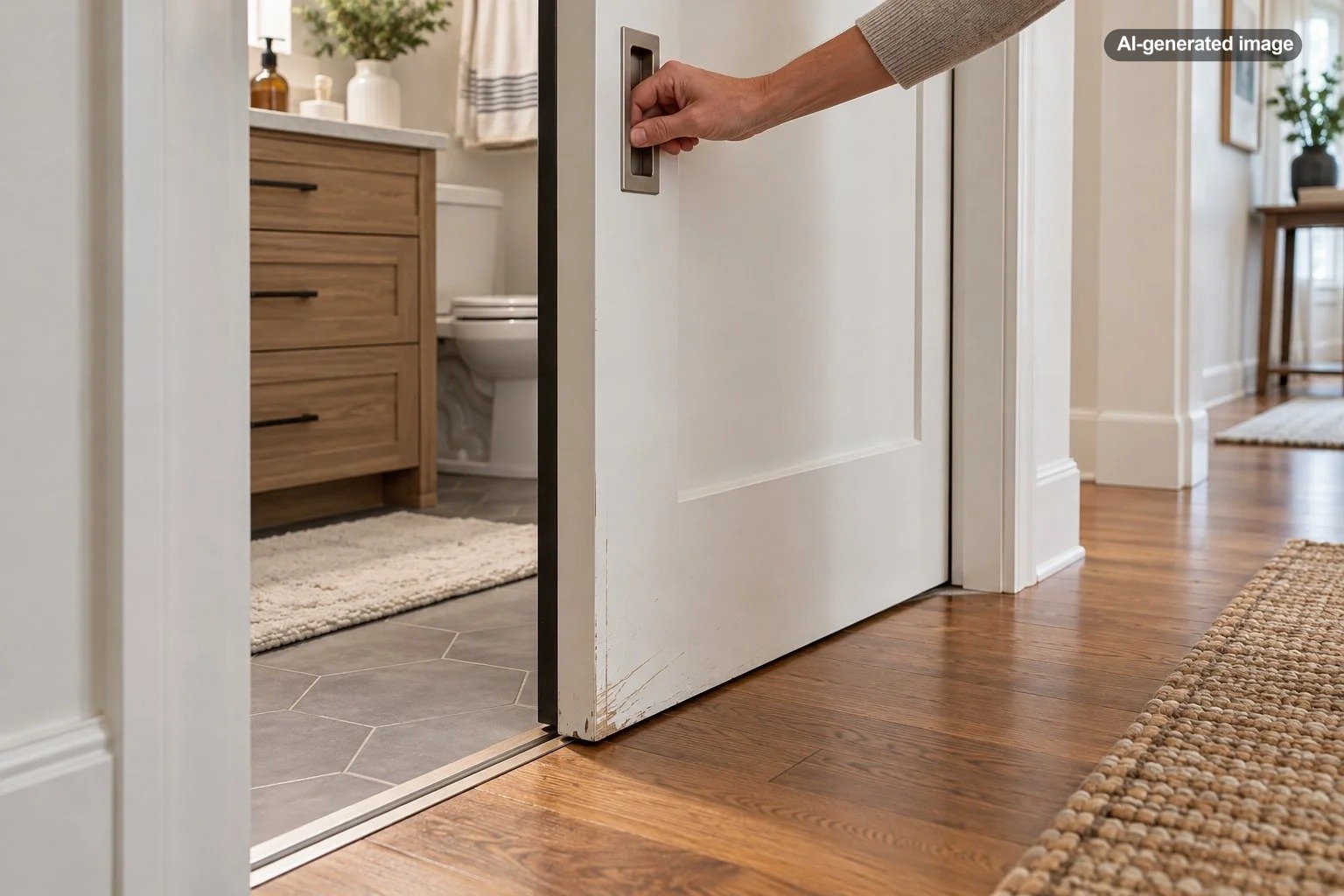
Look for polished rub marks on painted edges, scratches in the flooring, or compressed areas of the door finish. These marks can reveal contact that is difficult to see while the door is moving.
Check the Floor Clearance Before Adjusting Anything
A pocket door that drags on the floor may have settled slightly on its hangers. It may also have become too close to the flooring after new carpet, tile, or other floor covering was installed.
With the door partly extended, look along the gap beneath it. The clearance should be consistent enough for the panel to travel without touching the finished floor. There is no single appropriate gap for every pocket door because hardware designs, floor conditions, and installation requirements vary.
If the clearance visibly narrows toward one side, the door may be tilted rather than uniformly too low. That difference matters: raising both ends unnecessarily could create a new alignment problem at the top.
A thin piece of paper can sometimes help identify a contact point beneath the accessible portion of the door. Do not force paper or tools under a tightly jammed panel, particularly near delicate flooring.
Adjust the Overhead Hangers if the Door Is Hanging Too Low
Many pocket door systems have adjustable hanger assemblies that allow the panel’s height and angle to be corrected. Depending on the manufacturer, these may use threaded adjustment bolts, nuts, or another mechanism. Some systems require a special wrench, while others require trim removal to reach the hardware.
Before turning anything, identify the hardware if possible. The adjustment method should match the actual track and hanger system rather than a generic procedure.
What to do
- Inspect the overhead opening. Look for accessible hanger bolts and carriages. Do not remove structural trim or concealment panels merely to guess at the mechanism.
- Support the door. Have another adult help stabilize a heavy panel so its weight is not unexpectedly transferred to an adjustment component.
- Check for loose attachments. Follow the hardware instructions when inspecting hanger connections and locking mechanisms.
- Make a small adjustment. If the manufacturer permits in-place adjustment, raise or level the appropriate hanger in small increments.
- Test the entire travel. Slide the door gently from nearly closed to nearly open, checking floor clearance, top clearance, and alignment with the receiving jamb.
- Secure the adjustment. Confirm that any locking nuts or tabs are properly engaged according to the hardware instructions.
Do not assume that turning a bolt clockwise always raises the panel. Adjustment direction varies by hardware design, and turning the wrong component may loosen the hanger rather than reposition it.
Inspect the Bottom Guides if the Door Scrapes Sideways
Bottom guides keep a pocket door centered as it enters and exits the wall opening. Depending on the system, these guides may sit beside the panel, attach near the split jambs, or engage a groove in the bottom of the door.
If a guide loosens, shifts, breaks, or wears unevenly, the panel can swing sideways and rub against trim or the interior pocket framing.
Look for a loose or damaged guide
Examine the visible guides near the base of the opening. Check whether any guide is visibly crooked, cracked, or missing a fastener. Also look for accumulated dirt or an object trapped between the guide and panel.
Where accessible, tighten loose fasteners gently without stripping them. If the guide is adjustable, follow the manufacturer’s instructions to center the panel while leaving enough clearance for free movement. Guides should steady the door, not clamp tightly against its finished surfaces.
Check whether the door swings as it slides
A door that moves sideways when lightly pushed may have inadequate guidance or a hanger alignment problem. Observe the motion without pulling hard on the panel. Excessive movement can help explain why the door scrapes on one side but not the other.
What if the Pocket Door Scrapes Inside the Wall?
Scraping that begins only after the door enters the wall cavity deserves a different approach. The door may be contacting a displaced component, a piece of debris, or an obstruction protruding into the pocket.
Use a flashlight to examine the accessible opening while the door is extended. Look for visible debris, bent guides, or a loose component. If something is within easy reach and can be removed without forcing the door or inserting tools deeply into the cavity, clear it carefully.
Never blindly push a screwdriver, pry bar, or other rigid tool into the wall pocket. Concealed plumbing, wiring, fasteners, and door-frame components may be present. Do not remove drywall simply because the source of a noise cannot be seen.
Could the Track or Rollers Be the Problem?
Not all scraping comes from the door touching the surrounding surfaces. A worn or damaged rolling carriage can produce a rough scraping or grinding noise even when the panel appears to have adequate clearance.
A healthy system generally rolls smoothly with fairly consistent resistance. A damaged wheel, loose hanger, or distorted track may instead produce vibration, uneven movement, or a repeating noise at particular points along its travel.
Check the accessible section of the overhead track for obvious debris or damage. If the manufacturer allows cleaning, use a suitable soft brush or vacuum attachment without disturbing the rolling components.
Do not automatically apply oil, grease, or household lubricant to the track. Some rollers are designed to operate without added lubrication, and inappropriate products can collect dust or interfere with the mechanism. Consult the hardware documentation before applying anything.
If a carriage is broken, a roller is no longer seated correctly, or the track itself is bent, adjustment alone is unlikely to provide a durable repair. Replacing these components may require taking down the door and accessing the concealed portion of the track.
Check for Paint Buildup, Swelling, and New Flooring
Sometimes the door hardware is functioning properly, but the available clearance has changed.
Paint or finish buildup
Several layers of paint along the door edge or split jamb can narrow the space between surfaces. Look for an identifiable high spot before making adjustments. If excess finish is clearly causing contact, carefully correcting that local area and touching up the coating may resolve minor rubbing.
Avoid aggressively sanding an older painted surface, particularly when the home’s age raises the possibility of lead-based paint. Use appropriate lead-safe practices and qualified help when necessary.
Humidity-related wood movement
Wood doors can change dimensions as indoor humidity changes. A panel that slides freely during dry weather but rubs during humid periods may have swollen enough to reduce its clearance.
Check for visible swelling, damaged finish, or signs of moisture exposure. Address moisture problems before permanently removing material from a door. Cutting or sanding a swollen panel while it is temporarily expanded can leave an unnecessarily large gap when conditions become drier.
Flooring that was recently replaced
New flooring can change the available space beneath a pocket door. Thick carpet and padding are especially noticeable, but a new hard-surface floor can also create a clearance issue if the previous installation was already tight.
Measure the available clearance and compare it with the limits specified by the pocket door hardware. In some cases, raising the door is sufficient. In others, the system does not provide enough adjustment travel, and modifying the door may need to be considered.
Should You Trim the Bottom of a Scraping Pocket Door?
Shortening a door should generally be a later option, not the first repair. If the true issue is a loose hanger or an incorrectly positioned guide, cutting the door will not solve the mechanical problem.
Trimming may be appropriate when a new floor has reduced the available opening height and the panel cannot be adjusted sufficiently. However, the door’s construction matters. Hollow-core panels, veneered doors, and factory-finished products may have restrictions on how much material can be removed.
Before cutting, confirm the manufacturer’s limits, verify the finished clearance needed, and consider how the change would affect the bottom guide or any routed groove. A carpenter can help determine whether the panel can be shortened without weakening it or compromising its appearance.
When Should You Call a Professional?
Some pocket door problems are straightforward maintenance issues. Others involve heavy panels, concealed hardware, or conditions that are difficult to evaluate without partial disassembly.
Professional assessment is sensible when the door cannot be safely supported, the rollers appear damaged, the track is bent, or the panel repeatedly comes out of alignment. It is also appropriate when opening the wall or removing extensive trim would be necessary to locate the cause.
If the problem began after a major renovation or is accompanied by visible changes in surrounding walls and door openings, have the installation and surrounding conditions evaluated rather than assuming the rollers are solely responsible.
Renters should report hardware problems to their property manager rather than removing trim or altering the door. Condo owners may also need to confirm which parts of the opening they are permitted to modify.
How to Keep a Pocket Door Sliding Smoothly
Once the scraping has been corrected, a little routine attention can help preserve the adjustment.
- Keep the opening clean. Vacuum accessible dust and debris near the bottom guides and track opening.
- Operate the panel gently. Avoid slamming it into its stops or pulling sideways on the door edge.
- Watch for changing gaps. A gradually narrowing clearance may indicate that an adjustment is loosening.
- Check the guides periodically. Make sure visible components remain secure and free of debris.
- Control unnecessary moisture. In humid rooms, adequate ventilation and promptly addressing water problems can help protect wood finishes.
- Follow the hardware instructions. Use the specified cleaning and maintenance practices for the actual roller and track system.
Do not wait until the door becomes difficult to move before investigating a recurring scraping sound. Finding a small alignment issue early may prevent additional wear on the panel or surrounding trim.
Frequently Asked Questions
Why does my pocket door scrape only when I close it?
The door may be tilted slightly, causing its leading edge to contact the floor or receiving jamb as it reaches the closed position. Check the panel’s alignment and whether the floor clearance changes along its length. A mispositioned guide may also allow the door to drift sideways near the opening.
Can you adjust a pocket door without removing the trim?
Sometimes. Many systems have hanger adjustments accessible from the top of the doorway, but access depends on the hardware and finish trim design. Other installations require removing a specific piece of trim or temporarily detaching the panel. Identify the system before attempting disassembly.
Will WD-40 stop a pocket door from scraping?
It will not correct a door that physically rubs against flooring, trim, or wall framing. Lubrication also may not be recommended for the particular rollers or track. Correct alignment and clearance first, and use only maintenance products approved for the installed hardware.
Why did my pocket door suddenly start scraping?
A loose guide, shifted hanger, damaged roller, newly introduced obstruction, or recent flooring work may explain a sudden change. Inspect accessible components and determine whether the noise occurs throughout the slide or only in one position. Stop using the door if it becomes unstable or jams.
Can a pocket door be repaired without opening the wall?
Yes, many alignment and guide problems can be corrected using accessible hardware. However, a damaged concealed track, failed internal component, or obstruction deep inside the pocket may require additional access. The repair method depends on the original installation.
The Bottom Line
Stopping a pocket door from scraping starts with locating the contact point rather than immediately adjusting or cutting the panel. Floor scraping often points to a height or alignment issue, side rubbing suggests a guide or centering problem, and grinding inside the wall may involve concealed hardware or an obstruction.
Begin with careful observation, visible fasteners, and accessible guides. Make only hardware-approved adjustments, test the full sliding motion, and leave unstable doors or concealed repairs to a qualified professional. A properly aligned pocket door should move comfortably and quietly, allowing the doorway to do its job without drawing attention to itself.