
Do Air Purifiers Help With Mold Spores?
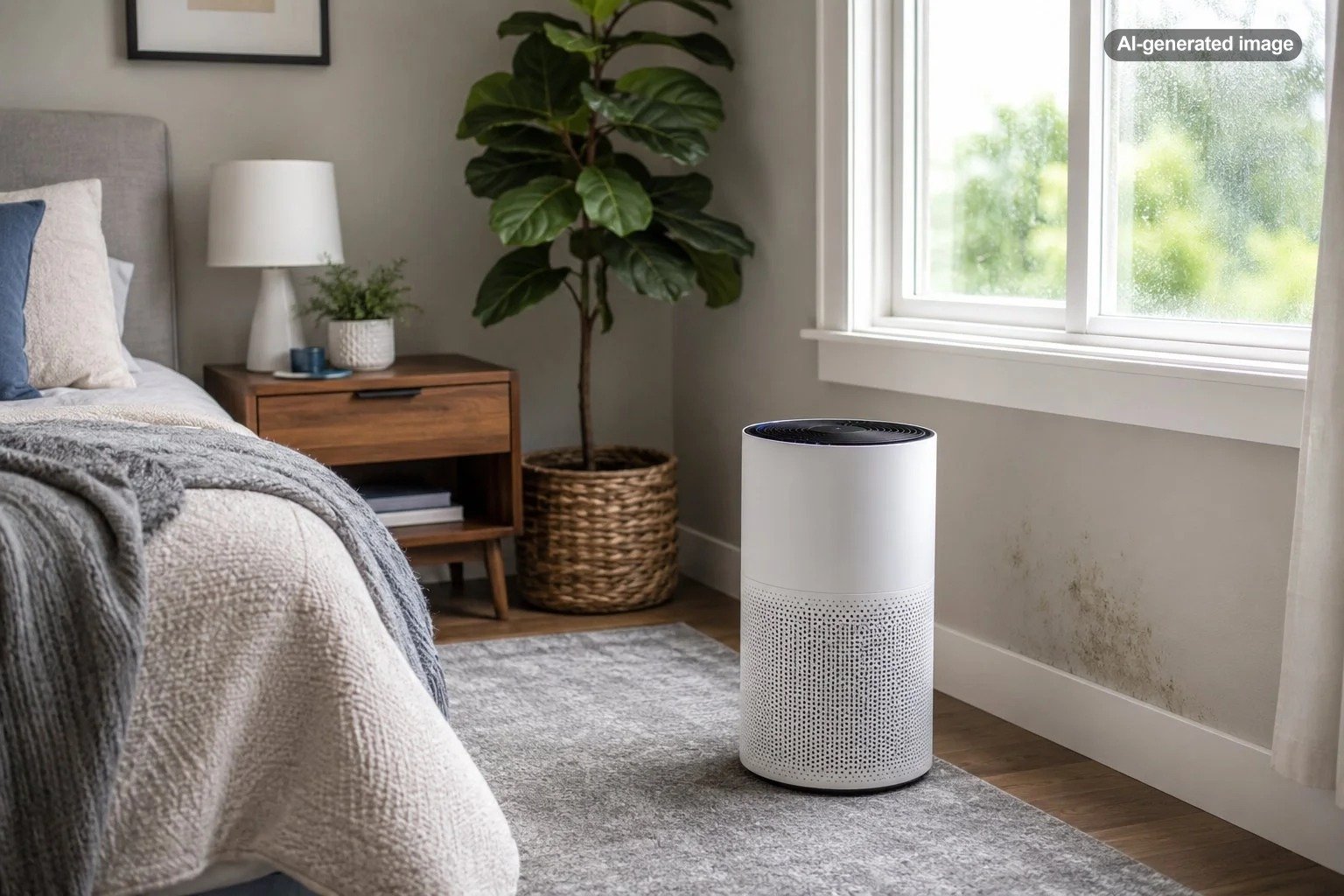
Yes, a well-sized air purifier with an effective particle filter can capture some mold spores that are floating through the air. It may reduce the number of airborne particles in a room and help collect spores disturbed during ordinary activity. However, an air purifier cannot remove mold growing on a wall, stop a plumbing leak, dry damp drywall, or correct the humidity that allowed mold to develop.
Think of filtration as supporting work rather than the main repair. The lasting solution is to find the moisture source, correct it, remove contaminated material appropriately, and dry the area. Without those steps, mold can continue producing new spores faster than an air purifier can collect them.
What an air purifier can do about mold spores
Mold reproduces by releasing microscopic spores. Some remain airborne for a time, while others settle into dust or land on furniture, flooring, textiles, and other surfaces. An air purifier works only on particles that travel through the machine, so it can capture a portion of the spores suspended in the air but cannot reach everything that has settled or is growing on building materials.
A true HEPA filter is designed to capture very small airborne particles. According to the U.S. Environmental Protection Agency, this type of mechanical filter can theoretically remove at least 99.97 percent of particles measuring 0.3 microns under the filter’s defined test conditions. The percentage describes filter-media performance, however, not a promise that a portable appliance will remove 99.97 percent of every spore from an actual room.
Real-world performance also depends on how much air the unit processes, the room’s size and layout, fan speed, operating time, filter condition, and where the purifier is placed. Air that slips around the room without entering the machine is not filtered.
An air purifier can collect airborne evidence of a mold problem, but it cannot repair the damp condition creating that evidence.
Why an air purifier cannot solve active mold growth
Active mold is fundamentally a moisture problem. A roof leak, plumbing drip, damp basement, poorly vented bathroom, condensation-prone wall, malfunctioning air-conditioning system, or persistently humid room can keep materials wet enough for mold to grow.
Filtration does not change those conditions. Even if a purifier captures spores continuously, growth can continue behind cabinets, beneath flooring, inside wall cavities, around windows, or on damp furnishings. The EPA advises that the key to controlling mold is controlling moisture: clean up the growth and correct the water problem, or the mold will probably return.
An air purifier also cannot reliably remove a musty odor when the odor source remains. Some machines include activated carbon or another gas-adsorbing material, which may reduce certain odors temporarily, but ordinary particle filtration is not designed to eliminate gases. A fading smell should not be treated as proof that the mold source is gone.
What type of purifier is most useful
For airborne mold spores, prioritize particle filtration, airflow, and appropriate sizing rather than novelty features. The following considerations matter most:
Before you decide
- Effective particle filtration: Look for a genuine HEPA filter or clearly documented performance for fine particles.
- Room-appropriate capacity: Select a unit intended for the actual room size rather than relying on a vague whole-home claim.
- Useful airflow at a tolerable noise level: A powerful purifier provides little benefit if it is always turned down or switched off because it is too loud.
- Available replacement filters: Check the filter model, replacement process, and expected upkeep before buying.
- No intentional ozone production: The EPA advises avoiding air cleaners that intentionally produce ozone because ozone is a lung irritant.
- Sensible controls: Automatic operation, timers, air-quality indicators, and filter reminders can improve consistency, but they do not replace moisture inspection.
Clean Air Delivery Rate, commonly called CADR, can also help compare how quickly portable units process particles. A higher rating generally indicates greater particle-cleaning capacity, but the machine still needs to be appropriate for the room and operated at a meaningful fan speed.
Affiliate disclosure: CraneManor.com may earn a commission when you purchase through links on this page. This does not affect the price you pay. Learn more.
For a typical occupied room, a HEPA air purifier with automatic mode can be a practical option when its stated capacity suits the room. Treat air-quality sensors and automatic settings as conveniences rather than mold detectors; consumer sensors generally do not identify whether a particle is a mold spore or locate the moisture source.
Where to place the purifier
Place the unit in the room where airborne particles are most concerning, while following the manufacturer’s clearance instructions. Keep the intake and outlet away from curtains, furniture, bedding, and walls that could obstruct airflow. A central, open position is often more useful than hiding the machine behind a sofa.
Do not place an ordinary portable purifier directly in a wet area, on damp flooring, or where it could contact dripping water. Electrical equipment should remain dry. If mold cleanup is actively disturbing materials, containment, protective equipment, and cleanup procedures matter more than simply positioning a consumer purifier beside the work.
Closing the room’s door may help a portable unit recirculate that room’s air more efficiently, but circumstances vary. During professional remediation, airflow and containment should follow the remediation plan so spores are not pushed into clean areas.
A practical response to suspected mold
Use a calm, source-first sequence rather than buying several devices and hoping one solves the problem.
What to do
- Look for moisture. Check for leaks, staining, condensation, damp carpet, wet cabinetry, peeling finishes, or persistently humid areas.
- Stop the water source. Repair the leak, improve exhaust ventilation, correct drainage, or use appropriate dehumidification.
- Dry wet materials promptly. The EPA recommends drying damp or wet materials within 24 to 48 hours when possible to discourage mold growth.
- Assess the affected area. Consider the size of the growth, the type of material, the water source, accessibility, and the health of household members.
- Clean or remove affected materials appropriately. Hard surfaces may often be cleaned and dried, while moldy porous materials may need to be discarded.
- Use filtration as support. Run a suitable purifier to collect airborne particles, and replace filters according to the manufacturer’s directions.
- Watch for recurrence. Continued odor, staining, condensation, or visible growth suggests that moisture remains unresolved.
Humidity control matters more than many purifier features
Mold does not need elaborate smart-home technology; it needs moisture. Indoor humidity that remains high can support condensation and dampness, particularly on cooler surfaces or in rooms with weak air circulation.
The EPA advises keeping indoor relative humidity below 60 percent and ideally between 30 and 50 percent when practical. A basic humidity monitor can help reveal patterns that are easy to miss. For example, a bathroom may appear dry by lunchtime but remain above 60 percent for hours after every shower.
A purifier and a dehumidifier perform different jobs. The purifier captures airborne particles. The dehumidifier removes water vapor from the air. In a humid basement or poorly ventilated room, dehumidification may be more important for preventing continued growth, provided leaks and water intrusion are also corrected.
What not to expect from UV, ionizers, and odor claims
Some air cleaners combine mechanical filtration with ultraviolet lights, ionization, plasma, or other electronic features. These additions should not distract from the basic questions: Does the unit move enough air, does it use effective particle filtration, and can it operate without producing problematic byproducts?
A purifier marketed as killing or neutralizing mold still cannot remove damp drywall, clean contaminated dust from surfaces, or repair a leak. Dead mold particles may also remain allergenic for some people, which is another reason that physically removing contamination matters.
Avoid machines that intentionally generate ozone. Ozone may be promoted with clean-sounding language, but it can irritate the lungs and is not a suitable substitute for source control, ventilation, and filtration.
When professional help makes sense
The EPA notes that homeowners can often handle a relatively small mold area of less than about 10 square feet, depending on the circumstances. Size is not the only consideration. Professional evaluation may be appropriate when water damage is extensive, the source is uncertain, porous building materials are affected, sewage or contaminated water is involved, or growth returns after cleanup.
HVAC concerns deserve particular care. If mold is suspected inside ducts or on heating and cooling components, ask a qualified service provider to show the affected area and explain the moisture source. Cleaning a system without correcting condensation, drainage, or insulation problems can lead to recurrence.
Mold cleanup can expose people to airborne particles and cleaning chemicals. The Centers for Disease Control and Prevention recommends appropriate respiratory, skin, and eye protection during cleanup and cautions that people with certain respiratory conditions or immune suppression should not perform the work.
Frequently asked questions
Will an air purifier remove all mold spores from a room?
No. It can collect some airborne spores that pass through its filter, but spores may remain on surfaces, in dust, inside furnishings, or within hidden building cavities. Some background mold spores are normally present indoors and outdoors.
Should I run an air purifier all day?
Continuous or extended operation generally processes more air than occasional use. Follow the manufacturer’s operating and maintenance instructions, keep airflow unobstructed, and remember that continuous filtration does not replace moisture correction.
Can an air purifier tell me whether I have mold?
No. A general air-quality sensor may respond to changes in particle levels, but it does not reliably identify the particles as mold or locate their source. Visible growth, moisture, staining, leaks, and recurring musty odors are more useful reasons to investigate.
Can I use a purifier instead of a dehumidifier?
No. A purifier filters particles, while a dehumidifier lowers moisture in the air. A damp room may benefit from both, but neither appliance repairs active water intrusion.
Does a musty smell mean mold is present?
A persistent musty odor can justify inspecting for dampness or hidden growth, but odor alone does not identify the material, location, or extent of the problem. Investigate moisture rather than masking the smell.
The bottom line
Air purifiers can help with airborne mold spores, especially when they use effective particle filtration, are properly sized, and run consistently. Their role is limited, though. They clean air that passes through the machine; they do not clean mold from surfaces or prevent damp materials from producing more spores.
For a durable result, correct leaks and humidity, dry wet materials, remove mold appropriately, and use filtration as an additional layer. That approach is less dramatic than expecting one appliance to solve everything, but it is far more likely to keep the problem from returning.
Sources & further reading
- U.S. Environmental Protection Agency: Guide to Air Cleaners in the Home
- U.S. Environmental Protection Agency: What Is a HEPA Filter?
- U.S. Environmental Protection Agency: A Brief Guide to Mold, Moisture and Your Home
- Centers for Disease Control and Prevention: Mold Clean Up Guidelines and Recommendations