
How Do You Improve Air Quality During Home Renovations?
Home renovations can improve the way a house looks and functions while temporarily making its indoor air considerably harder to manage. Cutting, sanding, demolition, painting, flooring work, adhesives, sealants, and simple foot traffic through a construction zone can introduce dust, particles, odors, and chemical emissions into occupied rooms.
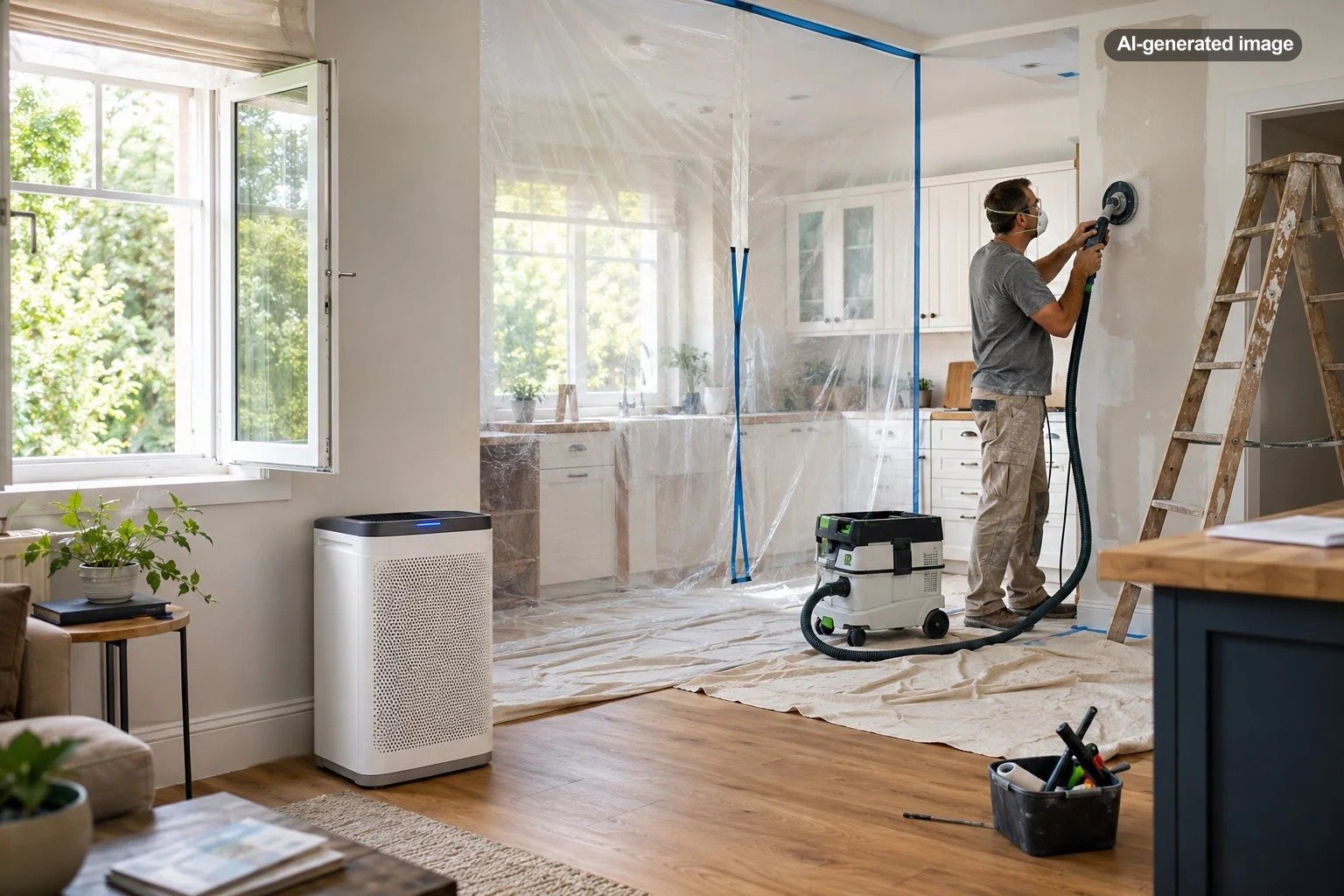
The most effective approach is layered: control pollutants where they are created, separate the work zone from the rest of the house, ventilate appropriately, filter airborne particles, and clean without simply stirring settled dust back into the air. Air cleaning can help, but it should support source control and ventilation rather than replace them. The U.S. Environmental Protection Agency specifically recommends controlling pollutant sources and using barriers and local exhaust ventilation during remodeling projects.
Start by controlling pollution at the source
The cleanest renovation dust is the dust that never spreads through the house. That makes source control more important than trying to capture every particle after it becomes airborne.
Ask contractors how they plan to control dust during cutting, grinding, sanding, drilling, and demolition. Depending on the task, appropriate methods can include tool-connected dust collection, local exhaust, wet methods designed for the material and operation, and immediate removal of debris instead of allowing piles of dusty material to accumulate. Work involving concrete, brick, mortar, stone, and similar materials deserves particular attention because these materials can contain crystalline silica. OSHA requires specific exposure-control practices for workers who may encounter respirable crystalline silica during construction.
Source control also applies to chemical emissions. Paints, coatings, adhesives, solvents, sealants, cabinetry, flooring, and other materials can release volatile organic compounds, commonly called VOCs. When appropriate for the product and project, select lower-emission materials, follow manufacturer ventilation instructions, keep containers closed when they are not being used, and avoid storing open or poorly sealed chemicals near HVAC equipment.
Separate the construction zone from occupied rooms
A renovation becomes much easier to manage when the dusty space is treated as a separate zone rather than an extension of the living area. Close doors where possible and use properly installed temporary barriers at larger openings. EPA remodeling guidance specifically discusses barriers such as taped plastic sheeting to help prevent pollutants from spreading through a home.
Think beyond the doorway. Workers carrying debris through a hallway, uncovered piles of demolished material, repeatedly opening a barrier, and tracking dust on shoes can undermine otherwise careful containment. Establish a predictable path between the work area and the exterior, cover or protect surfaces along that path when appropriate, and remove debris in a way that minimizes its movement through occupied rooms.
Manage ventilation instead of simply opening everything
Fresh outdoor air can dilute indoor pollutants, but renovation ventilation should be deliberate. Opening windows may be useful during painting or other work when outdoor conditions are suitable and the product instructions allow it. Local exhaust that directs contaminated air outdoors can also help keep pollutants from migrating into the rest of the house.
Do not assume that running every fan in the house automatically improves the situation. Air moves according to pressure differences. A fan positioned poorly can pull contaminated air from the work zone into a clean room instead of sending it outside. The goal is to move pollutants away from occupied areas, not merely move more air.
Weather matters as well. Outdoor smoke, high particulate pollution, heavy pollen, extreme heat, or high humidity can make wide-open-window ventilation less desirable. When natural ventilation is unsuitable, a contractor or HVAC professional can help determine how to manage airflow without spreading renovation contaminants through the home.
Use filtration as a supporting layer
Portable air cleaners can remove airborne particles, and EPA advises choosing a unit with a clean air delivery rate, or CADR, appropriate for the size of the room or area being treated. Many high-performing particle air cleaners use HEPA filtration. A unit that is too small for the space may provide less useful particle removal even if the filter itself is efficient.
Placement also matters. A portable air cleaner tucked behind furniture or placed where its intake and outlet are obstructed cannot move air as effectively as one positioned according to its manufacturer’s instructions. Running the unit for longer periods generally allows more air to pass through its filter.
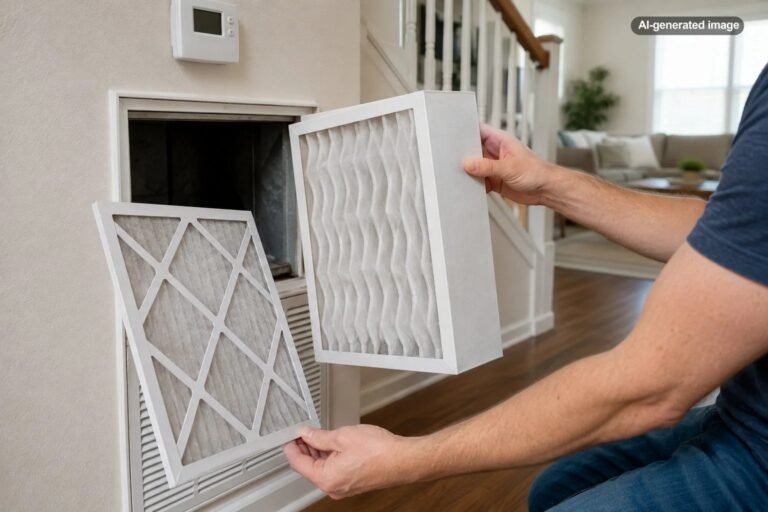
Central HVAC filtration can be another useful layer, but a higher-efficiency filter is not automatically compatible with every system. Use a filter your equipment is designed to accommodate, and consult the equipment documentation or an HVAC professional before making a substantial change in filtration. Avoid treating the home’s HVAC system as a construction-dust collector unless the project plan specifically accounts for it.
Keep renovation dust out of the HVAC system
Supply and return openings can become pathways for construction dust. The correct treatment depends on whether the HVAC system must operate during the project, which rooms it serves, and how airflow is being managed. Discuss the plan before demolition begins rather than improvising after visible dust has already reached vents and returns.
If portions of a system are intentionally isolated during work, the approach should not create moisture, temperature, combustion-safety, or equipment problems. Major HVAC changes are better handled with professional guidance, particularly when the renovation affects ducts, mechanical rooms, exhaust systems, or combustion appliances.
Clean dust without repeatedly redistributing it
Dry sweeping can send fine settled material back into the air. For renovation cleanup, use methods suited to the debris and surface, with HEPA-equipped vacuuming where appropriate. Follow with suitable damp-cleaning methods on surfaces that tolerate moisture. Clean horizontal ledges, trim, window sills, floors, and other places where fine dust tends to settle rather than judging cleanliness only by what is visible at eye level.
Frequency matters. A major demolition phase may justify repeated cleanup rather than waiting until the entire remodel is finished. Removing accumulated debris and dust reduces the reservoir available to be tracked or disturbed again as workers move through the space.
What to do
- Identify which renovation tasks will create dust, fumes, or strong odors before work begins.
- Establish containment and a debris-removal path between the work zone and the exterior.
- Control dust at cutting, sanding, grinding, drilling, and demolition operations whenever practical.
- Plan ventilation so contaminated air is directed away from occupied rooms.
- Use appropriately sized particle filtration as an additional control rather than the sole solution.
- Remove debris and clean accumulated dust throughout the project, not only on the final day.
- Inspect and clean the area thoroughly before removing containment and returning it to normal use.
Choose renovation materials with indoor air quality in mind
Material selection can influence air quality long after demolition dust has settled. Paints, varnishes, adhesives, cleaning products, and many other household and construction products can emit VOCs. Lower-emission options may be worth considering, particularly in bedrooms, nurseries, home offices, or projects where the occupants will remain nearby.
However, a low-VOC label should not replace the product’s actual safety and application instructions. Different products have different ventilation, curing, storage, and disposal requirements. Follow the manufacturer’s directions and allow finishes, adhesives, and coatings the necessary drying or curing time before treating a room as fully ready for normal occupancy.
Take extra precautions before disturbing older materials
Some renovation projects require more than ordinary dust control. In homes built before 1978, disturbing painted surfaces can create lead-contaminated dust. EPA’s Renovation, Repair and Painting program establishes requirements for paid renovation work that disturbs painted surfaces in covered pre-1978 homes and child-occupied facilities. Homeowners hiring contractors for applicable work should look for firms and renovators that meet the relevant lead-safe requirements.
Asbestos is another reason not to begin demolition blindly. Certain older flooring, ceiling materials, insulation, pipe wrap, siding, and other building products may contain asbestos. EPA recommends professional assessment when suspect material is damaged or a renovation will disturb it. Visual inspection alone cannot reliably confirm whether a suspect material contains asbestos.
Protect the clean part of the house too
Air-quality planning should include the people and rooms outside the renovation zone. Keep children, pets, and unnecessary occupants away from active construction areas. Close off bedrooms and other clean spaces when practical, and avoid storing clothing, bedding, upholstered furniture, or frequently used household items where renovation dust can settle on them.
If the project is extensive, consider whether remaining in the house during the dustiest or most chemically intensive phases is sensible for the household. People with health concerns or heightened sensitivity should discuss their individual circumstances with an appropriate health professional rather than relying on a general remodeling article to determine what level of exposure is acceptable.
Clean renovation air comes from controlling the mess before it travels, not from trying to filter an entire construction project after the fact.
Frequently asked questions
Should I run a portable air purifier during a renovation?
It can be useful for reducing airborne particles when it is appropriately sized and operated, but it should supplement containment, source control, ventilation, and cleanup. It is not a replacement for proper dust control at the work itself.
Should I open windows while remodeling?
Opening windows can increase ventilation when outdoor air conditions are suitable, but airflow should carry pollutants away from occupied areas. Follow manufacturer instructions for products such as paints, adhesives, and sealants, and consider outdoor smoke, pollution, temperature, and humidity before relying on open windows.
Does HEPA filtration remove renovation odors?
HEPA filtration is primarily intended to capture particles. Odors and gaseous pollutants may require source removal, ventilation, or filtration specifically designed for gases. No air cleaner should be treated as a substitute for controlling the pollutant source.
When should air-quality planning begin?
Before demolition. Containment, ventilation, debris routes, dust-generating operations, HVAC considerations, material choices, and possible lead or asbestos concerns are much easier to manage before walls are opened and dust is already moving through the house.
Sources & further reading
- U.S. EPA: Best Practices for Indoor Air Quality when Remodeling Your Home
- U.S. EPA: Guide to Air Cleaners in the Home
- U.S. EPA: Volatile Organic Compounds’ Impact on Indoor Air Quality
- U.S. EPA: Lead Renovation, Repair and Painting Program
- U.S. EPA: Asbestos and Home Remodeling
- OSHA: Respirable Crystalline Silica in Construction