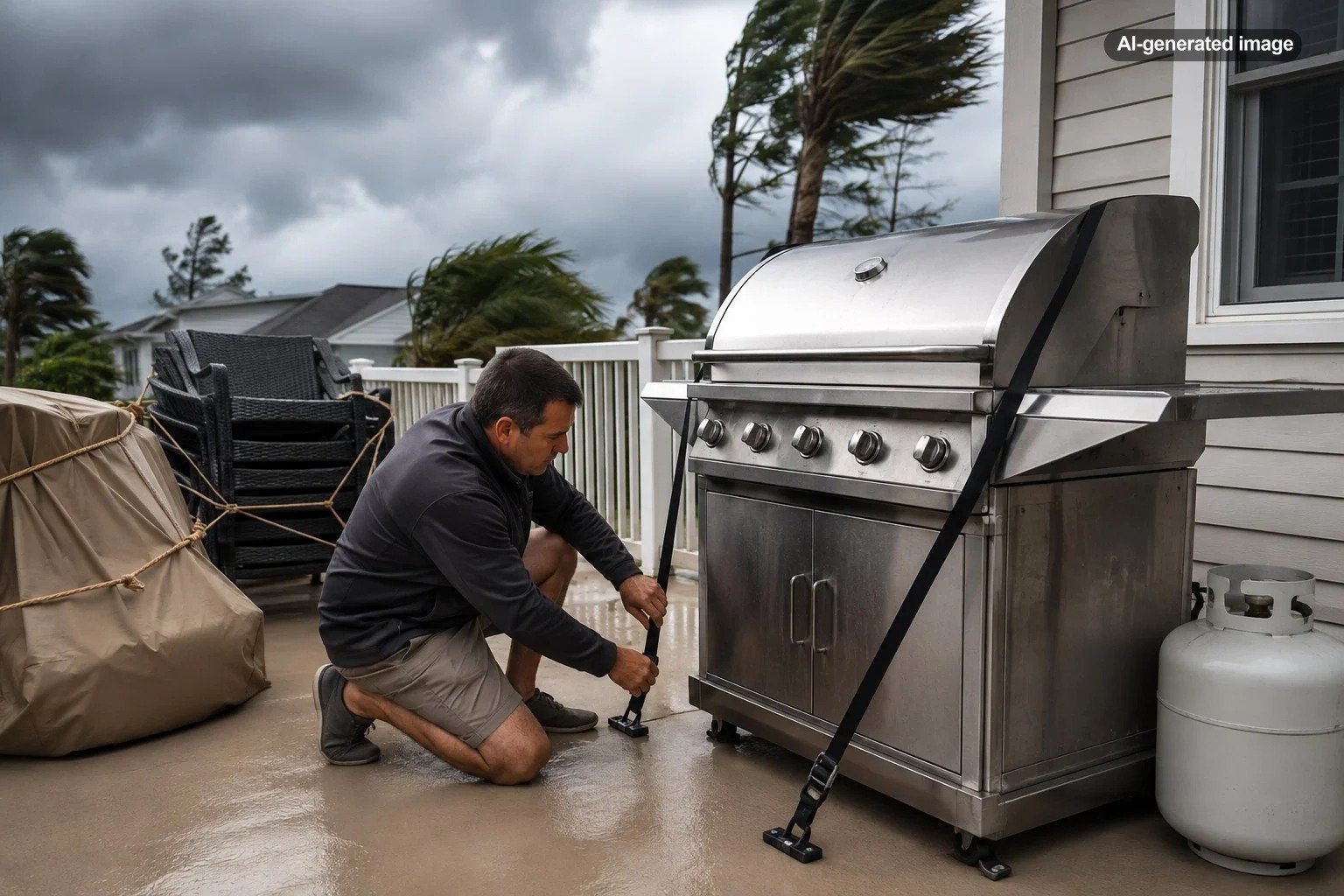
How Do You Secure a Grill Before a Hurricane?
To secure a grill before a hurricane, shut it down early, remove loose accessories, address its fuel safely, and either relocate the grill to an appropriate protected location or anchor its frame to a substantial fixed point. Do not count on locked casters, a fitted cover, or the grill’s weight to keep it in place.
The fuel type matters. A propane cylinder must remain upright and outdoors rather than being moved into a garage, shed, basement, or home. Charcoal must be completely extinguished, while pellet and electric grills should be cool and disconnected from power. If evacuation orders or worsening weather leave too little time to complete the work safely, leave the grill alone and follow local emergency instructions.
Start before the wind arrives
A hurricane watch is a prompt to deal with the patio, not an invitation to squeeze in one last cookout. A grill can remain dangerously hot long after the food is finished, and rushing around hot metal, grease, ash, or propane as rain begins is an avoidable risk.
Begin by reading the grill’s manual for shutdown, cylinder disconnection, moving, and storage instructions. Photograph the model and serial labels if they are still legible, then remove or firmly stow anything that can detach: warming racks, rotisserie rods, side shelves designed to lift off, tool hooks, utensils, covers, grease cups, thermometers, and removable prep bins. Secure the lid only after the grill is fully cool.
What to do
- Stop using the grill early enough for every surface and fuel component to cool completely.
- Turn off the appliance and close its fuel supply according to the owner’s manual.
- Remove loose parts and clean out material that could spill, blow away, or retain heat.
- Choose between protected relocation and outdoor anchoring based on the grill, fuel, structure, and local rules.
- Complete the work before tropical-storm-force winds, flooding, or evacuation activity reaches the area.
Handle propane, natural gas, charcoal, and pellets differently
Propane grills
Turn every burner control off, then close the cylinder valve. If the manual allows the cylinder to be disconnected, follow its procedure rather than forcing a tight fitting or improvising with tools. Never attempt to repair a valve, regulator, hose, or cylinder as part of storm preparation.
A portable propane cylinder should be kept outside, upright, and protected from tipping, rolling, impact, ignition sources, and excessive heat. The Propane Education & Research Council specifically warns against using or storing cylinders in enclosed areas such as garages, sheds, basements, and tents. An apparently empty cylinder can still contain propane, so empty does not mean indoor-safe.
Use a purpose-made cylinder stabilizer or a secure strap arrangement that does not press on, cover, or damage the valve and relief device. The location must remain ventilated and should not be in a low spot where water collects. If your property has no suitable outdoor location, contact the propane supplier or local fire authority before the storm instead of inventing a storage arrangement.
Natural gas grills
Turn off the grill controls and close the appliance shutoff valve if the manufacturer directs you to do so and the valve is readily accessible. Do not disconnect rigid piping, alter the home’s gas system, or use the grill’s flexible connector as a restraint. A built-in outdoor kitchen may look immovable, but doors, access panels, side burners, and loose equipment can still become windborne debris.
If the grill or gas connection must be disconnected to protect it, arrange qualified service before the storm. This is especially important when corrosion, a damaged connector, an uncertain shutoff, or previous flood exposure is present.
Charcoal grills
Allow coals and ash to become completely cold before moving or securing the grill. Do not pour hot ash into a plastic trash can, leave it in a paper bag, or bring a grill containing smoldering material into an enclosed space. Remove bags of charcoal, starter products, matches, and loose chimney starters from the patio and store them as their labels direct.
A lightweight kettle grill is often easier to disassemble and place in suitable protected storage than it is to anchor reliably. Remove the cooking grate, ash catcher, lid, and wheels if the design permits, then keep the parts together so none can become debris.
Pellet and electric grills
Complete the manufacturer’s shutdown cycle, let the grill cool, and unplug it before moving or anchoring it. Protect the plug and controller from water without creating an enclosed pocket that can hold moisture. Emptying pellets may be sensible if the manual recommends it, since pellets exposed to moisture can swell and obstruct the feed system.
Relocate the grill only to a genuinely suitable place
Moving the grill out of the wind is usually preferable to leaving a portable appliance exposed, but the destination must be appropriate for the grill and its fuel. A clean, fully cool grill body may be eligible for storage in a protected structure when the manufacturer’s instructions permit it. A propane cylinder is different: it stays outdoors in a secured, ventilated location.
Never operate a gas, charcoal, or pellet grill inside a home, garage, carport, tent, or other enclosed or partly enclosed space during a power outage. Opening a garage door does not turn the garage into a safe grilling area. Fire and carbon monoxide remain the concerns, even when the weather makes outdoor cooking inconvenient.
For condos, apartments, and townhouses, building rules and local fire codes may limit where grills and cylinders can be used or stored. Contact management early. A shared hallway, stairwell, mechanical room, or evacuation route is not an acceptable overflow storage area.
Anchor an outdoor grill by its frame, not its accessories
When a grill cannot be relocated, secure the structural frame to a sound fixed anchor using exterior-rated straps, cable, chain, or hardware appropriate for the expected load and environment. Connect at low, strong points on the frame so the restraint limits both sliding and overturning. Use more than one direction of restraint where practical; a single loose tether can allow the grill to swing and strike nearby surfaces.
Do not attach restraints to side tables, lid handles, control knobs, thin sheet-metal panels, plastic shelves, hoses, regulators, or the propane cylinder valve. Do not tie the grill to a tree, lightweight fence, decorative screen, loose railing, drainpipe, or patio furniture. Those objects may fail first and create a larger moving assembly.
An anchor is only as dependable as the material holding it. Fasteners placed into cracked masonry, loose pavers, rotted wood, or an unverified railing may provide little protection. Permanent anchors also involve waterproofing, corrosion, structural, lease, HOA, and local-code considerations. Have a qualified contractor evaluate the location when the supporting structure is uncertain.
Salt air and repeated rain can weaken ordinary hardware. Coastal installations generally benefit from corrosion-resistant components selected for the site, but material compatibility matters: mixing metals can accelerate corrosion. Inspect reusable anchors and straps before every storm rather than assuming last season’s setup is still sound.
Reduce the hazards around the grill
The grill is only one item in the outdoor preparation zone. Move utensils, mats, cushions, umbrellas, planters, folding furniture, toys, hoses, and small decor indoors when safe to do so. FEMA advises bringing in items the wind can pick up and securing outdoor objects that are unsafe to bring inside, including barbecues and gas canisters.
Keep the secured grill away from windows, glass doors, pool enclosures, vehicles, emergency exits, and equipment that must remain accessible. Avoid a location vulnerable to storm surge, fast-moving runoff, or falling branches. Do not block shutters or the path needed to leave the property.
Built-in grills need attention as well. Latch access doors, remove loose cooking components, secure removable panels, and clear nearby countertops. Do not drill into a masonry island, countertop, roof deck, or exterior wall without understanding the structure and its waterproofing.
Know when to stop
Storm preparation should never compete with an evacuation order. Stop working outdoors when local officials direct residents to leave, when winds make it difficult to control the grill or hardware, when lightning is nearby, or when water begins covering the work area. The grill is replaceable; the time needed to reach safety may not be.
Call a qualified professional before the storm if the grill is connected to a fixed gas line, the shutoff does not work smoothly, permanent anchoring may affect the structure, or the appliance is too heavy to move safely. Contact the propane supplier or fire department for a leaking, damaged, badly corroded, or uncertain cylinder.
Inspect everything before using the grill again
Wait until officials say conditions are safe before returning or going outdoors. Approach cautiously and look for flooding, fallen electrical lines, sharp debris, displaced fuel cylinders, damaged gas piping, and the odor of propane. Do not light the grill merely to see whether it still works.
For a gas grill, inspect the cylinder, regulator, hose, connections, burners, control valves, and frame. CPSC guidance advises checking hoses for cracking, brittleness, holes, and leaks. Follow the manufacturer’s leak-test procedure whenever reconnecting a propane cylinder. If bubbles persist during an approved soapy-water test, close the valve and contact the propane retailer or a qualified professional.
A grill exposed to floodwater, saltwater, impact, fire, or visible structural damage deserves professional evaluation before reuse. Electrical and pellet grills should remain unplugged if the controller, motor, wiring, plug, or internal components became wet. Do not bypass damaged safety devices or straighten questionable gas components for a quick meal.
Frequently asked questions
Can I put my propane grill in the garage during a hurricane?
Do not move a propane cylinder into the garage. A fully cool grill body may be stored in an appropriate protected location only when its manufacturer permits it and the cylinder has been handled separately. Never operate the grill in the garage.
Is locking the grill’s wheels enough?
No. Caster locks help prevent ordinary rolling but do not address overturning, component failure, or extreme wind. Relocation or a properly designed restraint attached to the frame provides a more complete approach.
Should I disconnect the propane tank?
Follow the grill manufacturer’s instructions. Whether connected or disconnected, close the cylinder valve and keep the cylinder upright, outdoors, ventilated, and secured against movement. Never disconnect a damaged or leaking system yourself.
Can I chain the grill to a deck railing?
Only if a qualified evaluation confirms that the railing and connection are suitable for the load, which should not be assumed. Many railings are not designed as hurricane anchors, and damaging one could create additional debris or a fall hazard.
Can I use the grill for cooking after the power goes out?
Only outdoors, after the storm has passed, in a well-ventilated area away from the home and combustible materials, and only after the grill and fuel system have been inspected. Never use a grill indoors or in a garage, porch, carport, or other enclosed or partly enclosed location.
Sources & further reading
- Federal Emergency Management Agency: Six Ways to Prepare Your Home for a Hurricane
- Propane Education & Research Council: Safety Guide for Portable Propane Cylinders
- U.S. Fire Administration: Outdoor Fire Safety
- U.S. Consumer Product Safety Commission: Summer Grill Safety
- Florida Division of Emergency Management: Hurricane Retrofit Guide – Equipment and Loose Objects