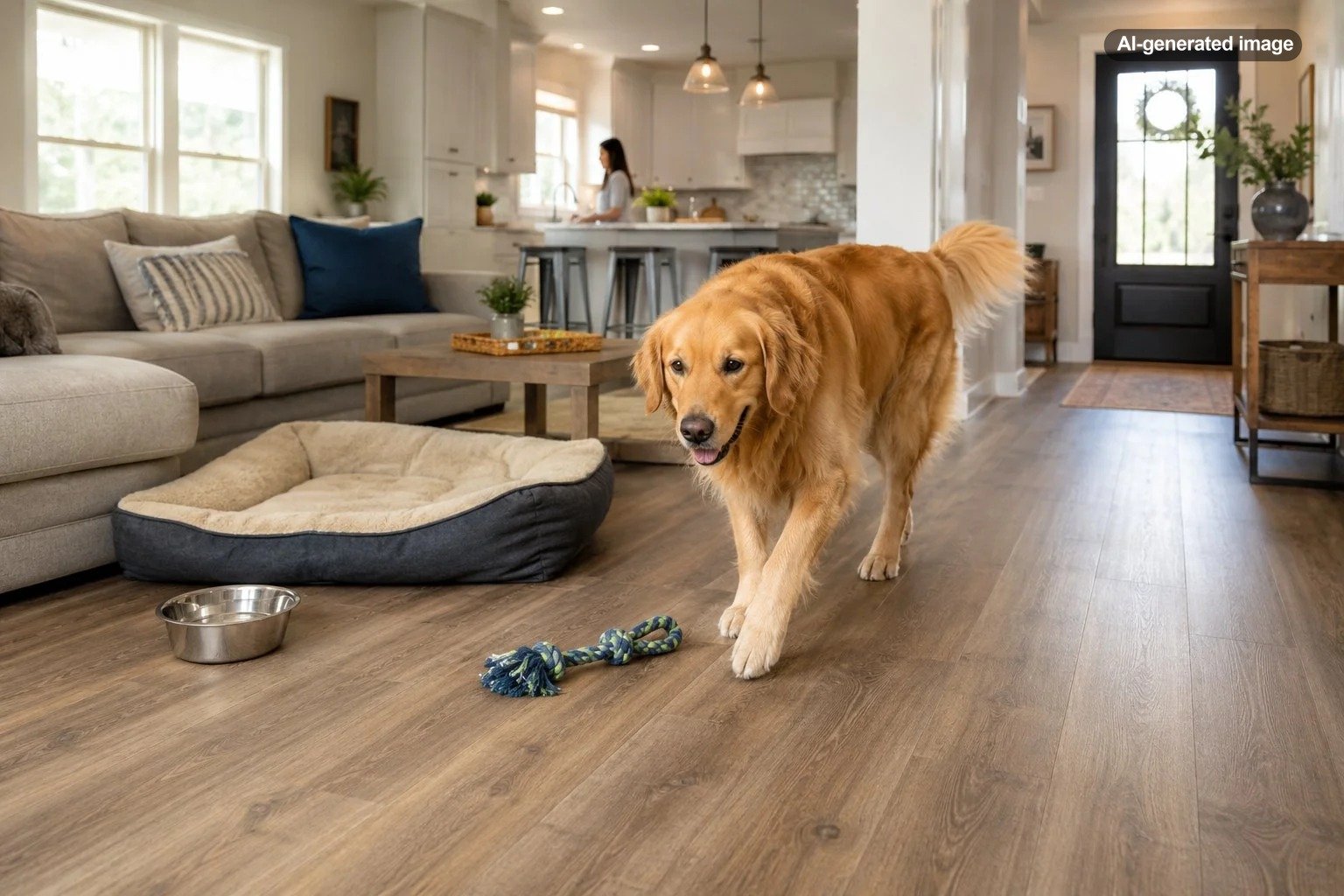
What Is the Best Flooring for Homes With Large Dogs?
For most homes with large dogs, high-quality luxury vinyl plank is the best all-around flooring choice. It balances moisture resistance, easy cleaning, reasonable scratch resistance, comfort, and design flexibility better than most alternatives. Porcelain tile is tougher and more water-resistant, but it is harder, colder, and potentially more slippery. Scratch-resistant laminate can also perform well, provided the specific product offers strong moisture protection.
The right answer still depends on the dog and the household. An older Great Dane with mobility trouble needs more traction and cushioning than a young Labrador that regularly charges through the back door with wet paws. Flooring should therefore be judged by more than whether a manufacturer calls it pet-friendly.
What large dogs require from a floor
Large dogs place unusual demands on flooring. Their weight increases the force behind claws, sudden turns, dropped toys, and repeated traffic between favorite rooms. Water bowls, muddy paws, occasional accidents, and slobber add a moisture problem that may be more consequential than scratching.
The most useful comparison criteria are:
- Traction: The surface should offer enough grip for starting, stopping, turning, and standing up.
- Moisture resistance: Seams, edges, and the subfloor should not be easily damaged by spills or accidents.
- Scratch and wear resistance: The finish should tolerate routine claw contact without looking distressed immediately.
- Comfort: Some resilience and warmth can make a meaningful difference for senior dogs and dogs with joint limitations.
- Cleanability: Dirt, hair, and moisture should be removable without elaborate maintenance.
- Repairability: Individual damaged pieces should ideally be replaceable without redoing the entire room.
How the main flooring options compare
| Flooring | Best quality | Main tradeoff | Best fit |
|---|---|---|---|
| Luxury vinyl plank | Balanced moisture resistance, comfort, and easy care | Quality and scratch performance vary | Most active dog households |
| Porcelain tile | Excellent water and wear resistance | Hard, cold, and sometimes slippery | Entries, mudrooms, kitchens, and warm climates |
| Moisture-resistant laminate | Strong wear resistance and realistic wood appearance | Water protection depends on the product and installation | Dry living areas with heavy foot and paw traffic |
| Engineered hardwood | Real wood appearance and long-term design appeal | Can scratch, dent, and react to moisture | Owners willing to accept patina and maintain the finish |
| Carpet | Traction, warmth, and softness | Retains hair, soil, odors, and moisture | Bedrooms or limited low-mess areas |
Why luxury vinyl plank is usually the best overall choice
Luxury vinyl plank, often shortened to LVP, is popular in dog-friendly homes because it solves several problems at once. Many current collections are marketed as waterproof, easy to clean, and resistant to routine scratches and stains. It also feels less severe underfoot than tile and can reproduce wood or stone visuals without the same sensitivity to moisture.
Look beyond the broad LVP label, however. A smooth, glossy plank may provide poor traction even if its wear surface is durable. A more convincing option for large dogs usually has a low-sheen finish, visible texture, tightly locking joints, and manufacturer care instructions compatible with frequent cleaning.
Advantages
- Handles wet paws and bowl spills better than traditional wood.
- Usually cleans easily with routine sweeping and damp maintenance.
- Offers more warmth and slight resilience than ceramic or porcelain tile.
- Available in many wood-look colors that help disguise hair and minor wear.
Tradeoffs
- No resilient floor is completely immune to gouges or dragged furniture.
- Thin or poorly installed products may sound hollow or reveal subfloor irregularities.
- Very smooth finishes can be difficult for older dogs to navigate.
- Repairing a click-lock plank in the middle of a room may require partial disassembly.
When porcelain tile is the better answer
Textured porcelain tile is a strong candidate for homes where durability and water resistance outrank softness. It is particularly practical in mudrooms, kitchens, laundry rooms, and entrances used after rainy walks. Claws are unlikely to harm the tile surface, and ordinary dirt can generally be removed without worrying about a wood veneer or fiber-based core.
The difficulty is comfort. Tile is hard during falls, uncomfortable for extended lounging, and unforgiving to aging joints. Highly polished tile may also be dangerously slick for a dog that moves quickly or struggles to stand. Choose a matte or textured finish, keep grout joints reasonably manageable, and add washable runners in travel lanes.
Is laminate good for large dogs?
Laminate can be a sensible alternative when scratch resistance and a realistic wood look matter more than maximum moisture tolerance. Modern pet-oriented and water-resistant collections may provide durable wear layers and protected plank joints. They can perform especially well in living rooms, offices, and hallways where accidents are uncommon.
Do not assume that water-resistant and waterproof mean the same thing. Protection may apply only for a stated exposure period, may depend on correct perimeter sealing, or may exclude moisture entering beneath the planks. Review the exact warranty and installation requirements for the product being considered.
What about real hardwood?
Hardwood is not automatically incompatible with large dogs, but it requires realistic expectations. Claws can mark the finish, large bodies can create dents through impact, and standing moisture can damage boards or seams. Owners who expect a permanently flawless surface may find the relationship frustrating.
If real wood is important, engineered hardwood with a durable factory finish may offer better dimensional stability than some solid wood installations. Mid-tone colors, visible grain, wire-brushed textures, and lower-sheen finishes tend to conceal ordinary wear better than very dark, glossy, or uniform floors. Rugs near doors and water bowls can reduce concentrated damage.
The best dog-friendly floor is not the one that never shows life; it is the one that handles life without becoming difficult to maintain.
Why traction may matter more than scratch resistance
A floor can remain visually pristine and still be a poor choice for a dog. Large breeds may slide when accelerating, turning, climbing stairs, or rising from a resting position. Senior dogs and dogs with orthopedic or neurological limitations may be especially uncomfortable on slick surfaces.
Before ordering an entire floor, place a full-size sample where the dog walks and observe normal movement. Check whether the dog hesitates, splays its legs, shortens its stride, or avoids turning. A textured finish can help, but washable area rugs and nonslip runners are often still necessary in hallways, near stairs, beside beds, and around food stations.
How to choose a specific flooring product
Before you decide
- Bring home the largest samples available and view them in daylight and artificial light.
- Test traction with the dog during ordinary walking and turning.
- Confirm whether moisture protection covers the surface, seams, perimeter, and subfloor.
- Read exclusions related to pets, scratches, accidents, improper cleaning, and installation.
- Ask whether individual planks or tiles can be replaced later.
- Choose a matte or low-sheen texture rather than a polished surface.
- Match the color loosely to the dog’s hair and the soil commonly tracked indoors.
- Confirm that the subfloor is flat, dry, stable, and appropriate for the installation method.
Common mistakes to avoid
Choosing only by hardness: The hardest surface may also be the least comfortable and most slippery.
Assuming every product in a category performs alike: One LVP or laminate collection may have very different moisture, texture, installation, and warranty provisions from another.
Using tiny showroom samples: Small pieces do not reveal repeating patterns, glare, joint appearance, or how confidently a dog moves across the finished surface.
Ignoring transitions: Raised reducers, stair edges, thresholds, and changes between hard flooring and rugs can create tripping or slipping points.
Skipping nail and paw care: Flooring cannot compensate fully for overgrown nails, fur covering paw pads, or wet feet after outdoor activity.
Frequently asked questions
What flooring hides dog hair best?
A mid-tone floor with moderate visual variation usually disguises hair and dust better than a very dark, very pale, or solid-colored surface. Bring a small amount of shed hair when comparing samples rather than relying on memory.
Is vinyl plank better than laminate for dogs?
Vinyl plank is generally the easier choice where moisture, accidents, or wet paws are frequent. Laminate may offer excellent surface wear resistance and a convincing wood look, but its moisture performance must be verified product by product.
Is tile too hard for large dogs?
It can be uncomfortable for prolonged resting and less forgiving during slips or falls. Dog beds, washable rugs, and nonslip runners can make tile more livable, particularly for senior dogs.
Can large dogs scratch luxury vinyl?
Yes. Scratch-resistant does not mean scratch-proof. Grit underfoot, untrimmed nails, dragged crates, and heavy furniture can mark resilient flooring. Prompt sweeping and protective pads remain worthwhile.
Should flooring be installed before bringing home a large dog?
Ideally, allow the installation, adhesive curing, ventilation, and cleaning steps specified by the manufacturer to finish before the dog uses the room. Keep pets away from tools, loose planks, exposed adhesives, and unfinished transitions during the project.