

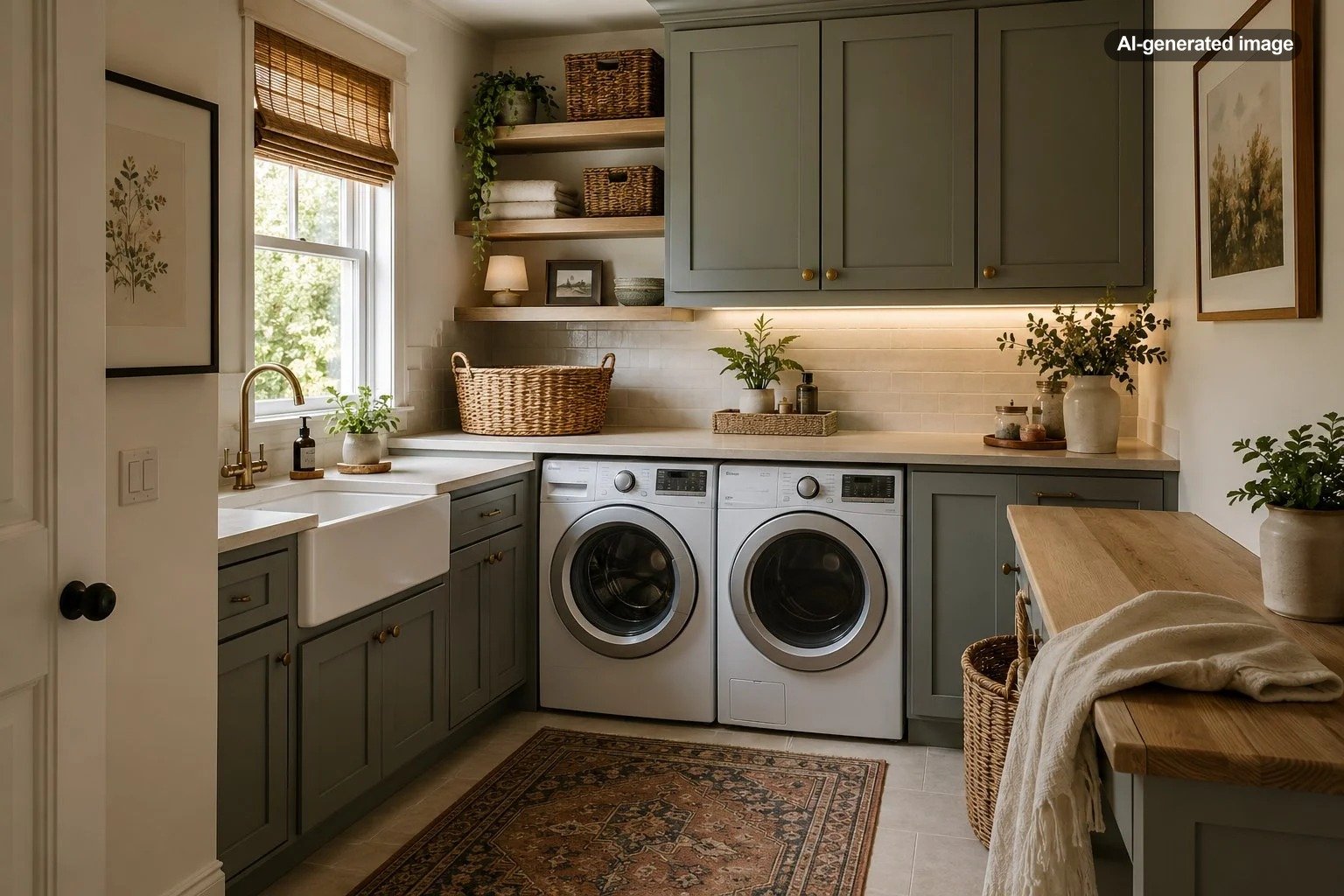
How to Make a Laundry Room Feel Less Like a Utility Closet
A laundry room stops feeling like a utility closet when it is treated as a complete room rather than a parking spot for appliances. The most effective changes are not necessarily expensive. Better lighting, intentional storage, a restrained color palette, and a few finished surfaces can make even a narrow laundry area feel orderly and considered.
The goal is not to disguise what the room does. A laundry room still needs to handle detergent, damp clothing, lint, baskets, and the occasional missing sock. The goal is to give those practical elements proper places so the room feels calm instead of improvised.
Begin With the Room’s Most Visible Problem
Before choosing paint or ordering baskets, stand at the doorway and notice what catches your eye first. In many laundry rooms, it is a crowded shelf, a tangle of hoses, an exposed water heater, a pile of supplies, or a washer and dryer surrounded by empty wall space.
Addressing the dominant visual distraction creates more improvement than scattering decorative objects around the room. If the first thing you see is detergent clutter, storage is the priority. If the room feels dim and gray, lighting and paint will matter more. If the machines dominate the space, a counter, cabinetry, or coordinated shelving can help them feel integrated.
Create a Deliberate Color Palette
Utility spaces often inherit whatever paint was left over from another project. Choosing a deliberate palette immediately makes the room feel more finished. Light warm neutrals, soft greens, muted blues, and gentle clay tones can add personality without making a compact room feel crowded.
White can work well, but it benefits from contrast. Consider pairing white walls with warm wood shelves, dark hardware, woven baskets, or a patterned floor. In a windowless room, a slightly warm white may feel more comfortable than a stark blue-white under artificial light.
For a bolder approach, use color on lower cabinets, a door, or the wall behind open shelving. Keeping the larger surfaces quieter allows one stronger color to look intentional rather than overwhelming.
Replace Harsh Lighting With Layered Light
A single bare bulb or cool ceiling fixture can make a laundry room feel like a basement work zone. Good lighting should help you identify stains, sort colors, and check whether clothing is clean while also making the space pleasant to enter.
Use a bright, diffused ceiling fixture for general illumination. If there is a counter or sink, add under-cabinet lighting or a compact wall light to reduce shadows. In a larger room, a simple pendant can provide visual interest, but it should not hang where it interferes with cabinet doors, drying racks, or movement.
Consistent light temperature matters. Mixing very warm and very cool bulbs can make the room feel disjointed and may distort fabric colors. Choose bulbs that provide clear, comfortable light and use the same general tone throughout the room.
Give Everyday Supplies a Home
Open detergent bottles, stain removers, dryer sheets, clothespins, and cleaning tools create visual noise because they vary in color, shape, and size. The simplest solution is not to decant everything. It is to group supplies by task and place them inside storage that is easy to reach.
Closed cabinets provide the calmest appearance, but open shelving can work when containers are limited and coordinated. Use bins for stain treatment, sewing supplies, pet-laundry items, and spare cleaning cloths. Keep frequently used detergent at hand, and store refills or specialty products higher up.
Labels are useful when several people use the room, but they do not need to cover every container. A few clear categories are usually more helpful than an elaborate system that takes longer to maintain than the laundry itself.
What to do
- Remove expired, empty, or duplicate products.
- Group the remaining supplies by task.
- Place daily-use items between waist and eye level.
- Move refills and rarely used products to higher storage.
- Reserve one empty bin or shelf section for items that accumulate temporarily.
Add a Real Work Surface
A folding surface is one of the clearest differences between a utility closet and a functional laundry room. Front-loading machines placed side by side may support a fitted counter above them, provided the installation allows proper clearance, ventilation, access, and appliance movement.
If a permanent counter is not practical, consider a wall-mounted drop-leaf surface, a narrow console, or a rolling cart that can be moved when appliance access is needed. Even a modest surface can hold a laundry basket, provide room for stain treatment, and prevent clean clothing from landing on top of a machine.
Choose a material that tolerates occasional moisture and routine cleaning. Decorative finishes should never block shutoff valves, electrical connections, ventilation, drain access, or the ability to service the appliances.
Use the Walls for More Than Shelves
Laundry rooms often have limited floor space but generous vertical space. A wall-mounted drying rail, retractable clothesline, peg rack, or slim hanging rod can make the room more useful without crowding the walkway.
Hooks can hold reusable bags, a small ironing board, garment bags, or an empty laundry basket. A shallow ledge can display one framed print while still leaving room for practical items. In a rental, removable hooks and freestanding shelving may provide useful storage without permanent alterations.
Keep wall storage shallow near doors and narrow passages. A shelf that appears modest on paper can feel intrusive when someone is carrying a full basket through the room.
The room feels less utilitarian when every practical object looks as though it belongs there.
Introduce Texture Without Adding Clutter
Texture softens a room filled with hard appliance surfaces. A washable runner, woven basket, wood shelf, fabric shade, or linen-look curtain can make the room feel more connected to the rest of the home.
Choose materials according to the room’s conditions. A laundry area that experiences splashes, humidity, or muddy traffic needs surfaces that dry easily and can be cleaned without fuss. Thick rugs and delicate natural-fiber baskets may be less practical beside a utility sink or exterior door.
A small amount of pattern can also help. Wallpaper on one wall, patterned floor tile, or a simple curtain can provide character. In a compact room, use one strong pattern rather than several competing ones.
Conceal What You Can, but Preserve Access
Exposed hoses, valves, vents, pipes, and electrical connections may be visually distracting, but they remain essential. Avoid permanent panels or cabinetry that prevent inspection, shutoff, cleaning, or repairs.
A removable panel, ventilated screen, shallow curtain, or strategically placed basket may soften the view while preserving access. Any covering near appliances should account for heat, moisture, airflow, and the manufacturer’s installation requirements.
Make Room for the In-Between Laundry
The most polished laundry room can still unravel when there is nowhere to put clothes awaiting treatment, air-drying garments, unmatched socks, or items that need to be returned to another room.
Create specific landing zones for these temporary categories. A divided hamper can separate loads before wash day. A small basket can hold orphaned socks. A hanging section can accommodate pieces that should not enter the dryer. A tray or bin can collect items found in pockets.
These spaces do not need to be large. They simply need to exist. Without them, temporary laundry tends to spread across every available surface.
Add Decor That Can Survive the Room
A laundry room benefits from decor, but it should not interfere with the work. One framed print, a small clock, an attractive wastebasket, or a plant suited to the available light may be enough.
Avoid filling shelves with objects that must be moved whenever detergent is needed. Decorative glass containers are best reserved for products that are safe and practical to store that way, and all household chemicals should remain clearly identified and kept according to their labels.
The strongest decorative choice may be a functional one: handsome cabinet hardware, a good-looking faucet, a patterned shade, or matching baskets. When useful objects contribute to the design, the room stays easier to maintain.
Common Mistakes That Keep the Room Feeling Utilitarian
- Decorating before organizing: Art cannot compensate for a shelf overflowing with supplies.
- Using too many small containers: A collection of tiny bins can create more visual clutter than the products they hold.
- Blocking appliance access: Counters and built-ins should allow for maintenance and replacement.
- Ignoring the floor: A worn or stained floor can dominate a small room. Deep cleaning, a washable runner, or an appropriate new finish may have more impact than wall decor.
- Choosing storage that is too deep: Oversized shelves and cabinets can make a narrow laundry room uncomfortable to use.
- Eliminating all open space: One empty section of counter or shelving gives the room breathing room and handles temporary clutter.
A Finished Laundry Room Can Still Be Practical
The best laundry rooms do not hide their purpose. They make that purpose easier to manage. A clear work surface, accessible supplies, useful lighting, and a place for clothing at every stage of the process will improve the room more than decoration alone.
Once the functional pieces are in place, color, texture, hardware, and a restrained amount of decor can make the space feel connected to the rest of the home. Even a small laundry room can feel intentional when nothing appears accidental.
Frequently Asked Questions
How can I improve a laundry room on a small budget?
Start by decluttering supplies, repainting the walls, replacing mismatched bulbs, and adding a few coordinated bins. A washable runner, new cabinet hardware, or one wall-mounted drying rail can provide noticeable improvement without a full renovation.
What colors make a small laundry room feel larger?
Light neutrals and muted colors generally keep the room visually open. However, a darker accent wall or painted cabinet can add depth when the lighting is adequate and the rest of the palette remains controlled.
Should laundry room storage be open or closed?
Closed storage creates a calmer appearance and hides varied packaging. Open shelving is easier to install and can work well for frequently used items, especially when supplies are grouped in a few practical containers.
How do I decorate a windowless laundry room?
Prioritize bright, diffused lighting and reflective or light-colored surfaces. Add interest through paint, cabinet hardware, a framed print, or a modest pattern rather than relying on plants that require natural light.
What should stay accessible around a washer and dryer?
Keep appliance connections, shutoff valves, drains, dryer ventilation, electrical access, and service clearances reachable. Decorative panels, counters, and storage should be removable or positioned so maintenance is not obstructed.