
How to Organize a Linen Closet So It Actually Stays Organized
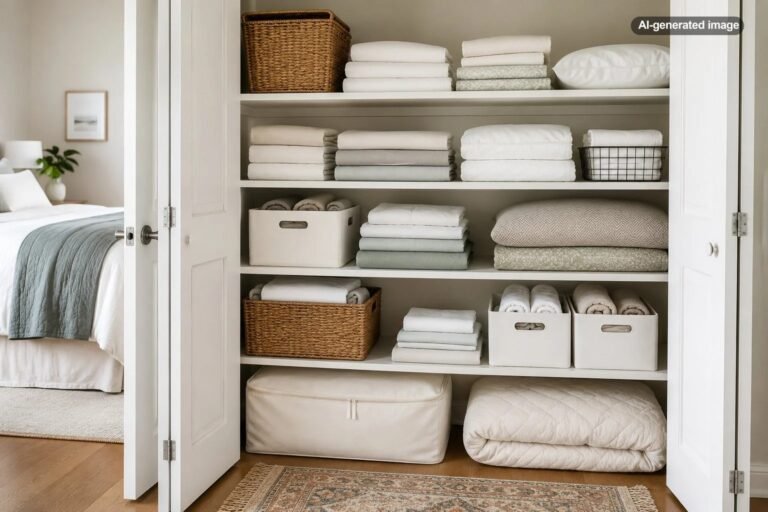
A linen closet stays organized when every category has a clear home, frequently used items are easy to reach, and the shelves are not packed so tightly that putting something away becomes a chore. The goal is not to create a perfect display of identical baskets. It is to build a storage system that works during an ordinary week, including laundry day, rushed mornings, and visits from people who did not design the system.
Start by removing everything, deciding what the closet genuinely needs to hold, and arranging the remaining items by use and frequency. Then add containers or dividers only where they solve a specific problem. A little breathing room is more useful than squeezing one more faded towel into an already unstable stack.
Empty the closet before buying organizers
It is tempting to order bins first, especially when an unruly shelf appears to be begging for them. That usually produces a closet full of containers without addressing why the space became disorganized.
Take everything out and sort it into practical groups: bath towels, hand towels, washcloths, sheet sets, pillowcases, blankets, guest linens, cleaning cloths, toiletries, and household supplies. Remove items that are worn beyond useful service, no longer fit any bed, or have not been used in years.
Set aside linens that belong elsewhere. Tablecloths may make more sense near the dining area, beach towels near an exterior door or pool supplies, and everyday cleaning products in the room where they are used. A linen closet becomes easier to maintain when it is not serving as the household’s miscellaneous cabinet.
Measure the usable space
Measure the width, depth, and height of each shelf, including the clearance around hinges, door frames, and fixed supports. Measure before choosing bins, baskets, or shelf dividers. A container that fits the shelf but cannot slide past the door opening is not especially helpful.
Also notice whether the shelves are unusually deep. Deep shelves often create a second row of forgotten linens behind the visible stack. In that situation, use the rear area for predictable backups rather than unrelated items. For example, keep everyday bath towels in front and a clearly labeled reserve set behind them.
Before you decide
- Measure shelf width, depth, height, and door clearance.
- Identify shelves that are difficult to reach safely.
- Check whether folded towels overhang the shelf.
- Decide which categories need open access and which need containment.
- Leave room for the closet’s contents to change slightly over time.
Create zones based on how the household uses linens
There are two sensible ways to divide a linen closet: by item type or by destination. A household with several bathrooms may find it easiest to keep all bath towels together, all hand towels together, and all washcloths together. Another household may prefer one zone for the primary bathroom, one for the guest bathroom, and one for children’s rooms.
Choose the method that makes putting laundry away easiest. If towels are washed and folded together, organizing by type may feel natural. If each room uses different sizes, colors, or sets, organizing by room may prevent mix-ups.
Place frequently used sheets and towels on shelves between approximately waist and eye level. Keep lighter, less frequently used items on upper shelves. The floor can hold sturdy containers, bulk packages, or a hamper, provided nothing blocks the door or creates an unstable pile.
Store complete sheet sets together
Loose pillowcases are talented escape artists. Keep each fitted sheet, flat sheet, and matching pillowcase together so that making the bed does not require a search through several stacks. One practical method is to fold the pieces and place them inside one matching pillowcase.
Label shelves or stacks by bed size when the closet holds linens for more than one mattress. Twin, full, queen, and king sheets can look frustratingly similar when folded. Labels reduce guesswork and help other household members return sets to the correct place.
Affiliate disclosure: CraneManor.com may earn a commission when you purchase through links on this page. This does not affect the price you pay. Learn more.
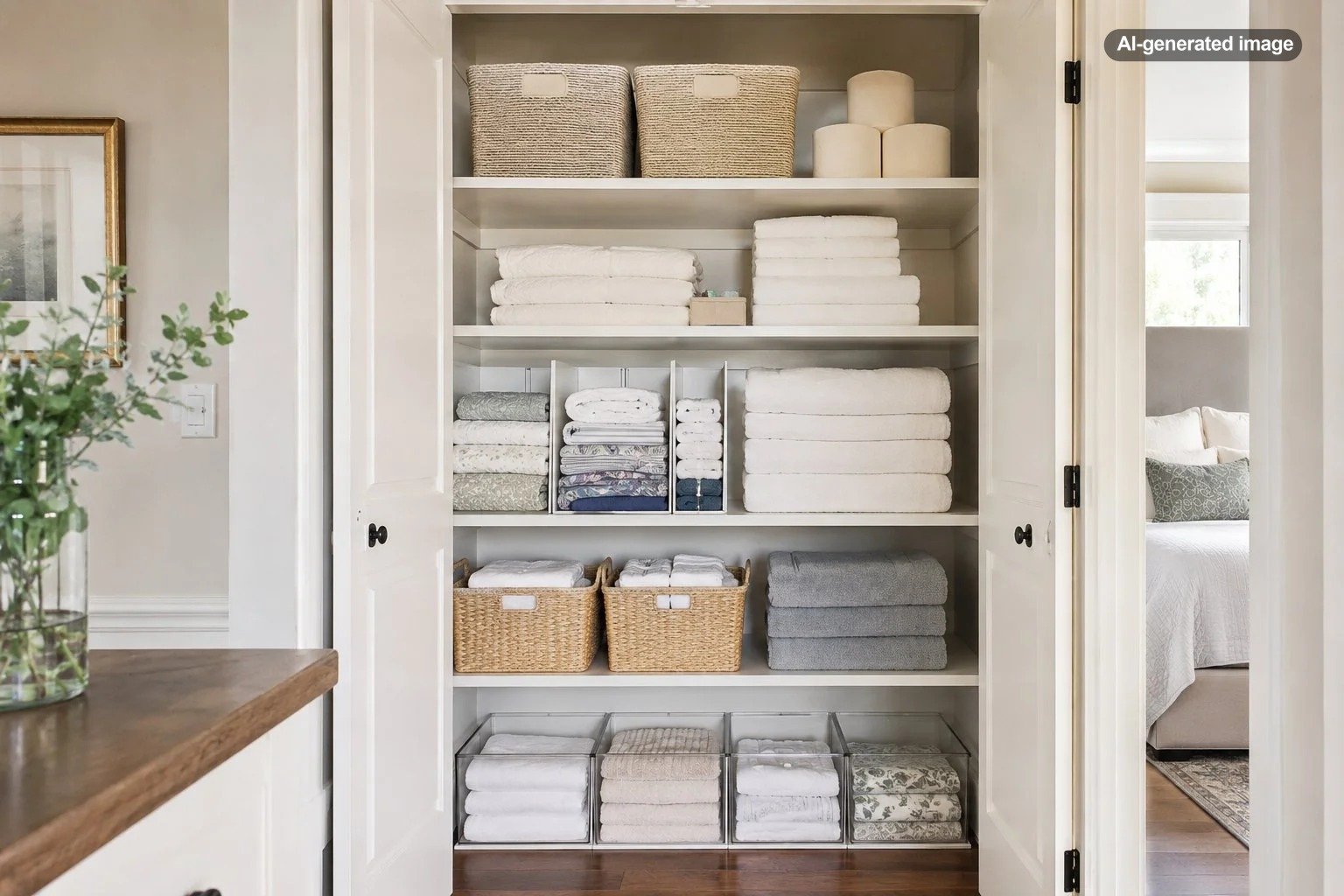
Avoid stacking too many sets vertically. Tall piles lean, collapse, and make the bottom set difficult to retrieve. Several shorter stacks separated by size or room are easier to use. On suitable wood shelves, metal shelf dividers can help keep folded towels and bedding from spreading into neighboring categories.
Fold for the shelf, not for a photograph
The most useful folding method is the one that fits the shelf and can be repeated easily. Towels may be folded in thirds when shelf depth is limited or folded more broadly on deeper shelves. Consistency matters more than using one supposedly correct technique.
Keep stacks modest enough that removing one towel does not disturb everything above it. Smaller washcloths can be rolled or folded upright inside a shallow bin, which makes each piece visible and prevents the pile from scattering.
A storage method succeeds when returning an item is as easy as taking it out.
Use containers only for items that need containment
Open shelves work well for neatly folded towels and bedding because the contents are easy to see. Bins are more useful for small, irregular, or visually busy categories such as travel toiletries, extra soap, stain-treatment supplies, heating pads, or cleaning cloths.
Choose handled bins for high shelves so they can be pulled down without reaching blindly. Use transparent containers when seeing the contents matters, and opaque baskets when the category contains mismatched packages that would otherwise make the closet look cluttered.
Do not fill every shelf with matching baskets merely for appearance. Containers consume usable width, and an unlabeled basket can become a hiding place for items nobody remembers owning. Give each container one defined purpose.
Separate clean linens from laundry in transit
A linen closet often becomes messy because clean towels, items awaiting washing, and linens being moved between rooms all pass through the same space. Keep the storage shelves reserved for clean items.
When the laundry area is distant from bedrooms or bathrooms, a large rolling laundry hamper may make it easier to move towels and bedding without temporarily piling them on the closet floor. The hamper should live outside the closet unless the floor area is large enough to accommodate it without obstructing access.
Label the system after testing it
Labels are particularly useful in shared homes, but wait until the arrangement has survived a few laundry cycles. You may discover that guest towels need more room, extra blankets are stored too high, or a category belongs in another room.
Once the layout works, label shelves, shelf edges, or containers with plain terms such as Queen Sheets, Guest Towels, Washcloths, Toiletries, and Cleaning Cloths. Avoid overly narrow labels that leave no room for normal changes in household needs.
Keep a small amount of empty space
An organization system needs a landing zone. Leave part of a shelf or one small section open so freshly laundered items can be returned without balancing them on top of already full stacks.
This space also accommodates temporary changes, such as extra guest towels, seasonal bedding, or a replacement set purchased before the old one leaves the house. A closet packed to complete capacity may look efficient for one afternoon, but it has no tolerance for real life.
Adopt a five-minute maintenance routine
After the initial organization, straighten the closet briefly whenever you put away laundry. Return stray items to their zones, refold anything that has slumped, and remove empty packages. This is usually enough to prevent a major reset.
What to do
- Return complete sets to their labeled zone.
- Place newly washed items beneath or behind older ones when rotation matters.
- Move unrelated household items out immediately.
- Refill small supplies without opening several duplicate packages.
- Review the closet seasonally and remove linens that are no longer useful.
Common linen closet mistakes
The most common mistake is keeping more than the available space can support. Other problems include placing daily towels on hard-to-reach shelves, mixing several bed sizes in one stack, using deep bins for frequently needed items, and storing liquids above linens where a leak could affect fabrics below.
Avoid unstable towers of heavy bedding on upper shelves. Bulky comforters and pillows may be better stored in a breathable container elsewhere if the linen closet is small. Do not stand on an unsuitable chair to reach high storage; reorganize the shelf or use an appropriate household step stool according to its instructions.
Frequently asked questions
Should towels be rolled or folded?
Either method can work. Folded towels usually create stable stacks on open shelves, while rolled washcloths and hand towels can fit neatly inside bins. Choose the method that matches the shelf dimensions and is easy to repeat.
Where should extra blankets go?
Place lightweight, infrequently used blankets on an upper shelf. Bulky bedding may fit better in a breathable storage container under a bed, in a bedroom closet, or in another dry storage area.
How should deep linen closet shelves be organized?
Keep frequently used items in front and predictable backups behind them. Avoid placing unrelated categories in two invisible rows. Shallow bins or clearly labeled zones can make the rear portion easier to manage.
How often should a linen closet be reorganized?
A brief seasonal review is usually sufficient when the daily system works. A full reorganization is unnecessary unless household needs, available space, or the closet’s purpose changes.
The lasting version of an organized linen closet is not rigid or showroom-perfect. It is easy to understand, forgiving enough for busy days, and spacious enough that every clean towel and sheet set can be put away without starting a small domestic puzzle.