What Is the Difference Between Damp-Rated and Wet-Rated Ceiling Fans?
The difference between damp-rated and wet-rated ceiling fans comes down to how much water the fan is designed to withstand. A damp-rated ceiling fan can handle humidity and moisture in the surrounding air, but it must remain protected from direct rain or water exposure. A wet-rated ceiling fan is designed for locations where rain, snow, or splashing water may reach the fan itself.
That distinction matters when choosing a fan for a porch, patio, balcony, or outdoor seating area. A roof overhead does not automatically mean a fan will stay dry, especially when wind-driven rain enters from the sides.
The right rating depends less on whether a space looks indoors or outdoors and more on what actually happens to the fan during bad weather.
Damp-Rated vs. Wet-Rated Ceiling Fans at a Glance
Both ratings describe suitability for particular environmental conditions. Neither is primarily a measure of airflow, appearance, motor efficiency, or how quietly the fan operates.
| Feature | Damp-rated fan | Wet-rated fan |
|---|---|---|
| Humidity exposure | Designed to tolerate it | Designed to tolerate it |
| Direct rain | Not suitable | Suitable within its listed installation conditions |
| Typical locations | Protected porches, covered patios, humid rooms | Open pergolas, exposed patios, rain-prone porches |
| Moisture protection | Designed for damp conditions | Designed for direct water exposure |
| Indoor installation | Possible when appropriate for the room | Possible when appropriate for the room |
| Best deciding factor | Fan stays out of direct water | Water may reach the fan |
The most important row is direct rain exposure. Even a beautifully sheltered outdoor room may require a wet-rated fan if storms occasionally send water across the ceiling.
What Is a Damp-Rated Ceiling Fan?
A damp-rated ceiling fan is designed for environments where moisture is present without direct exposure to rain or significant splashing. Its materials and construction are intended to tolerate conditions that an ordinary dry-location fan may not be designed to handle.
Damp-rated fans are commonly used in covered porches, protected patios, screened outdoor rooms, and certain humid interior spaces. Their suitability depends on the specific installation location and manufacturer instructions.
Where damp-rated fans work best
- Deeply covered porches: An overhead roof and sufficient protection from the sides keep wind-driven rain away from the fan.
- Protected screened porches: Screening and roof coverage help protect the fan, although screens alone do not prevent rain from entering.
- Covered balconies: An overhead structure and building layout keep direct precipitation away from the installation location.
- Humid indoor rooms: Certain bathrooms, laundry rooms, and similar spaces may call for moisture-resistant equipment, depending on the actual location.
A damp rating does not mean the fan can be sprayed with a hose, left under direct rainfall, or installed immediately beside an unprotected water source.
Why a covered location can still be unsuitable
Imagine a patio with a solid roof extending several feet beyond its seating area. Most days, everything beneath the roof stays dry. During a windy thunderstorm, however, rain blows underneath the outer edge and reaches the ceiling near the fan.
That location may call for a wet-rated model even though the patio technically has a roof.
The actual exposure of the installed fan is what matters. A roof protects from precipitation falling straight down, but it does not necessarily stop rain arriving sideways.
What Is a Wet-Rated Ceiling Fan?
A wet-rated ceiling fan is designed for installation in locations where direct water exposure is possible. Depending on the model and its listing, this may include rain, snow, and the weather conditions encountered in exposed outdoor installations.
Wet-rated models typically use construction details appropriate for greater moisture exposure. These may include moisture-resistant motor assemblies, corrosion-resistant components, weather-suitable blades, and protective housing designs. The exact materials and protective features vary by manufacturer and model.
Where wet-rated fans make sense
- Open pergolas: Rain can pass through slatted or open roofing.
- Uncovered outdoor seating areas: A permanently installed fan may be exposed directly to weather.
- Exposed gazebos: Wind can carry rain into partially sheltered structures.
- Porches with frequent wind-driven rain: Water may reach a fan despite overhead coverage.
- Poolside covered areas: A wet-rated fan may be appropriate where water can splash or blow toward the installation, subject to applicable electrical requirements and the manufacturer’s instructions.
Wet-rated does not mean waterproof under every imaginable condition. It does not automatically authorize submersion, pressure washing, placement in a pool’s regulated electrical clearance area, or installation contrary to product instructions.
How to Choose the Correct Rating for Your Space
Start by evaluating the exact ceiling location where the fan will hang. Look beyond the room’s name and consider the worst weather the space commonly experiences.
What to check before buying
- Identify the overhead protection. Is there a continuous solid roof, an open pergola, or no cover at all?
- Examine exposure from the sides. Consider whether wind-driven rain reaches the proposed fan location during storms.
- Check nearby water sources. Sprinklers, roof runoff, pool splashing, and cleaning activities can change the exposure.
- Consider the local environment. Coastal salt air, persistent humidity, and seasonal weather may affect material and finish selection.
- Verify the actual product rating. Read the manufacturer’s installation instructions and confirm that the complete fan assembly is approved for the intended location.
If rain can reach the fan, look for a wet-rated model. If the fan remains consistently protected from direct water, a damp-rated model may be suitable.
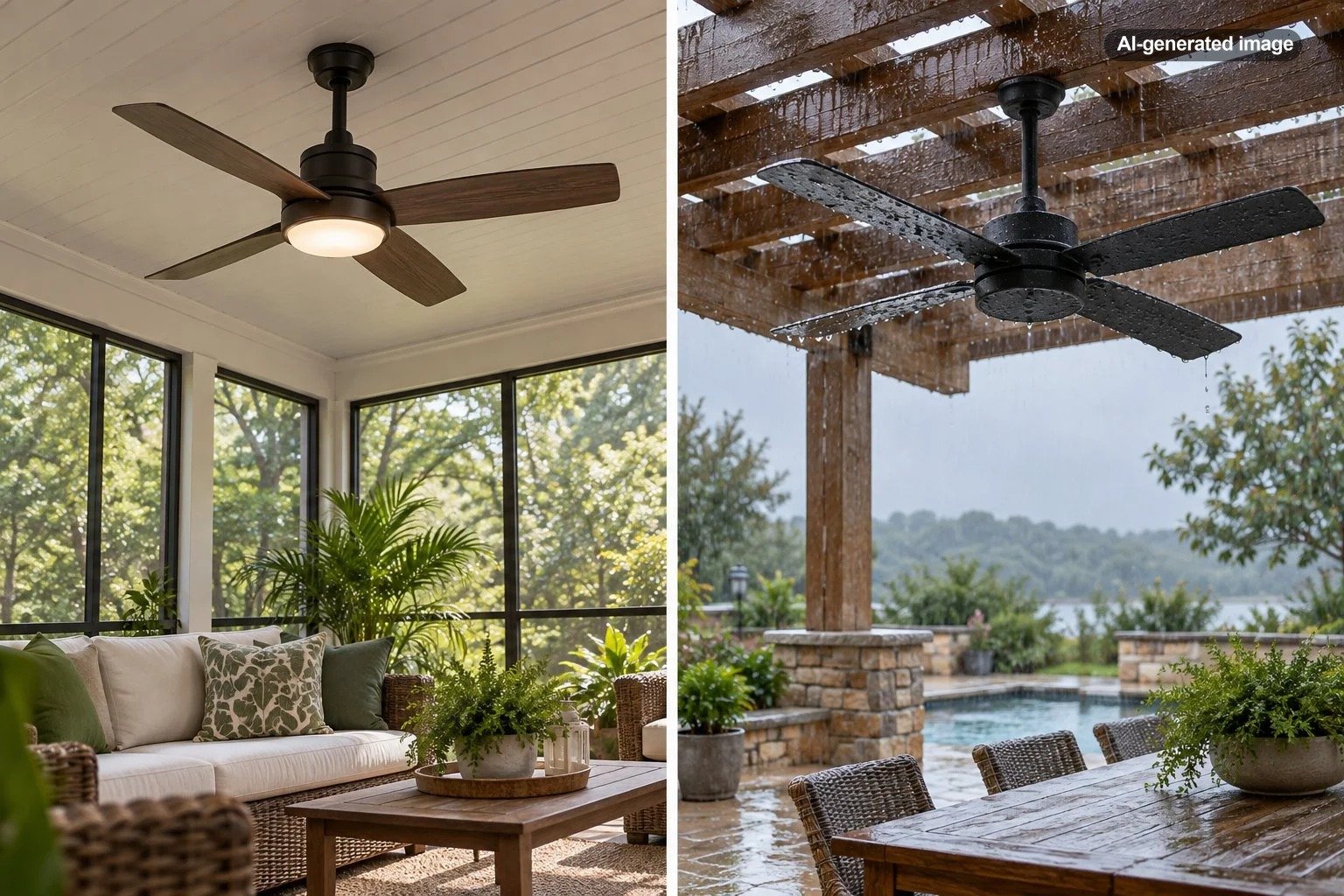
Scenario: A screened porch
Scenario: A patio beneath a pergola
A pergola with open slats allows precipitation through its roof. A damp-rated fan is not the appropriate choice for a location where direct rainfall can reach the equipment. A wet-rated model designed and approved for that particular installation is the more appropriate starting point.
Adding fabric shade panels or decorative screening does not necessarily create reliable weather protection. Such additions may also affect mounting, clearance, and access requirements.
Does Wet-Rated Mean Better Quality?
Not automatically. A wet rating indicates that a fan is intended for a more demanding moisture environment, but it does not tell you everything about the quality of its motor, the precision of its construction, the strength of its airflow, or its operating noise.
A well-designed damp-rated fan can be an excellent choice for a properly sheltered porch. A poorly matched wet-rated fan may still disappoint if it is too small, hangs at the wrong height, or produces insufficient airflow for the seating arrangement.
Think of moisture rating as a necessary compatibility requirement. Once that requirement is satisfied, compare the features that determine how comfortable the fan will be to use.
Airflow and blade size
Look at published airflow information, often expressed in cubic feet per minute, or CFM. Consider the fan’s diameter, the area being served, ceiling height, and the placement of chairs or dining furniture.
A large patio may benefit from multiple appropriately placed fans rather than one oversized fan mounted at a distant corner. Actual performance depends on the model, speed settings, and installation.
Motor performance and controls
Consider noise, available speeds, control options, and whether the fan can reverse direction if that feature matters to you. Remote controls, wall controls, smart features, and any associated components should be suitable for their installation environments.
Do not assume that every accessory packaged with an outdoor fan can be exposed to water. Check each component’s stated installation limitations.
Materials and appearance
Outdoor-rated fans come in styles ranging from traditional multi-blade designs to streamlined contemporary forms. Select a finish that complements the architecture while remaining appropriate for the environment.
For example, a dark, minimalist fan may suit a contemporary covered terrace, while a softly textured neutral finish may work better with a coastal-style porch. These are aesthetic considerations; they do not replace the required environmental rating.
Can You Use a Wet-Rated Fan Indoors?
Yes, a wet-rated ceiling fan can generally be installed indoors when its listing and installation instructions permit the application. A higher moisture rating does not prevent a fan from being useful in a dry or damp location.
However, choosing wet-rated for every indoor room is rarely necessary. A dry-location fan may be suitable for an ordinary living room or bedroom, while a damp-rated model may make sense in a humid space.
Bathrooms deserve extra attention because a fan’s location relative to showers, tubs, and other water sources may trigger specific product and electrical requirements. A moisture rating alone does not establish that any particular mounting location is permitted.
For most homeowners, the sensible approach is to select the rating appropriate to the environment and then compare design, airflow, and convenience.
Can You Use an Indoor-Only Ceiling Fan on a Covered Porch?
An indoor-only, dry-rated ceiling fan should not be installed on a covered outdoor porch unless its listing and manufacturer instructions specifically approve that environment.
Outdoor locations can expose a fan to humidity, condensation, changing temperatures, and windborne moisture even when rain does not fall directly on the equipment. Dry-location fans are not necessarily designed for those conditions.
Paint, sealant, protective sprays, or improvised covers do not convert an indoor fan into an approved outdoor fan. They may also interfere with ventilation, electrical components, or moving parts.
If you are replacing an existing porch fan, check its model information rather than assuming the previous installation was appropriate.
Installation and Maintenance Details That Matter
Correct moisture rating is only one part of a suitable outdoor ceiling fan installation. Electrical connections, structural support, mounting hardware, clearances, and accessories must also be appropriate for the location.
Check the mounting support
Ceiling fans create moving loads, so they require a properly supported mounting system suitable for ceiling fan use. An ordinary light fixture box is not automatically acceptable.
Outdoor installation introduces additional considerations, including exposure to weather and the condition of the supporting structure. A qualified electrician can assess whether the existing installation is suitable.
Confirm appropriate blade clearance
Fan blades need adequate clearance from floors, walls, and other obstructions. Follow the manufacturer’s specific instructions and applicable electrical requirements rather than relying on one universal dimension for every installation.
On low-ceiling patios or balconies, fan height may become a deciding factor in whether a ceiling fan is practical at all.
Keep electrical components appropriately protected
The fan’s rating does not automatically apply to every separate accessory. Verify that the electrical box, controls, downrod, light kit, and other applicable components are suitable for their locations and compatible with the fan.
Electrical installation and modifications should be handled by a qualified professional where required. Local requirements can vary, particularly around swimming pools and other water features.
Maintain the fan without damaging it
Keep the fan clean according to the manufacturer’s instructions. Periodically check for visible corrosion, blade damage, looseness, or unusual movement, without opening electrical housings or attempting repairs while the equipment is energized.
Do not pressure wash a fan simply because it is wet-rated. Its approved exposure to rain is not the same as approval for high-pressure cleaning.
Common Mistakes When Shopping for Outdoor Ceiling Fans
The most frequent buying errors come from confusing descriptive marketing language with a verified environmental rating.
- Assuming outdoor style means outdoor approval. A fan’s appearance does not establish whether it is damp-rated or wet-rated.
- Assuming every covered porch is a damp location. Wind-driven rain can turn an apparently protected mounting point into a wet location.
- Using humidity resistance as proof of rain resistance. A fan designed for moisture in the air is not necessarily designed for direct water contact.
- Ignoring corrosion exposure. Salt air and other environmental conditions may influence durability beyond the basic moisture rating.
- Overlooking installation accessories. Outdoor suitability should be checked for the applicable complete installation, not just the fan motor.
- Choosing by diameter alone. Published airflow, ceiling height, placement, and usable seating area all matter.
Product descriptions should identify the approved locations clearly. When information is missing or ambiguous, consult the manufacturer’s documentation before purchasing.
Frequently Asked Questions
Does a damp-rated ceiling fan tolerate occasional rain?
A damp-rated ceiling fan is not intended for direct rain exposure. Occasional wind-driven rain is still direct water exposure, even if the location is usually sheltered. Choose a wet-rated model when rain may reach the fan.
Is a wet-rated fan necessary on a covered patio?
Not always. If the installation location is reliably protected from direct water, a damp-rated model may be appropriate. If rain can blow underneath the roof or reach the fan through an opening, a wet-rated model is the better choice.
Are all wet-rated fans suitable for coastal homes?
A wet rating addresses water exposure, but it does not guarantee resistance to every level of salt-air corrosion. For coastal properties, review the manufacturer’s guidance on materials, finishes, corrosion resistance, and suitable environments.
Can a damp-rated fan be used in a bathroom?
Often, yes, when the manufacturer approves the installation and the fan is positioned appropriately. Locations near showers or tubs may have additional requirements. Follow the product instructions and applicable local electrical rules.
Does a wet-rated ceiling fan move more air than a damp-rated one?
Not necessarily. Moisture ratings describe environmental suitability, while airflow depends on the fan’s design, motor, blade characteristics, speed, and installation. Compare published performance information rather than using the moisture rating as a measure of airflow.
The Bottom Line
The practical difference is straightforward: damp-rated ceiling fans belong where humidity is expected but direct water exposure is prevented, while wet-rated ceiling fans belong where water may reach the fan.
For a deeply sheltered porch, a damp-rated model may be all you need. For an open pergola, exposed patio, or porch that catches sideways rain, look for a wet-rated fan suitable for the actual installation conditions.
Once the environmental rating is settled, focus on airflow, placement, ceiling clearance, materials, and controls. Those details determine whether your outdoor fan is as comfortable and useful as it is attractive.
Sources & Further Reading
- ENERGY STAR: Ceiling Fan Basics – Guidance on moisture ratings, fan mounting styles, and selecting ceiling fans for different locations.
- Hunter Fan: What Is the Difference Between Damp- and Wet-Rated Fans? – Manufacturer guidance on suitable environments and the construction of outdoor ceiling fans.
- Hunter Fan: Can Outdoor Ceiling Fans Get Wet or Be Rained On? – Explanations of direct rain exposure, covered patios, pergolas, and selecting a rating based on actual weather conditions.