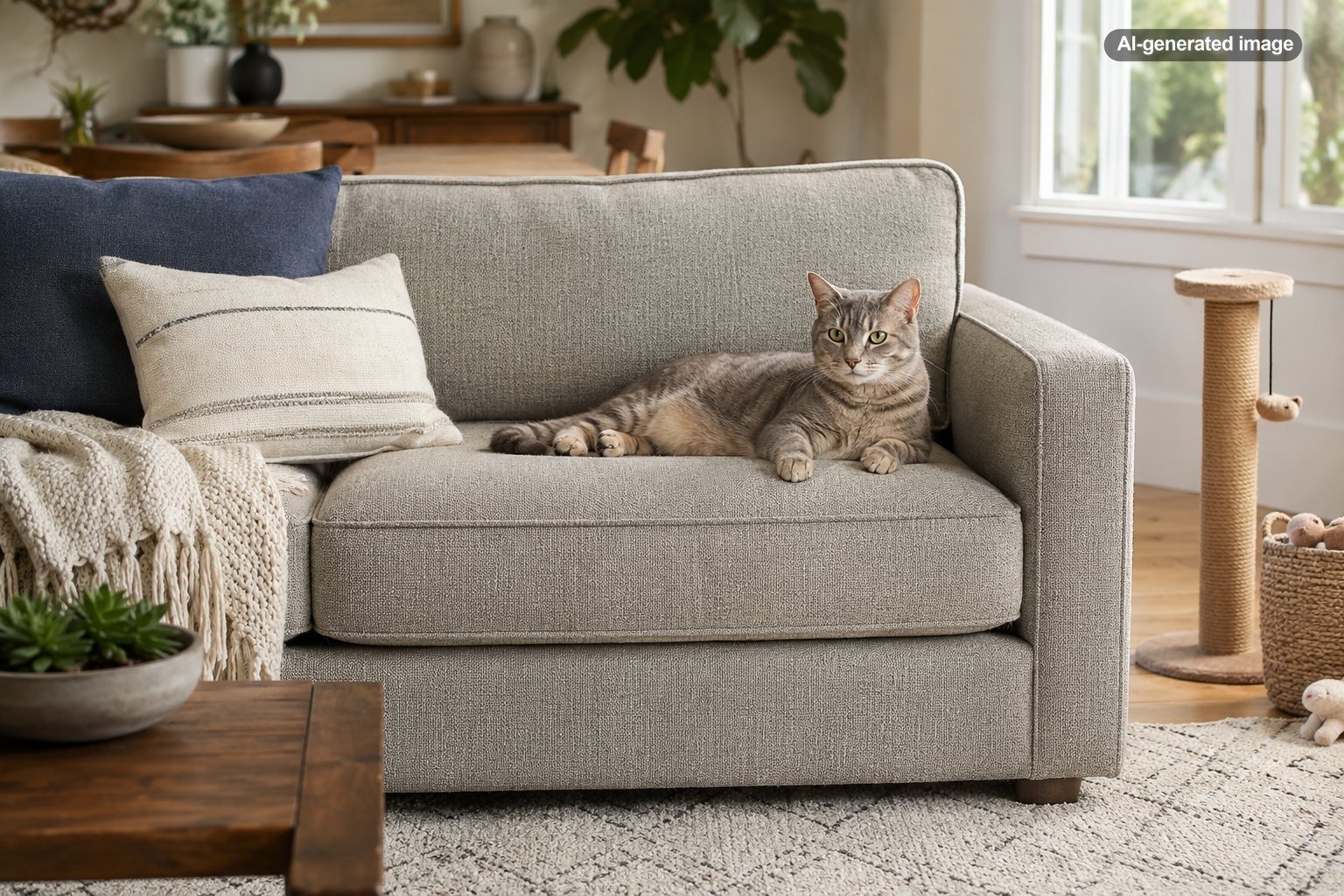
What Is the Best Sofa Fabric for Cats?
The best sofa fabric for most homes with cats is a tightly woven, smooth performance fabric, especially microfiber or a durable synthetic blend. These materials give claws fewer obvious loops to catch, release fur more easily than nubby textiles, and are usually simpler to spot-clean than delicate natural fabrics.
No upholstery is truly cat-proof, however. The right choice depends on whether your main concern is scratching, shedding, stains, snagging, or the occasional hairball landing in the least convenient place possible. A sofa that works beautifully for a short-haired cat that ignores furniture may be a poor match for a long-haired climber who treats the armrest as personal territory.
The best overall choice: tightly woven performance fabric
A tightly woven performance fabric offers the most balanced combination of durability, cleanability, and appearance. The term performance fabric covers many upholstery constructions, so it should not be treated as a guarantee by itself. What matters is the actual texture, weave, fiber content, and care guidance.
Run your hand across a sample. The surface should feel compact and relatively smooth, without loose loops, raised threads, or a chunky texture. If you can easily catch the weave with a fingernail, a cat may be able to do the same with considerably more enthusiasm.
Synthetic fibers such as polyester tend to resist everyday abrasion and absorb less moisture than many untreated natural fibers. They are also commonly available in stain-resistant upholstery. Still, owners should check the sofa manufacturer’s cleaning code and care instructions rather than assuming every performance fabric can be scrubbed with household cleaner.
How common sofa fabrics compare
| Fabric | Cat-friendly strengths | Main tradeoffs |
|---|---|---|
| Microfiber or microsuede | Dense surface, few loops, easy fur removal, generally practical for spot cleaning | Can show oily marks or flattened areas; appearance may feel casual |
| Tightly woven performance fabric | Good balance of durability, stain resistance, color choice, and polished style | Quality varies; marketing labels do not reveal the full construction |
| Synthetic velvet | Short, dense pile; limited exposed weave; fur often lifts with a brush or vacuum | May show pressure marks, lint, or changes in nap |
| Leather | Does not trap fur; wipes clean; no woven threads to pull | Claw punctures and scratches can be permanent and highly visible |
| Canvas or heavy cotton | Sturdy, familiar, and sometimes washable when used as a slipcover | Can hold fur and absorb stains; claws may still pull visible threads |
| Linen or linen blend | Relaxed, breathable appearance | Wrinkles, absorbs spills, and may snag when loosely woven |
| Boucle or chenille | Soft, dimensional texture | Loops and raised yarns invite snagging and hold fur |
Microfiber is the practical favorite
Microfiber is often the safest starting point for a cat household because its fibers create a dense, suede-like surface rather than an obvious woven grid. Claws have fewer loops to enter, and loose fur can usually be removed with a vacuum upholstery attachment, lint brush, or slightly damp rubber glove.
It is not immune to damage. A determined cat can scratch almost any upholstered surface, particularly along corners and arms. Microfiber may also show darker areas where skin oils or repeated contact alter the surface. Choosing a mottled texture rather than a perfectly flat solid color can make those everyday variations less noticeable.
Velvet can work better than it looks
Velvet may appear too precious for pets, but a short-pile synthetic velvet can be surprisingly practical. Its dense surface has no prominent loops, and cat hair often sits on top rather than becoming deeply embedded. It also provides a richer visual option for readers who do not want their living room to feel designed around damage control.
The distinction between velvet types matters. Delicate silk velvet and other specialty textiles are poor choices for routine pet use. A durable polyester velvet intended for residential upholstery is more realistic. Test a sample for lint, pressure marks, and ease of cleaning before committing to an entire sofa.
Is leather a good sofa material for cats?
Leather solves one problem and creates another. It does not trap fur, odors, or dust in a woven surface, and routine debris is easy to wipe away. For a cat that does not scratch furniture and rarely launches across the cushions, leather can be an excellent choice.
For an active cat, however, claw marks may become part of the sofa almost immediately. Smooth, pristine leather makes scratches especially visible. Thicker, matte, naturally varied leather may disguise wear better than a highly uniform finish, but punctures and deep scratches remain possible.
Households considering leather should be comfortable with patina rather than expecting the surface to remain flawless. Faux leather is not automatically safer; once its coated surface is punctured or begins peeling, repairs can be difficult to conceal.
Fabrics to approach cautiously
Loose, looped, or highly dimensional upholstery tends to be the least forgiving around cats. Boucle, chenille, loosely woven linen, tweed, and open basket weaves provide visible texture that claws can catch. Once one thread is pulled, trimming it may prevent further unraveling, but it rarely restores the original appearance.
Very pale solid upholstery can also demand more maintenance than expected. It reveals paw marks, small stains, and dark fur quickly. At the opposite extreme, a black sofa may show every strand of pale cat hair. A medium neutral, muted color, or subtle two-tone weave is usually more forgiving.
The most successful cat-friendly sofa hides ordinary wear without looking as though it was chosen solely to survive it.
What matters beyond the fabric name
A tight surface
Inspect the material at close range. A compact construction is generally more important than whether the label says polyester, cotton blend, velvet, or performance upholstery.
Removable cushion covers
Zip-off covers make targeted cleaning easier, but removable does not always mean machine washable. Follow the stated care method to avoid shrinking, fading, water rings, or distortion.
Replaceable components
Separate seat and back cushions can often be rotated, cleaned, or re-covered more easily than a sofa with fully attached upholstery. Reversible cushions are particularly useful because wear can be distributed across more than one surface.
Forgiving color and pattern
Choose upholstery that relates to the cat’s fur color without matching it so precisely that the entire room becomes an elaborate camouflage operation. Heathered gray, taupe, olive, warm brown, and small-scale patterns often conceal fur and minor marks better than stark solids.
A sample you can test at home
Request the largest swatch available. Place it near the cat’s preferred lounging area for several days. Check whether fur clings, whether claws catch during normal contact, and whether the fabric shows moisture or pressure marks. Do not deliberately encourage scratching, but do evaluate how the material behaves in real household conditions.
Before you decide
- Prioritize a dense, smooth surface over a loose or looped texture.
- Review the manufacturer’s cleaning instructions and upholstery cleaning code.
- Choose a color that works with both the room and the cat’s shedding.
- Look for removable, reversible, or replaceable cushion covers.
- Consider how much visible scratching or patina you are willing to accept.
- Test a fabric sample for fur release, snagging, and stain visibility.
Protecting the sofa after it arrives
Fabric choice helps, but the room setup often determines whether a sofa becomes a scratching post. Place a stable scratching surface near the area where the cat already stretches or scratches. Cats commonly target sofa arms because the position is convenient, vertical, and socially central, not because they have developed a strong opinion about upholstery.
Protective throws can cover a favored sleeping spot and simplify fur removal. A fitted arm cover may be useful during the adjustment period, especially on vulnerable corners. Keep claws maintained as appropriate for the cat, and redirect scratching consistently rather than relying on punishment.
Vacuum upholstery regularly with a suitable attachment, working into seams and under cushions. Address spills promptly according to the sofa’s care instructions. Avoid soaking upholstery or experimenting with strong cleaners in a visible area.
Frequently asked questions
What couch fabric does cat hair stick to the least?
Leather and other smooth, nonwoven surfaces trap the least fur, but they may show scratches. Among upholstered options, microfiber, microsuede, and short-pile synthetic velvet usually release fur more easily than boucle, chenille, or loose woven fabrics.
Can cats scratch microfiber?
Yes. Microfiber is resistant to snagging because it lacks prominent loops, but it is not scratch-proof. Repeated clawing can roughen the surface or damage seams and corners.
Is a slipcovered sofa good for cats?
It can be, particularly when the slipcover is durable, properly fitted, and washable according to its care label. Loose fabric can shift or tempt climbing, while shrinking may make a washed cover difficult to reinstall.
Should the sofa match the cat’s fur?
It does not need to match exactly. A medium-value fabric with subtle variation is often more effective because it disguises both light and dark hairs, small stains, and everyday texture changes.
What is the worst sofa fabric for cats?
Highly looped, nubby, or loosely woven fabrics are usually the riskiest because claws can catch and pull threads. Boucle, open-weave linen, and some chenilles deserve particular caution in homes with active scratchers.
The final verdict
For most cat owners, a dense microfiber or tightly woven performance fabric is the best sofa upholstery. Synthetic velvet is a strong alternative when a richer look matters, while leather suits calm cats and owners who are comfortable with visible patina.
Focus less on the marketing name and more on the material in front of you: smooth texture, tight construction, practical cleaning instructions, forgiving color, and cushions that can be rotated or removed. Pair that choice with well-placed scratching surfaces and routine maintenance, and the sofa has a much better chance of remaining both handsome and genuinely livable.