Why Does My Air Conditioner Smell Worse on Humid Days?
Yes, humidity can make an air conditioner smell noticeably worse. The reason is usually not that humid weather creates a completely new odor, but that extra moisture makes existing sources of odor more active or easier to notice. Damp dust, a wet filter, moisture on the evaporator coil, a dirty condensate pan, a slow drain, or damp materials near the HVAC system can all smell stronger when the air stays humid.
An air conditioner is designed to remove both heat and some moisture from indoor air. On very humid days, however, the system has a larger moisture load to manage. If drainage, airflow, maintenance, or humidity control is less than ideal, that added moisture can expose a problem that was barely noticeable during drier weather.
Why humidity changes what your air conditioner smells like
Cooling systems naturally create condensation. Warm indoor air passes over a cold evaporator coil, water vapor condenses, and that moisture is supposed to collect in a drain pan and leave through the condensate drain. The process is normal. Problems begin when moisture lingers where it should not.
The U.S. Environmental Protection Agency notes that high indoor humidity increases the likelihood of mold and recommends controlling indoor relative humidity, generally keeping it below 60 percent and ideally in the 30 to 50 percent range when practical. The EPA also specifically advises keeping air-conditioning drip pans clean and drain lines unobstructed.
Humidity can therefore act like a magnifying glass for several ordinary HVAC problems. Materials that stay fairly dry during mild weather may remain damp longer. Dust on a cooling coil or inside an air handler can hold moisture. A partially restricted drain can leave water sitting in a pan. A damp filter may develop a stale odor. Humid outdoor air entering through leaks can also increase the moisture the system must remove.
The most common reasons the odor becomes stronger
A damp evaporator coil or surrounding surfaces
The evaporator coil becomes wet whenever the system removes moisture from the air. That alone is normal. Trouble can develop when dirt accumulates on wet surfaces or when the area does not dry adequately between operating cycles. The resulting odor is often described as musty, earthy, damp, or similar to wet laundry.
An HVAC technician can inspect the coil and nearby components without assuming that every musty smell is mold. Dust, standing condensate, wet insulation, and other damp materials can produce similar odors, so determining the source matters more than guessing based on smell alone.
A condensate pan or drain that is not clearing properly
During muggy weather, an air conditioner may collect considerably more condensation than it does on a dry day. That can make a marginal drainage problem much easier to notice. A drain that handles a small amount of water adequately may back up when condensation production increases.
Look for water where it normally should not be, repeated drain-related shutoffs, an overflowing auxiliary pan, dampness around the air handler, or staining near the equipment. Do not ignore recurring water. Besides creating odors, unmanaged condensate can damage surrounding building materials.
A dirty or damp filter
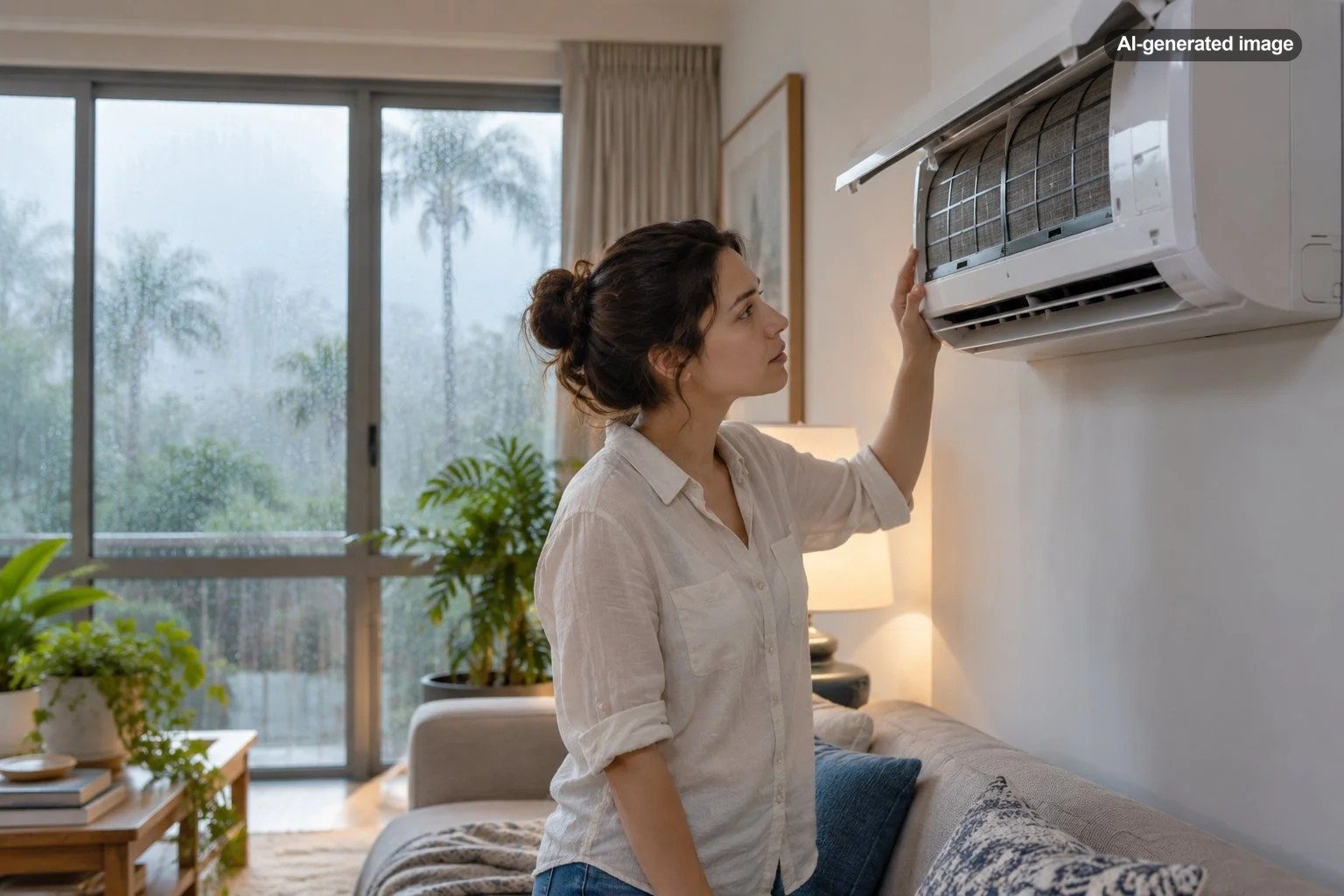
An overdue filter can collect household dust, pet debris, pollen, and other particles. If the filter or the area around it becomes damp, odors may become more pronounced. Check the filter according to the HVAC equipment and filter manufacturer’s instructions rather than relying on one universal replacement schedule.
A filter that becomes unusually wet is different from one that is merely dirty. Moisture reaching the filter can indicate condensation, drainage, airflow, or installation conditions that deserve further investigation.
High indoor humidity even while the AC is running
Air conditioning does not guarantee ideal humidity control. The U.S. Department of Energy has documented the challenge of controlling moisture in hot-humid climates, particularly when a home’s sensible cooling demand and moisture-removal demand do not line up neatly.
A system can cool the house quickly enough to satisfy the thermostat while still leaving the indoor air feeling damp. Frequent short cooling cycles, equipment sizing, airflow settings, outdoor-air infiltration, ventilation, and the characteristics of the home can all affect humidity performance. These are reasons to have the system evaluated rather than simply lowering the thermostat further.
Affiliate disclosure: CraneManor.com may earn a commission when you purchase through links on this page. This does not affect the price you pay. Learn more.
If you are unsure whether the house is genuinely humid or merely feels uncomfortable, a digital hygrometer can provide a simple room-level reading of temperature and relative humidity. Treat the number as useful evidence rather than a diagnosis: consistently high readings can help you recognize a moisture-control problem, but they cannot identify its source.
How to narrow down the smell without dismantling the system
What to do
- Describe the odor. Note whether it smells musty, sour, smoky, electrical, chemical, sewage-like, or simply stale. Different odor categories call for different responses.
- Notice when it appears. Does it happen only during very humid weather, only when cooling starts, throughout the entire cooling cycle, or even when the system is off?
- Check the filter. Replace or clean it if required by its instructions, and note whether it appears unusually damp.
- Look for visible moisture. Without opening electrical compartments or dismantling equipment, inspect the accessible area around the air handler, condensate piping, drain outlet, and nearby floor for water or staining.
- Check indoor humidity. Compare readings in several rooms over time instead of relying on a single measurement immediately after showering or cooking.
- Call an HVAC professional if the odor persists. The coil, drain pan, condensate piping, blower compartment, insulation, ductwork, airflow, and humidity performance may require inspection.
Could the smell actually be coming from somewhere else?
Absolutely. Airflow can carry an odor from one part of the house and make the vent seem responsible. Damp carpet, a plumbing issue, stored items, a wet utility room, a crawlspace, an attic problem, a nearby floor drain, or an odor around the return-air pathway can sometimes be mistaken for an AC problem.
A useful clue is whether the smell appears at every supply register or only in one location. An odor throughout the house when cooling begins points toward a different set of possibilities than an odor isolated to one room or one register.
When an AC odor should get professional attention
A mild stale smell after a long period of nonuse may disappear after the system operates, but recurring or worsening odors deserve attention. Stop treating the problem as ordinary household funk when there is visible water leakage, repeated condensate overflow, visible suspected microbial growth, wet insulation, unexplained persistent dampness, or an odor that returns immediately after basic maintenance.
For persistent musty odors, an HVAC professional can examine whether condensate is draining correctly, whether the coil and pan require cleaning, whether insulation or other materials are remaining wet, and whether system operation is controlling moisture appropriately. If significant moisture damage extends beyond the HVAC equipment, the source of that moisture must also be corrected.
How to make humid-weather odors less likely to return
Moisture control is the central theme. Keep filters maintained according to their instructions, address condensate drainage problems promptly, use bathroom and kitchen exhaust appropriately, repair water leaks, and pay attention when indoor humidity stays elevated for long periods.
Also avoid assuming that every humidity problem requires the same equipment change. A home with an obstructed condensate drain needs a different solution from a tightly built home that cools quickly but struggles with latent moisture. Another house may simply have excessive outdoor-air infiltration or a maintenance issue.
The useful question is not merely, “How do I cover up the smell?” It is, “What is staying damp enough to produce the smell, and why?” Once the moisture source is identified, the odor often becomes much easier to solve.
FAQ
Why does my AC smell musty only when it rains?
Rainy weather often arrives with higher outdoor humidity, which increases the moisture load on the home and cooling system. If a coil, drain pan, filter area, duct, or nearby material already tends to remain damp, the smell may become more noticeable during those conditions.
Does a musty AC smell automatically mean mold?
No. Odor alone cannot reliably identify mold. Damp dust, stagnant condensate, wet insulation, dirty HVAC components, and other moisture-related conditions can smell similar. Visible growth or persistent moisture should be evaluated and the water source corrected.
What indoor humidity should I aim for?
The EPA generally recommends keeping indoor relative humidity below 60 percent and, when practical, between 30 and 50 percent. The appropriate result can vary with climate, weather, construction, and comfort, but consistently high humidity is a reason to investigate moisture control.
Will running the AC longer remove the smell?
Sometimes additional runtime removes more moisture, but it will not correct a dirty drain pan, blocked condensate line, wet material, or another underlying source. Persistent odor is a reason to identify the cause rather than simply run the equipment harder.