Can a Smart Thermostat Save Money in a Small Condo?
Yes, a smart thermostat can save money in a small condo, but square footage alone does not determine whether the upgrade pays off. The biggest factor is whether the thermostat helps your heating and cooling system run less when full comfort is unnecessary. A condo that sits empty during workdays, weekends away, or frequent travel can offer more opportunity for savings than a similarly sized home where someone is present almost all the time.
The other important question is control. Some condos have a conventional individual HVAC system controlled by a standard wall thermostat, while others use fan coils, heat pumps, proprietary controls, or building-managed systems. Before buying anything, determine what equipment your thermostat actually controls and whether a replacement thermostat is compatible with it.
Why a small condo can still benefit from smarter temperature control
A smaller home generally requires less total heating and cooling than a large detached house, so there may be fewer dollars available to save. That does not make thermostat management irrelevant. Heating and cooling still represent a meaningful portion of household energy use, and the thermostat determines when that equipment is asked to operate.
ENERGY STAR says certified smart thermostats are independently certified using real-world field data to demonstrate energy savings. Its guidance also notes that the amount saved varies with climate, comfort preferences, occupancy patterns, and HVAC equipment. That variation is particularly important in condos: two units with identical floor plans can have very different energy needs depending on their exposure, floor level, neighboring units, windows, and HVAC design.
A middle-floor condo surrounded by conditioned units may need relatively little heating. A top-floor unit with large west-facing windows may need considerably more cooling. A smart thermostat cannot change those physical characteristics, but it can reduce avoidable runtime when the condo does not need to be maintained at the same temperature all day.
The schedule matters more than the floor plan
The strongest case for a smart thermostat is usually a household with changing occupancy. If everyone leaves in the morning and returns in the evening, scheduling or occupancy-aware features can let the HVAC system relax while the condo is empty and restore the preferred temperature before people return.
The opportunity can be smaller for someone who works from home, has pets requiring a narrow temperature range, or simply prefers a steady indoor temperature throughout the day. In those cases, the thermostat may still improve convenience, provide useful runtime information, and allow remote adjustments, but there may be fewer hours when the HVAC system can be set back.
How smart thermostats actually create savings
The thermostat itself does not make an air conditioner, furnace, or heat pump mechanically more efficient. Savings generally come from changing when and how much the equipment operates. Depending on the thermostat, useful functions can include scheduled temperature changes, remote control, occupancy-based adjustments, geofencing, learning features, and reports showing HVAC usage.
The U.S. Department of Energy notes that reducing heating or cooling during appropriate periods can lower energy use. Smart thermostats can make those setbacks easier to maintain because the adjustments happen automatically rather than relying on someone to remember them every day.
This distinction matters in a small condo. If you already adjust a basic programmable thermostat consistently, replacing it with a connected model may not dramatically change your energy habits. If your current thermostat stays at one temperature around the clock because schedules are inconvenient or frequently forgotten, automation may produce a more meaningful difference.
The useful part of a smart thermostat is not the screen on the wall; it is the ability to avoid conditioning an empty condo more than necessary.
Compatibility can be complicated in condos
Do not assume that a standard-looking wall thermostat can be replaced with any smart model. Condominiums can use conventional forced-air systems, individual heat pumps, fan-coil units, electric heating, hydronic systems, or controls connected to centralized building equipment. Some systems use proprietary communication rather than conventional low-voltage thermostat wiring.
ENERGY STAR recommends confirming HVAC compatibility before purchasing a smart thermostat. Power requirements matter as well. Many smart thermostats require dependable low-voltage power, commonly provided through a C-wire or another approved power arrangement.
The exact requirements depend on the thermostat and HVAC system. For example, Google provides a compatibility checker for Nest thermostats and notes that certain installations can require a C-wire or compatible power accessory. That is why inspecting the existing wiring and identifying the actual HVAC equipment is more reliable than choosing a thermostat based only on appearance.
Affiliate disclosure: CraneManor.com may earn a commission when you purchase through links on this page. This does not affect the price you pay. Learn more.
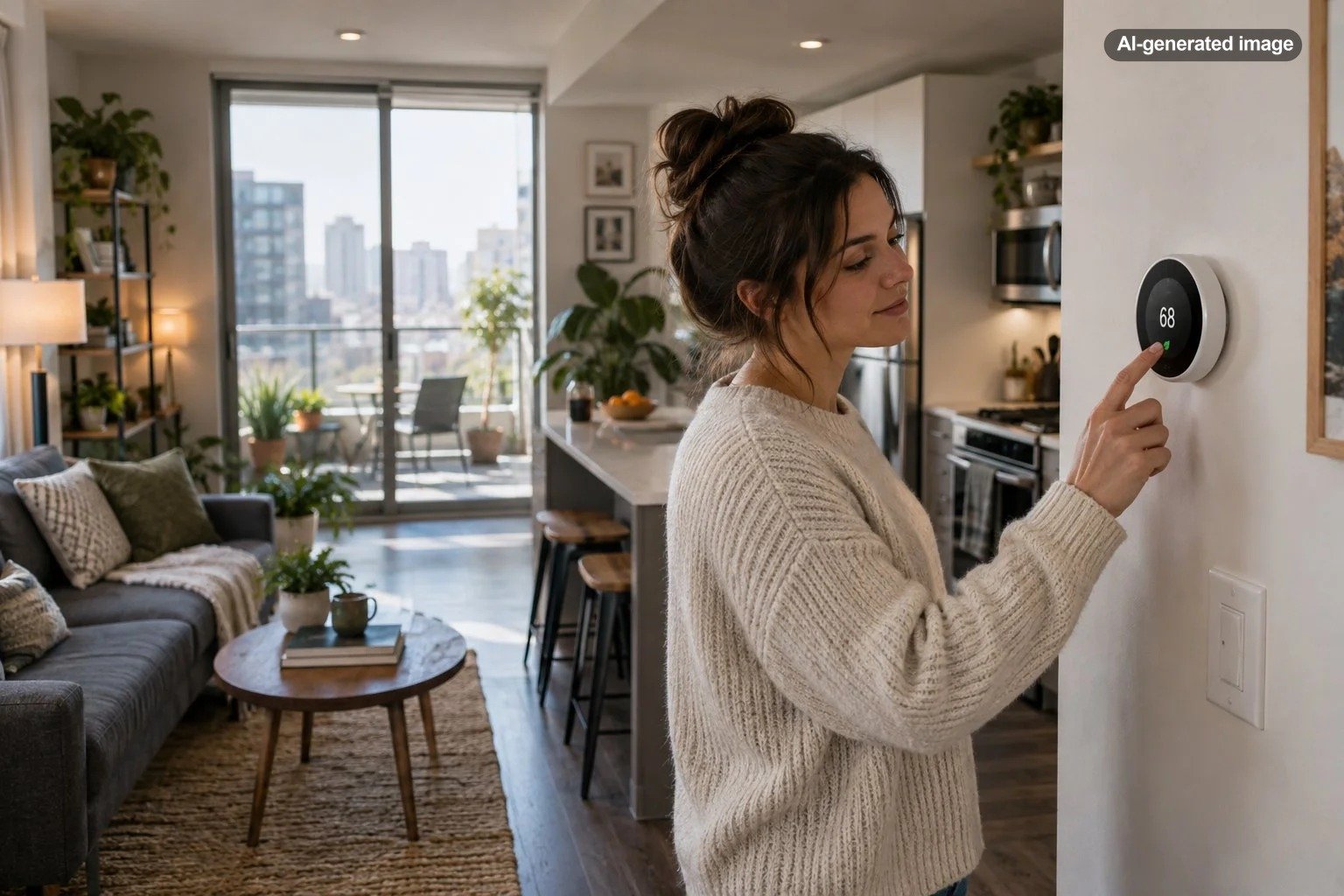
If the system is compatible, a programmable smart thermostat such as the Google Nest Thermostat can provide app-based control and scheduling. Compatibility should be verified for the specific condo HVAC system and wiring before purchase or installation; no smart thermostat is universally suitable.
When the financial payoff may be small
A smart thermostat is not automatically a money-saving purchase in every condo. The improvement can be limited when the HVAC bill is already low, the unit benefits heavily from neighboring conditioned spaces, the occupant maintains energy-conscious settings already, or someone is home nearly all day.
It can also be counterproductive to chase savings by creating uncomfortable temperature swings or using inappropriate setbacks for a particular HVAC system. Heat pumps and other equipment can have control strategies that differ from conventional furnaces and air conditioners. The thermostat should be configured for the equipment it actually controls.
| Condo situation | Potential value of a smart thermostat |
|---|---|
| Empty most weekdays | Strong opportunity for automatic scheduling and setbacks |
| Frequent travel | Remote monitoring and adjustment can be especially useful |
| Someone home most of the day | Less opportunity for occupancy-based savings |
| Already uses an effective programmable schedule | Convenience may improve more than energy use |
| Proprietary or building-controlled HVAC | Compatibility may prevent a conventional smart thermostat upgrade |
Do not overlook comfort and convenience
Energy savings are only one part of the decision. In a condo, the ability to check or change the temperature remotely can be genuinely useful. You might lower cooling after realizing you will be away overnight, adjust the temperature before returning from a trip, or review equipment runtime when trying to understand an unusually high utility bill.
Smart scheduling can also remove a small but repetitive household chore. Instead of manually changing settings before bed, leaving for work, or returning home, the thermostat can handle a predictable routine. For some households, that convenience is enough to justify the upgrade even if the direct financial savings are modest.
Check these details before buying
Before you decide
- Identify whether your condo has its own independently controlled HVAC equipment.
- Check the existing thermostat wiring and the new thermostat’s official compatibility guidance.
- Confirm whether a C-wire, approved power accessory, or professional wiring change is necessary.
- Review condo association or building rules if the thermostat interfaces with shared equipment.
- Think about how many hours each week the condo is actually unoccupied.
- Consider whether you will realistically use scheduling, occupancy features, or remote control.
- Compare the upgrade with your current thermostat habits rather than assuming automation alone guarantees savings.
So, is a smart thermostat worth it in a small condo?
It often can be, especially when the condo has a compatible individual HVAC system and spends predictable stretches of time unoccupied. The smaller space does not eliminate the opportunity to save; it simply means the absolute savings may be lower than in a large home with much higher heating and cooling consumption.
For a consistently occupied condo that already has sensible thermostat settings, the financial case may be less compelling. In that situation, app control, automation, usage information, and convenience may become the stronger reasons to upgrade.
The best first step is therefore not choosing a brand. It is understanding your HVAC system, confirming compatibility, and looking honestly at your daily schedule. A smart thermostat works best when its automation solves a real pattern of unnecessary heating or cooling rather than merely replacing a perfectly adequate thermostat with a more connected one.