How Do You Arrange Chairs Around a Fire Pit?
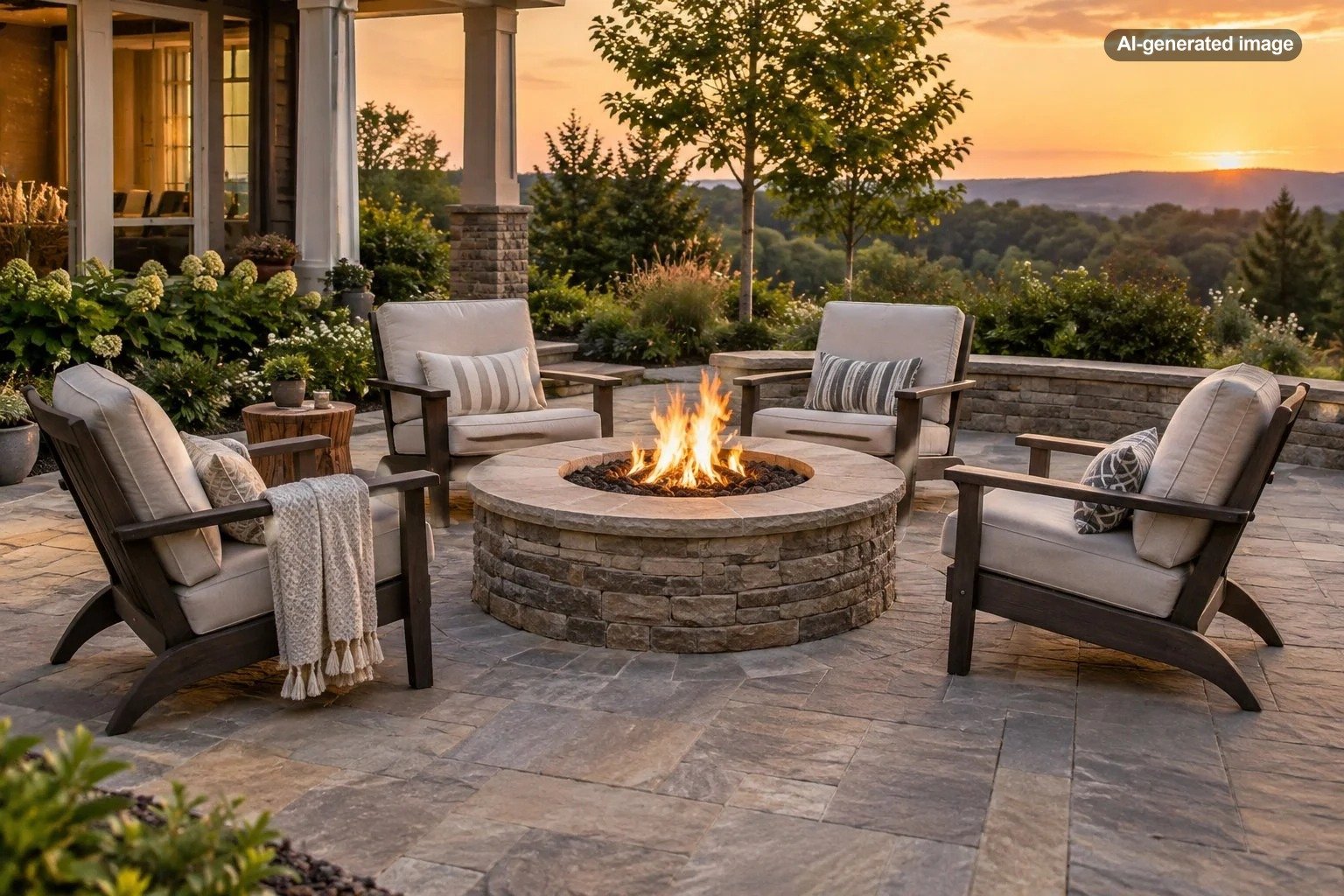
Arrange chairs around a fire pit so the group feels connected without crowding the fire, blocking circulation, or forcing everyone into a rigid ring. Start with the fire pit as the visual center, respect the clearance and operating instructions for your specific unit, and then space the chairs evenly enough for comfortable conversation and easy movement.
The best layout depends on the shape of the pit, the number of people you typically host, how large the patio is, and whether the chairs need to move. A small group often looks and functions better with four loosely arranged chairs than with a complete circle of furniture squeezed around the flames.
Start With Safety Clearance, Not Furniture Symmetry
A beautiful arrangement is not useful if the furniture is positioned too close to heat or flame. Fire pits vary substantially by fuel type, construction, burner design, enclosure, and manufacturer, so there is no single chair-to-fire measurement that should be treated as universal.
Check the instructions supplied with your fire pit for required clearances and operating conditions before deciding where the chairs belong. Those requirements should take priority over an ideal-looking layout.
The U.S. Fire Administration advises using outdoor fireplaces and fire pits outdoors and keeping them at least 10 feet from the home or anything that can burn. It also recommends closely supervising children, using a metal screen over wood-burning fires to help contain sparks, and fully extinguishing the fire before leaving the area.
Choose a Circle, Semicircle, or Open Conversation Group
A full circle is the most obvious fire pit arrangement, but it is not automatically the best one. The right geometry should fit the patio rather than forcing the patio to fit the geometry.
Full circle
A circular arrangement works especially well around a round fire pit on a spacious patio. It gives each chair a similar relationship to the fire and encourages conversation across the group. The drawback is circulation: a completely closed ring can make entering or leaving awkward unless one section is intentionally left open.
Semicircle
A semicircle is useful when the fire pit sits near the edge of a patio, faces a view, or shares space with a house, outdoor kitchen, pool, or garden. The open side creates a natural traffic route and keeps the arrangement from consuming the entire outdoor room.
Loose conversation group
Four or five chairs do not need to form a geometrically perfect arc. Slightly angling the chairs toward one another can feel more relaxed and may work better with rectangular patios, landscaping, and mixed furniture.
A fire pit should anchor the seating area without turning every chair into a piece of a compass drawing.
Match the Layout to the Shape of the Fire Pit
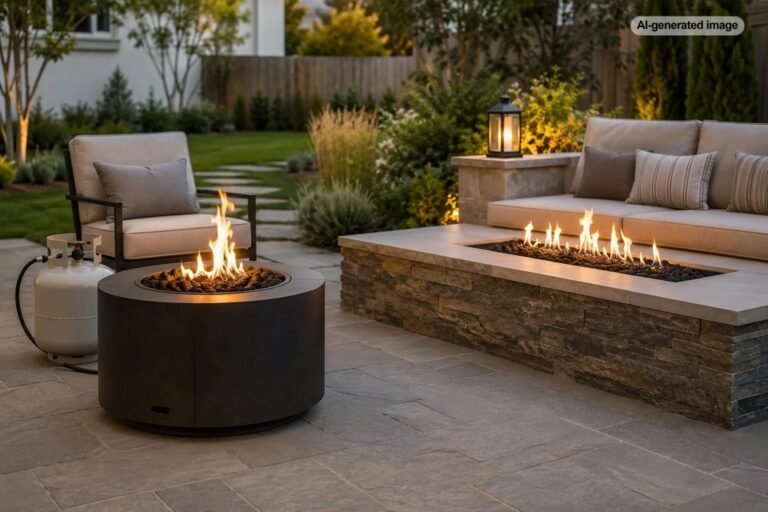
Round fire pits naturally support radial seating. Square fire pits can work with four chairs aligned loosely with the sides or with chairs positioned near the corners for a softer arrangement. Rectangular fire pits often look best with seating concentrated along the longer sides, creating something closer to an outdoor conversation room.
For a rectangular fire feature, two pairs of chairs facing one another can be more practical than trying to wrap furniture around every edge. This also helps preserve a walkway at one end.
| Fire pit shape | Layout that often works well | Main consideration |
|---|---|---|
| Round | Circle or semicircle | Keep an opening for circulation |
| Square | Four-sided or corner-oriented grouping | Avoid making the arrangement feel overly rigid |
| Rectangular | Opposing rows or open U-shape | Give the long sides visual priority |
| Irregular or built-in | Loose conversation grouping | Let patio boundaries guide the furniture |
Give Each Chair Some Breathing Room
Once the fire pit clearance is established, think about spacing between the chairs themselves. Furniture packed shoulder-to-shoulder can make a generous patio feel strangely cramped.
As a practical design starting point, roughly 18 to 24 inches between neighboring chair edges often provides useful personal space while keeping conversation comfortable. Larger lounge chairs may need more. Slim dining-style chairs may need less. Treat this as furniture-planning guidance rather than a fire-safety clearance.
Also consider how people actually sit down. A chair might technically fit in a gap yet still be inconvenient if someone has to squeeze behind another guest, step over a footrest, or walk too close to the fire to reach it.
Leave an Obvious Way In and Out
One of the most common layout mistakes is creating an attractive ring of chairs with no sensible entrance. Instead of distributing every gap equally, make one opening clearly wider and use it as the primary approach to the seating area.
This becomes especially important when guests carry drinks, when older adults use the area, or when the fire pit is part of a larger patio with several activity zones. People should not have to weave between the fire and a chair simply because symmetry won the argument.
Angle Chairs Toward People as Well as the Fire
The instinct is to point every chair directly at the flames. That can work for a large circle, but smaller groups usually feel more conversational when chairs are turned slightly toward neighboring seats.
Try sitting in the arrangement before declaring it finished. From each chair, you should be able to see the fire without twisting awkwardly while also being able to talk naturally with the rest of the group.
Swivel chairs can make this particularly easy in outdoor rooms that serve several purposes, although any outdoor seating should be appropriate for its environment and positioned according to the fire pit manufacturer’s clearance requirements.
Plan Around Real Furniture Dimensions
Measure the furniture rather than estimating from product photos. Deep lounge chairs, Adirondack-style chairs, rocking chairs, and recliners can occupy much more space than their seat width suggests.
Include the chair’s full footprint and the space needed for normal use. A rocking chair needs room to move. A recliner needs space behind or in front of it depending on its mechanism. A chair paired with an ottoman creates a much longer seating zone than a simple upright chair.
Before you decide
- Confirm the fire pit manufacturer’s required clearances.
- Measure the full depth and width of every chair.
- Allow room for people to sit down and stand up comfortably.
- Keep a clear route between the seating area and the house or patio entrance.
- Account for cushions, umbrellas, plants, rugs, and other combustible materials.
- Test the arrangement from every seat before making it permanent.
Do Not Oversize the Seating Group
More chairs do not necessarily make a better fire pit area. An arrangement designed around the maximum possible guest count can feel crowded during the other 95 percent of its life.
If you normally have four people around the fire but occasionally host eight, consider four substantial everyday chairs with lightweight supplemental seating that can be brought out when needed. This preserves circulation and keeps the patio visually calmer.
Small patios especially benefit from restraint. Four appropriately scaled chairs around a modest fire pit can look more intentional than six large chairs forced against walls and planting beds.
Remember That Fire Type Changes the Conversation
Wood-burning, natural-gas, propane, and other fire features do not all behave alike. Heat output, sparks, controls, fuel storage, and operating procedures vary, which is another reason not to copy a chair-spacing measurement from an unrelated patio photograph.
For wood-burning fires, the U.S. Fire Administration recommends a metal screen to help prevent sparks from floating out. The U.S. Consumer Product Safety Commission also advises keeping a hose or fire extinguisher nearby and never using gasoline to start or restart a backyard fire.
CPSC has separately warned consumers about certain alcohol or other liquid-burning fire pits that can present flame-jetting and pool-fire hazards. If you use a portable or tabletop fire product, check current CPSC safety notices and the manufacturer’s instructions rather than assuming it can be treated like a conventional built-in fire pit.
Frequently Asked Questions
Should chairs form a complete circle around a fire pit?
No. A complete circle works well when there is enough space, but leaving part of the circle open usually improves access. Semicircles and loose U-shaped arrangements can be equally attractive and often work better on rectangular patios.
How many chairs should go around a fire pit?
Use the number that fits comfortably after required fire clearances and circulation space are accounted for. Four to six chairs creates a natural conversation group on many patios, but the correct number depends on the dimensions of the fire pit, furniture, and surrounding area.
Should every chair be the same distance from the fire?
They can be approximately even for visual balance, but safety requirements come first. Do not move one chair closer simply to make the arrangement symmetrical if its location conflicts with the manufacturer’s instructions or nearby combustible materials.
Can you put an outdoor rug beneath fire pit seating?
Do not assume a rug is appropriate around every fire pit. Material, fire-pit construction, fuel type, required clearances, and manufacturer instructions all matter. Verify compatibility before introducing combustible furnishings near an open flame.