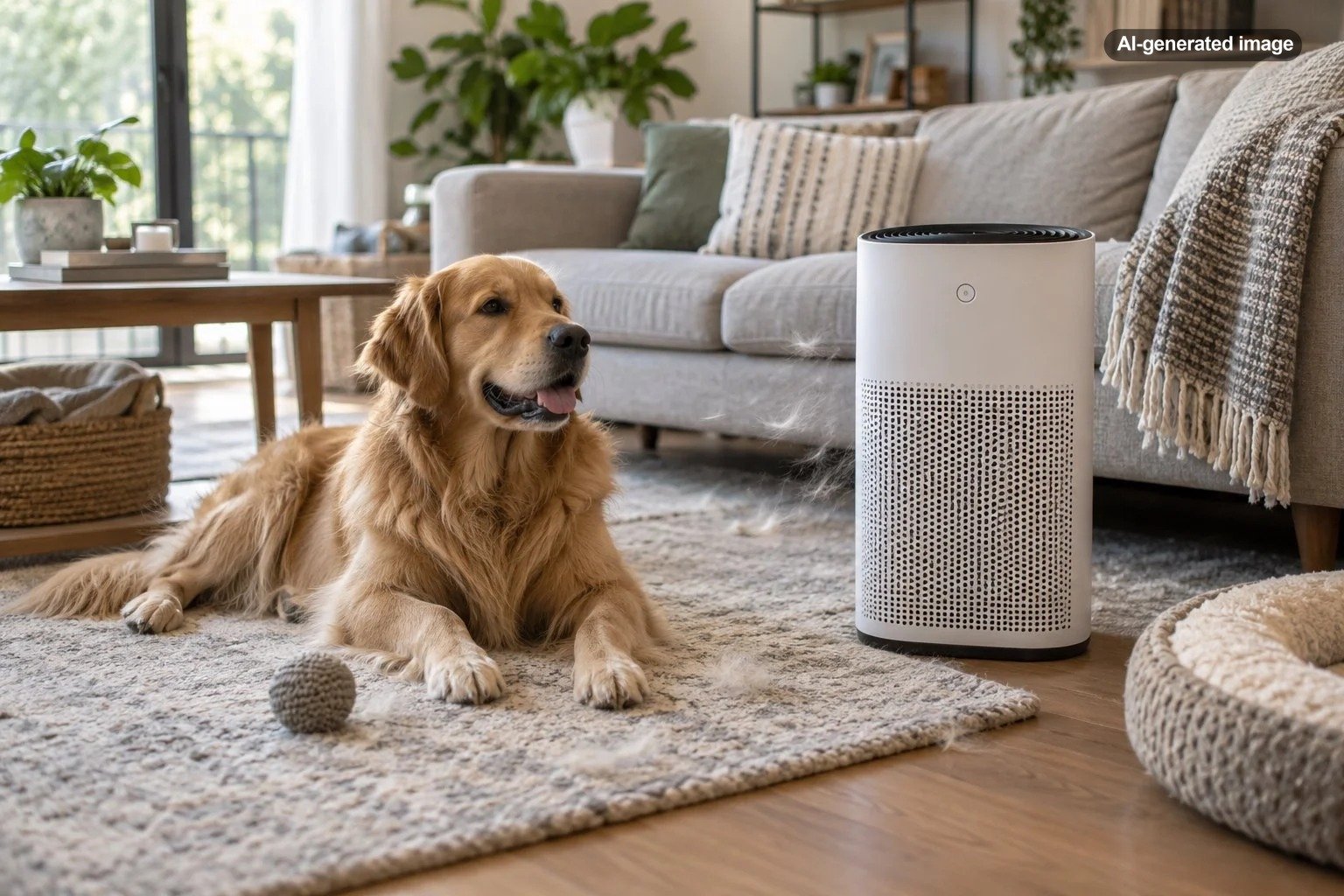
Do Air Purifiers Help With Pet Hair?
Yes, air purifiers can help with pet hair, but their biggest strength is capturing the smaller particles that pets send into the air rather than collecting every visible strand of fur around the house. A well-sized particle-filtering air purifier can capture airborne pet dander, dust, and some lightweight hairs before they settle. It will not replace vacuuming, upholstery cleaning, or grooming.
That distinction matters because the fur you can see on a sofa is only part of the pet-related material moving through a home. Smaller particles can remain suspended long enough to pass through an air purifier, while heavier hair usually settles on floors, furniture, bedding, and clothing first.
What an air purifier can actually do with pet hair
Portable air cleaners pull room air through a filter and return filtered air to the space. According to the U.S. Environmental Protection Agency, portable air cleaners can reduce indoor particle pollution, although no air cleaner removes every pollutant. Their effectiveness depends in part on the filter, airflow, room size, operating speed, and how long the unit runs.
For a pet household, this means an air purifier is most useful for material that becomes airborne. Fine dander, dust carrying pet allergens, and lightweight fragments of hair may enter the purifier while they are suspended. Long or heavy strands that have already landed under a chair or woven themselves into a rug are beyond the purifier’s reach.
An air purifier cleans the air that reaches it; it does not vacuum the room from across the floor.
Pet hair and pet dander are not the same problem
It is useful to separate visible pet hair from pet dander. Hair is relatively easy to see and usually settles onto surfaces. Dander consists of much smaller biological particles associated with animals and can behave differently in indoor air.
The EPA notes that animal dander and other larger allergen particles commonly settle on household surfaces rather than remaining continuously airborne. An air cleaner can only capture particles while they are suspended and moving through the unit. Activity in the room can disturb settled material and put some of it back into the air, but filtration still does not eliminate the need for source control and cleaning.
Why a HEPA air purifier can make sense in a pet household
HEPA is a mechanical particle-filtration standard commonly used in portable air cleaners. The EPA states that a HEPA filter can theoretically remove at least 99.97 percent of airborne particles at 0.3 microns under the filter’s defined performance conditions. That number describes filter efficiency under standardized conditions; it does not mean a portable purifier removes 99.97 percent of all particles from an actual room.
Real-world room performance also depends on how much air passes through the purifier. A highly efficient filter paired with inadequate airflow or an undersized machine may be less useful than expected. For that reason, shoppers should look beyond the word HEPA and consider the purifier’s Clean Air Delivery Rate, commonly abbreviated CADR, and its suggested room size.
Size the air purifier for the room, not the pet
A Great Dane does not automatically require a larger purifier than a Chihuahua. The more useful starting point is the size of the space being filtered.
The Association of Home Appliance Manufacturers uses CADR to express the volume of filtered air an air cleaner delivers. AHAM recommends choosing a purifier with a tobacco-smoke CADR equal to at least two-thirds of the room’s area in square feet under its general sizing guidance. A 300-square-foot room, for example, would call for a smoke CADR of roughly 200 or greater using that rule of thumb. Rooms with ceilings higher than the standard test assumption may benefit from a higher-capacity unit.
Before you decide
- Measure the room where the purifier will actually operate.
- Check the manufacturer’s suggested room size and available CADR information.
- Choose a particle-filtering model rather than relying only on odor-control features.
- Consider noise at the fan speed you are likely to use regularly.
- Check how the prefilter and main filter are maintained or replaced.
- Make sure the purifier can sit where furniture and curtains will not block airflow.
Placement matters when pets are involved
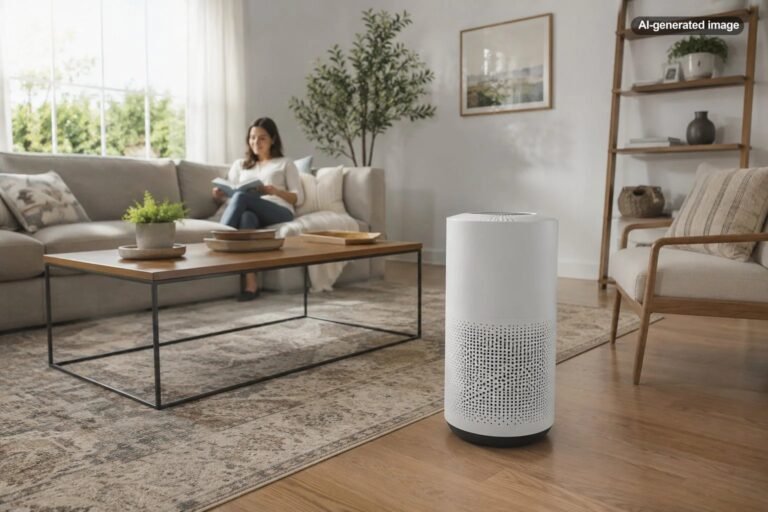
The purifier needs access to moving air. Hiding it tightly between furniture, behind a sofa, or underneath a table can restrict intake or exhaust airflow. A more open position generally gives the machine a better opportunity to circulate room air.
Place the purifier in the room where the pet spends substantial time or where you most want to reduce airborne particles. That may be a living room, bedroom, home office, or another frequently occupied area. One portable purifier in a closed bedroom should not be expected to clean an entire multi-level house.
Running time matters as well. EPA guidance notes that higher fan speeds and longer operating times generally increase the amount of air that passes through the filter. A purifier that is powerful on paper but routinely switched off because it is too noisy is not especially useful.
Expect the prefilter to do some messy work
Pet homes can load filters with visible debris faster than homes without shedding animals. Many particle purifiers use a washable, vacuumable, or replaceable prefilter ahead of the primary filter. Its job can include catching larger material before it reaches the finer filtration stage.
Follow the manufacturer’s instructions for cleaning or replacing each filter. The EPA emphasizes that filters need regular replacement and that an overloaded filter will not work as well. Avoid improvising washing procedures for filters that are not designed to be washed, because moisture or physical damage can compromise the filter media.
Affiliate disclosure: CraneManor.com may earn a commission when you purchase through links on this page. This does not affect the price you pay. Learn more.
For shoppers who want a conventional room purifier rather than a complicated whole-home system, a Coway Airmega purifier is one example of the HEPA-style portable-air-cleaner category. Whatever model you consider, room sizing, airflow performance, filter upkeep, operating noise, and ongoing use matter more than simply choosing a machine labeled for pets.
What works better for the hair you can see
If the real battle is tumbleweeds of fur along baseboards, filtration should be only one part of the routine. Removing hair at its source and from surfaces is usually more effective for visible buildup.
What to do
- Groom appropriately. Regular brushing suited to the animal’s coat can reduce the loose hair available to spread around the home.
- Vacuum floors and upholstery. Pay particular attention to rugs, fabric furniture, corners, and the places where the pet sleeps.
- Wash pet bedding. Follow the bedding manufacturer’s care instructions and clean surrounding surfaces at the same time.
- Run the purifier consistently. Give airborne particles repeated opportunities to pass through the filter.
- Maintain the filters. Inspect prefilters for accumulated fur and follow the manufacturer’s replacement schedule for the main filter.
What about pet odors?
A particle filter and an odor filter solve different problems. HEPA filtration is intended for particles. Gases and odors require filter media designed for gases, commonly activated carbon or another appropriate sorbent material. The EPA notes that CADR ratings apply to particles rather than gases.
This means a purifier can be excellent at particle filtration without being particularly effective against odor. If odor control is an important goal, examine what the machine actually uses for gas filtration rather than assuming every pet-marketed purifier performs the same way.
Should you buy an air purifier specifically because you have pets?
It can be worthwhile if your goal is to reduce airborne particles in rooms where pets spend time. It is particularly sensible when you already vacuum and clean regularly but still notice airborne dust or want another layer of particle control.
It is less compelling if your only problem is visible fur on hard floors and upholstery. In that situation, putting the same effort into grooming, vacuuming, washable throws, and cleaning pet bedding may make a more obvious difference.
Frequently asked questions
Will an air purifier remove dog hair from the air?
It can capture some lightweight dog hair while that hair is airborne and reaches the purifier. Most heavier strands settle onto surfaces quickly, where vacuuming or physical cleaning becomes the more effective solution.
Will an air purifier remove cat hair?
The same principle applies to cat hair. Floating fibers may be captured, but an air purifier will not remove hair that has already settled on furniture, bedding, clothing, or floors.
Is HEPA important for pet owners?
HEPA filtration can be useful when the goal is efficient particle capture. However, the purifier still needs adequate airflow for the room and regular filter maintenance. The HEPA label alone does not tell you how quickly a particular machine will clean a given room.
Can an air purifier replace vacuuming if I have pets?
No. Air purifiers address airborne particles. Vacuuming, dusting, laundering, and upholstery cleaning remove material that has settled onto household surfaces.
Should I leave an air purifier running all day?
Longer operating times generally allow more air to pass through the filter. Follow the manufacturer’s operating instructions, and choose settings that balance filtration, noise, and practical household use.