How Far Should Outdoor Furniture Be From a Fire Pit?
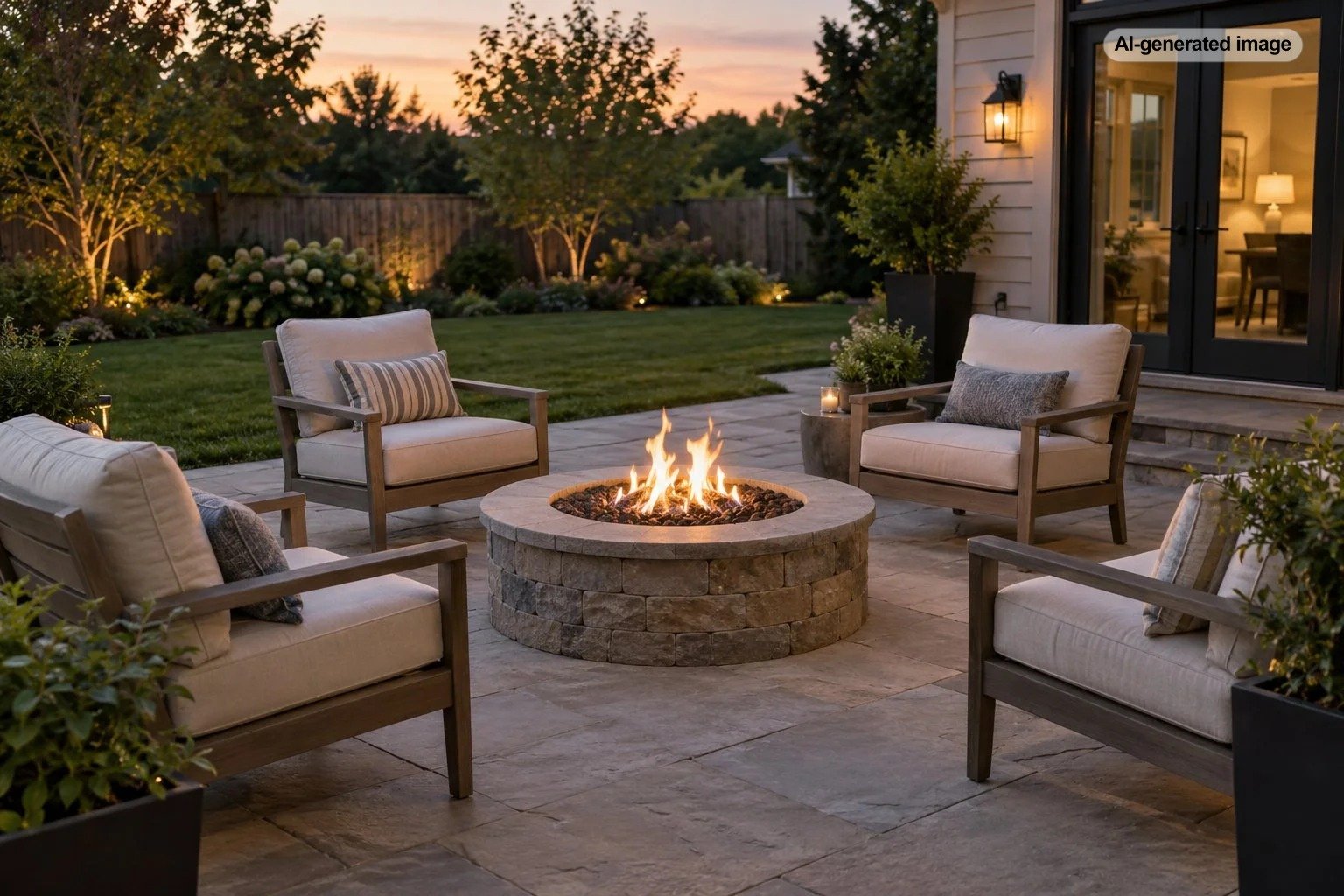
As a practical starting point, keep outdoor furniture at least 3 feet from the outer edge of a fire pit. That distance should be treated as a minimum clear zone, not a universal guarantee. The fire pit manufacturer’s instructions, local fire rules, fuel type, flame size, wind, and furniture materials may require substantially more room.
For wood-burning pits, generous spacing is particularly important because sparks and embers can travel beyond the bowl. Gas fire tables usually create fewer flying embers, but their flames and heated surfaces can still damage cushions, synthetic wicker, painted finishes, and exposed skin. When two rules differ, follow the larger clearance.
Why three feet is a starting point rather than a perfect number
The U.S. Fire Administration advises placing backyard fire pits at least 3 feet from a house and anything that can burn. That establishes a useful minimum for combustible furnishings, but it does not replace the instructions written for a particular appliance.
Fire pits vary widely. A low-output propane table with a controlled central flame behaves differently from an open wood fire loaded with several logs. Bowl diameter, burner output, flame height, spark control, and the temperature of the pit’s exterior all influence how much clearance is appropriate.
Published instructions can also be more restrictive. One wood-burning fire pit manual, for example, directs users to place that model no closer than 10 feet from walls and not to operate it on a combustible surface. This is why a generic patio diagram should never overrule the manual supplied with the actual pit.
The safest furniture layout begins with the appliance’s required clearance and then adds enough room for people to sit, stand, and walk without leaning over the fire.
Measure from the fire pit’s outer edge
Measure horizontally from the closest outside edge of the fire pit, not from its center. Stop at the nearest part of the furniture, which may be the front legs, cushion, arm, footrest, or curved edge of a sectional. Measuring from center to center can make a layout appear more generous than it really is.
For example, a 36-inch-diameter fire pit with a 3-foot clear zone needs a circle approximately 9 feet in diameter before furniture begins: 3 feet of clearance, 3 feet of fire pit, and another 3 feet of clearance. The chairs themselves and a circulation path require additional patio space beyond that circle.
How to mark the layout
- Place the unlit fire pit in its intended position on an approved surface.
- Confirm every clearance in the manufacturer’s manual, including side, overhead, and structural clearances.
- Measure outward from the pit’s outer edge and mark the minimum zone with painter’s tape, chalk, or removable landscape flags.
- Arrange furniture outside the marked zone, accounting for reclining backs, extended footrests, and cushions that project beyond the frame.
- Sit in each seat and confirm that guests can stand and exit without stepping toward the flame.
Allow more room for wood-burning fires
A wood-burning pit can release sparks when logs shift, resin pockets pop, or wind passes across the fire. A properly fitted metal screen can reduce escaping sparks, but it does not make nearby combustible furniture fireproof. Deep cushions, outdoor rugs, throw blankets, dry leaves, and woven furniture deserve particular attention because a small ember may settle unnoticed.
Start beyond the minimum when the pit has a broad open bowl, produces tall flames, or is used in an exposed location. Keep fires modest and use only the fuel permitted by the manufacturer. Do not add liquid fuel to an established fire, and do not overfill the bowl simply because the furniture has been moved farther away.
Local guidance may establish a separate distance between the fire pit and structures. Montgomery County, Maryland, for example, recommends at least 10 feet from a home and a clear area around the appliance, while also instructing residents to follow manufacturer guidelines. Local rules differ, so homeowners should consult their fire department or code authority rather than treating one jurisdiction’s number as nationwide law.
Gas fire pits still require clear space
Gas fire pits and fire tables eliminate drifting wood embers during normal operation, but they still generate radiant heat. A low table can place the flame surprisingly close to a seated person’s knees or to the front edge of a cushion. Some designs also have hot glass guards, metal surrounds, or decorative media that should never be touched while the appliance is operating.
Follow the manual’s clearances to combustible materials and its restrictions for overhead roofs, umbrellas, and partially enclosed areas. Never assume that a pergola or screened porch is suitable merely because it feels open. Ventilation and overhead-clearance requirements are specific to the appliance and installation.
Gas hoses, valves, and access panels must remain unobstructed. Arrange chairs so guests cannot kick a cylinder enclosure, pull a hose, or block the route to the shutoff control. If a permanent natural-gas unit needs installation or service, use a qualified professional and follow applicable local requirements.
Furniture material changes the risk, not the rules
Metal furniture will not ignite like dry wood, but metal can become painfully hot when exposed to radiant heat. It may also conduct heat toward armrests or frames that people naturally touch. Wood furniture can char, while plastic and synthetic wicker may soften, discolor, or melt before visible flames reach them.
Cushions are often the closest combustible component, even when the frame is metal. Consider the full upholstered profile when measuring. Loose pillows and throws should not be draped over a chair back where wind can lift them toward the fire.
An outdoor rug can quietly erase an otherwise sensible safety zone. Verify that both the fire pit and flooring arrangement comply with the appliance instructions. A decorative mat marketed as heat resistant is not automatic permission to operate a pit on wood, composite decking, artificial turf, or another surface prohibited by the manufacturer.
Plan for comfort and circulation
A safe arrangement should also work when people move. Adirondack chairs need extra rear space because of their reclined shape. Swivel chairs change position during use, and reclining furniture can extend into the clear zone after guests sit down. Lightweight chairs may migrate closer to the warmth as the evening cools.
Leave an unobstructed route around or away from the seating group. Guests should not have to squeeze between the fire and another chair, step over a gas hose, or back toward flames while standing. Avoid placing a frequently used cooler, serving station, or wood supply where people must repeatedly cross the fire zone.
Check the wider surroundings
Furniture distance is only one part of fire pit placement. Survey the complete area before lighting a fire:
- Look above for umbrellas, shade sails, rooflines, tree branches, and string lights.
- Move planters with dry foliage, mulch, firewood, propane cylinders not connected for use, and cleaning chemicals away from the pit.
- Clear leaves and other debris from beneath and around the seating area.
- Confirm that the pit rests on a stable surface permitted by its instructions.
- Check current burn restrictions, weather conditions, and local rules.
- Keep the appliance away from busy paths where someone could trip or collide with it.
Tabletop alcohol-fueled fire pits require special caution. The U.S. Consumer Product Safety Commission has warned about serious flame-jetting and pool-fire hazards involving certain products. Never refill a liquid-fueled device while it is burning, hot, or potentially holding a flame that is difficult to see, and stop using any model subject to an applicable safety warning or recall.
Move and protect furniture only after the pit is cold
When the evening ends, fully extinguish or shut down the fire according to the manufacturer’s instructions. Do not move the pit, install a lid, handle ashes, or bring cushions over it until the unit is completely cool. Embers and ash can retain heat long after visible flames disappear.
Once the fire pit is cold and the furniture has been returned to its storage position, a properly sized cover can help protect a compatible chair from routine dirt and weather exposure. Measure the chair first, secure the cover, preserve ventilation, and remember that water-resistant fabric is not necessarily waterproof.
Affiliate disclosure: CraneManor.com may earn a commission when you purchase through links on this page. This does not affect the price you pay. Learn more.
For an appropriately sized lounge chair, options include a Classic Accessories Veranda cover. A furniture cover is for protection between uses; it should be kept outside the required clearance whenever the fire pit is active.
Frequently asked questions
Is three feet enough for every fire pit?
No. Three feet is a useful minimum starting point for combustible objects and people, but the manufacturer’s stated clearance may be greater. Wind, tall flames, flying embers, furniture materials, and local regulations may also justify additional distance.
How far should a fire pit be from the house?
Follow the fire pit manual and local requirements. Some public fire-safety authorities recommend substantially more separation from a house or shed than the basic furniture clear zone. Do not assume that a safe chair distance is also a safe structural distance.
Can outdoor furniture sit closer to a propane fire table?
Only if the manual expressly permits the resulting clearance. A propane flame may be controlled and free of wood sparks, but radiant heat and hot surfaces can still injure people or damage furniture.
Should distance be measured from the flame or the table edge?
Use the outer edge of the appliance as the practical measuring point unless its manual specifies another method. Measuring from the flame alone can ignore hot surrounds and exterior surfaces.
Can a spark screen let furniture sit closer?
No. A screen can help contain sparks from a wood fire, but it does not eliminate radiant heat, all escaping embers, or the need to maintain required clearances.