

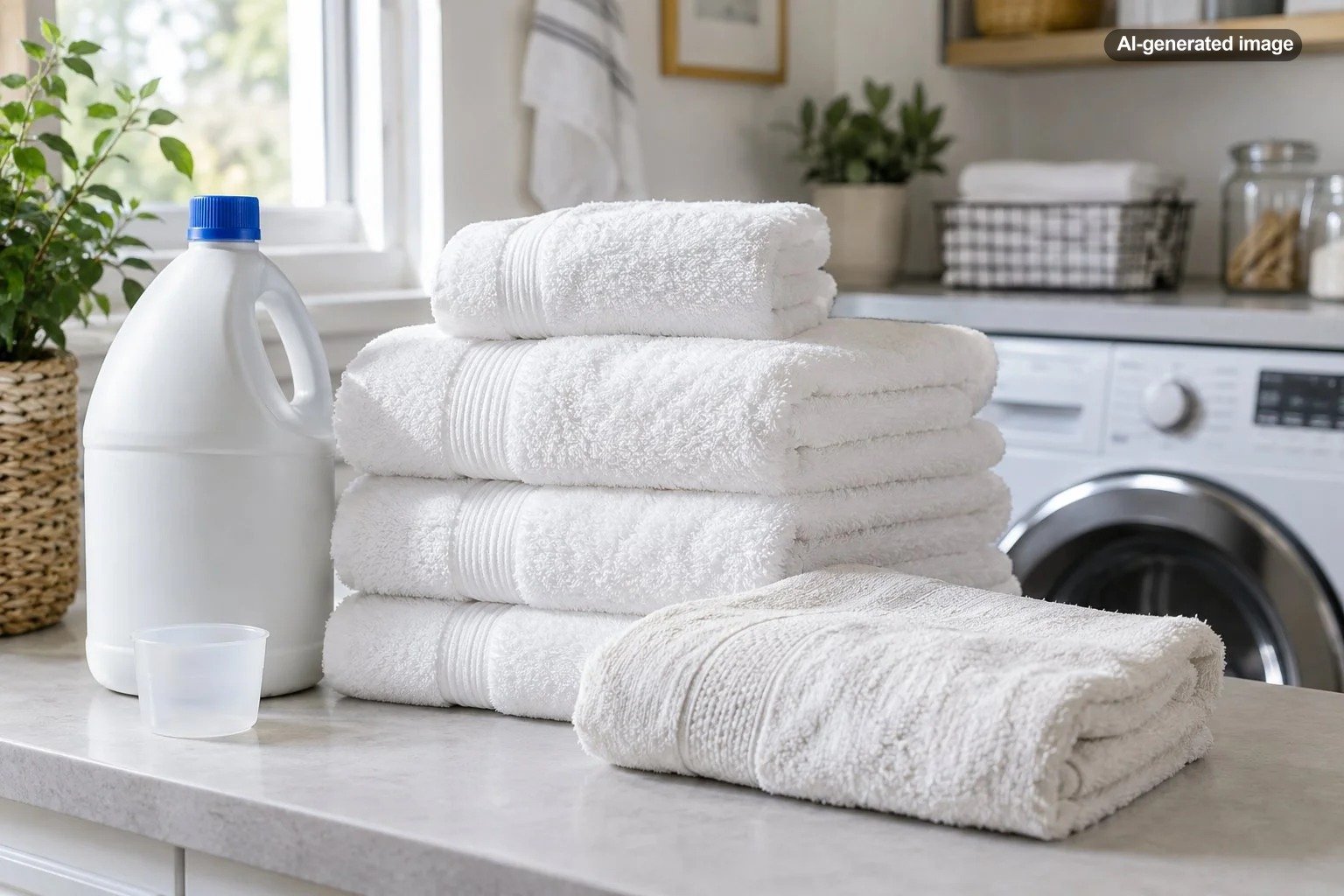
Can You Use Bleach on White Towels Every Time?
You generally do not need to use chlorine bleach on white towels every time you wash them. Bleach can be useful for compatible white towels when they are noticeably dingy, stained, or in need of occasional whitening, but a normal wash with detergent is usually the better everyday routine.
The important detail is the towel’s care label. White does not automatically mean bleach-safe. Towels can contain decorative threads, blended fibers, special finishes, or construction details that change how they should be laundered.
Why bleaching every load is usually unnecessary
For ordinary bath towels, the basic job of the wash cycle is to remove body oils, soil, skin-care residue, and other everyday buildup. A suitable laundry detergent and a properly loaded washing machine can handle most routine cleaning without adding chlorine bleach to every cycle.
That makes bleach better viewed as an occasional tool than an automatic ingredient. If towels come out clean, smell fresh after drying, and still look reasonably white, adding bleach simply because the fabric is white offers little practical benefit.
Repeated exposure to harsher laundering conditions can also contribute to ordinary textile wear over time. Towels already endure detergent, agitation, rinsing, spinning, and dryer heat. A simpler routine is often preferable when stronger treatment is not solving a specific problem.
Check the care label before reaching for bleach
The care label should settle the question before color does. Laundry instructions may permit any bleach when needed, restrict the towel to non-chlorine bleach, or prohibit bleaching altogether.
This matters because a white towel may not be made from plain, untreated white cotton. It might have contrasting embroidery, a decorative border, a performance finish, or another component that reacts differently from the main fabric.
When chlorine bleach can make sense
If the towel’s care instructions allow chlorine bleach, occasional use can be reasonable when regular laundering is no longer giving you the result you want. Common situations include persistent dinginess or certain stubborn stains on otherwise bleach-compatible white towels.
Use the washing machine’s bleach dispenser when the appliance provides one, and follow the bleach product’s directions for the machine type and load. Pouring concentrated bleach directly onto a towel is not a good substitute for proper dispensing and dilution.
It is also worth fixing the underlying laundry issue rather than repeatedly escalating the chemistry. Towels that become gray or dull quickly may be dealing with excessive detergent, overloaded wash cycles, incomplete rinsing, mineral-related buildup, or residue from products used on the body.
When a gentler approach is better
If the label says only non-chlorine bleach when needed, chlorine bleach is not the appropriate choice for routine care. An oxygen-based or other non-chlorine laundry bleach may be compatible, provided it is used according to both the textile and product instructions.
If the label says do not bleach, skip both chlorine and non-chlorine bleach unless the manufacturer specifically provides different care guidance for that towel.
You may also decide that no bleach is necessary even when the label permits it. A lightly used guest towel that remains clean and bright, for example, does not need the same treatment as a heavily used household bath towel with visible staining.
| Situation | Sensible approach |
|---|---|
| Towels look clean and white | Wash normally with detergent |
| White towels are becoming dingy | Check the care label, wash routine, and detergent use before adding stronger treatment |
| Label permits bleach when needed | Use bleach occasionally according to product and machine directions |
| Label permits only non-chlorine bleach | Avoid chlorine bleach |
| Label says do not bleach | Use a bleach-free laundering routine |
How to keep white towels looking white without bleaching every wash
A few laundry habits usually matter more than automatically adding bleach. Start by giving towels enough room to move in the washer. An overpacked drum can make it harder for detergent and rinse water to circulate through thick terry fabric.
Use an appropriate amount of detergent rather than assuming more detergent means cleaner towels. Excess product that does not rinse away can contribute to residue and stiffness. The same principle applies to other laundry additives: more is not necessarily better.
Dry towels thoroughly after washing and avoid leaving damp towels crumpled in a hamper or washing machine. If a towel develops persistent odor or discoloration despite a sound routine, investigate the cause instead of relying on repeated bleaching to cover it up.
A practical white-towel routine
- Read the care label before the first wash and whenever you are considering a new treatment.
- Wash towels with an appropriate detergent and avoid crowding the machine.
- Dry them thoroughly before folding or storing them.
- Evaluate the result before adding another laundry product.
- If whitening is genuinely needed, choose a bleach type allowed by the care instructions and use it according to its label.
Common bleach mistakes with towels
One of the most common mistakes is assuming every white textile should tolerate the same routine. A plain white bath towel, a towel with decorative stitching, and a premium towel with a specialized finish may all require different care.
Another mistake is treating bleach as a substitute for good laundering. If towels consistently leave the wash dull, stiff, or poorly rinsed, increasing the amount or frequency of bleach may distract from a loading, detergent, washing, or water issue that deserves attention.
Finally, avoid mixing bleach casually with other cleaning chemicals. Laundry products should be used according to their labels and through the washing machine compartments or procedures intended for them.
What if your white towels are already worn or permanently discolored?
Not every towel can be restored to a crisp original white. Older towels may show gradual fiber wear, discoloration, thinning, or staining that laundering cannot completely reverse. At that point, repeated aggressive treatment can become an exercise in chasing a finish the textile no longer has.
There is nothing wrong with retiring a visibly worn towel from the guest bath while keeping it for less appearance-sensitive jobs around the house. A towel can stop looking presentation-ready before it stops being useful.
The best white-towel routine is not the strongest one; it is the mildest routine that consistently gets the towels clean.
Frequently asked questions
Does white cotton automatically mean chlorine bleach is safe?
No. Check the care instructions. Construction details, finishes, trims, and other components can affect whether chlorine bleach is appropriate.
Should I bleach towels just because they are used in a bathroom?
Not automatically. For normal household use, routine laundering should be based on the towel’s care instructions and how soiled it actually is.
Can non-chlorine bleach be used more often?
Only when the towel’s care instructions allow it and the laundry product is used as directed. Non-chlorine does not mean that every product is appropriate for every textile.
Why do white towels turn dingy?
Dinginess can have several causes, including accumulated soil, detergent or product residue, inadequate rinsing, crowded wash loads, and gradual wear. It is worth reviewing the whole laundry routine before assuming stronger bleach is the answer.
So how often should I bleach white towels?
There is no universal schedule. If the towels are bleach-compatible, use bleach when there is a specific need rather than automatically adding it to every load. Clean, bright towels that respond well to ordinary washing do not need extra treatment simply because the bottle is nearby.