
Should You Sleep With an Air Purifier On?
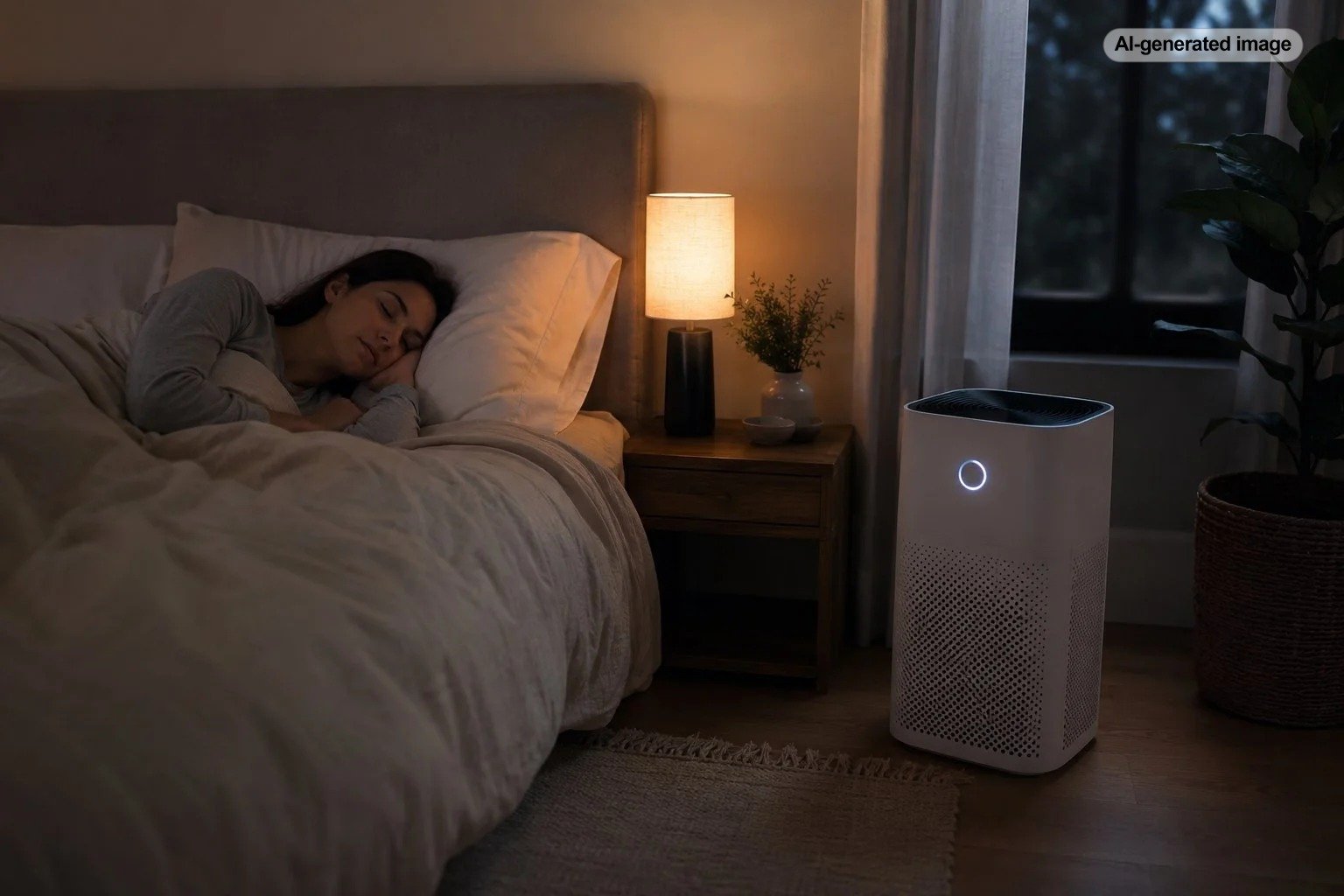
Yes, in most homes you can sleep with an air purifier on, and continuous overnight operation can be a sensible way to reduce airborne particles in the bedroom. A portable purifier works by repeatedly drawing room air through its filtration system, so turning it off for most of the night also stops that ongoing filtration.
The important qualifications are that the purifier should be appropriately sized and maintained, comfortable enough to sleep beside, and not intentionally generating ozone. It should also be treated as one part of an indoor-air strategy rather than a substitute for controlling pollution sources or bringing in clean outdoor air when conditions allow.
Why running an air purifier overnight can make sense
Portable air cleaners are designed to reduce airborne contaminants in a room or defined area. The U.S. Environmental Protection Agency says portable air cleaners and upgraded HVAC filtration can improve indoor air quality, although no air cleaner removes every pollutant.
A bedroom is particularly well suited to room-based filtration because the door may remain closed for hours and the occupants stay in essentially the same space. Dust, pollen, fine particles, pet-related particles, and other airborne material can continue circulating while you sleep. A purifier that continues moving air through an effective particle filter can keep filtering that air throughout the night.
That does not mean the machine needs to run at maximum speed. Many people will get more practical value from a purifier they can tolerate every night than from a louder setting that makes them switch the machine off.
The best overnight purifier setting is usually one that provides useful airflow without becoming the loudest thing in the bedroom.
What an air purifier can and cannot do while you sleep
Filtration is only one part of indoor air quality. EPA guidance emphasizes three broad approaches: control or remove pollutant sources, ventilate with clean outdoor air, and use filtration as a supplement. A bedroom purifier therefore should not become an excuse to ignore an active moisture problem, indoor smoke, a malfunctioning combustion appliance, persistent mold growth, or another identifiable source.
Particle filtration is also different from removing gases. A HEPA filter is designed for particles. EPA defines HEPA as a high-efficiency particulate air filter capable, in standardized terms, of removing at least 99.97 percent of airborne particles at 0.3 microns, with particles above and below that reference size also captured efficiently. That definition does not mean a HEPA purifier eliminates every contaminant from an actual bedroom, however, because real-world performance also depends on airflow, room conditions, placement, runtime, and pollutant type.
Should you leave the purifier on all night or use a timer?
Either approach can be reasonable. Leaving a particle-filtering purifier on throughout the night provides continuous filtration. A timer may be more comfortable if you mainly want extra filtration before falling asleep or if even the lowest fan setting bothers you later in the night.
Automatic modes offer another compromise. Some purifiers use a particle sensor to adjust fan speed according to detected air conditions. For example, the Coway Airmega AP-1512HH Mighty includes automatic operation, air-quality monitoring, timer settings, and an Eco mode according to the manufacturer’s current product information. Those sorts of controls can be convenient for a bedroom because they reduce the need to manually change speeds during the night.
Affiliate disclosure: CraneManor.com may earn a commission when you purchase through links on this page. This does not affect the price you pay. Learn more.
If you are shopping for that style of appliance, a Coway Airmega purifier is one example with automatic operation and adjustable modes. Whatever model you choose, prioritize suitable filtration, adequate airflow for the intended room, manageable noise, readily available replacement filters, and controls you will actually use.
Where should an air purifier go in a bedroom?
A purifier cannot move much air if its intake or outlet is buried against furniture, curtains, bedding, or a wall. Follow the manufacturer’s placement instructions and give the machine enough open space to draw in room air and release filtered air without obstruction.
It also does not need to sit inches from your face. A practical location often matters more than placing it immediately beside the pillow. Choose a stable surface or floor position allowed by the product instructions, keep airflow paths clear, and route the power cord where nobody will trip over it when getting out of bed in the dark.
Before you decide
- Check that the purifier is intended for the size of room where you plan to use it.
- Make sure its lowest practical fan setting is quiet enough for your sleeping preferences.
- Keep the intake and clean-air outlet clear of curtains, furniture, and bedding.
- Confirm that replacement filters are practical to obtain and maintain.
- Avoid intentionally ozone-generating air cleaners in occupied spaces.
What about ionizers and ozone?
This is an important distinction because products marketed under the broad term air cleaner do not all work the same way. EPA specifically advises against using ozone generators in occupied spaces. Ozone is a lung irritant, and EPA says no federal government agency has approved ozone generators for use in occupied spaces.
Some electronic air-cleaning technologies can also produce ozone as a by-product. EPA notes that evidence for newer technologies such as bipolar ionization is less established than the evidence for conventional filtration and recommends particular caution when evaluating them. If your primary goal is straightforward bedroom particle filtration, a conventional mechanical-filtration approach is easier to assess.
How to make overnight filtration easier to live with
Start by running the purifier at a higher speed before bedtime if the room needs more aggressive filtration, then reduce it to a quieter setting when you are ready to sleep. This can be more comfortable than putting the unit on its highest setting eight hours straight.
Keep up with filter maintenance as directed by the manufacturer. A neglected pre-filter can collect visible dust and pet hair, while other filters eventually need replacement according to the specific appliance’s instructions. Do not assume every purifier uses the same maintenance schedule.
Also consider what is happening elsewhere in the room. Regular cleaning can reduce settled dust that might otherwise be stirred back into the air. If outdoor conditions are good, appropriate ventilation may help with pollutants that filtration alone does not address. During wildfire smoke, heavy outdoor pollution, or other poor-air events, however, opening windows may be counterproductive, so outdoor conditions matter.
When leaving an air purifier on is not the real solution
If the bedroom has persistent dampness, visible mold, strong unexplained odors, smoke intrusion, or a suspected combustion or ventilation problem, simply operating a purifier longer may miss the underlying issue. Air cleaning can reduce some airborne material, but it does not repair a leak, eliminate a moisture source, correct unsafe combustion, or remove every gas.
Likewise, people with significant respiratory symptoms or other health concerns should not treat an air purifier as medical treatment. Indoor-air improvements can be useful, but unexplained or persistent symptoms deserve appropriate medical evaluation rather than assumptions about what is in the room.
Frequently asked questions
Is it better to run an air purifier continuously?
Continuous operation provides ongoing filtration, but you can choose fan speeds, automatic modes, or timers based on noise, room conditions, and the manufacturer’s instructions. The machine only filters room air while it is moving air through its filtration system.
Should I put an air purifier next to my bed?
Not necessarily. Place it where its intake and outlet remain clear and where the manufacturer’s instructions permit. A stable, unobstructed location that circulates air through the room is more important than placing the unit immediately beside your pillow.
Should I close my bedroom door when using an air purifier?
A closed door can make the bedroom a more defined space for a room purifier to filter, but household ventilation needs still matter. Do not block required ventilation or treat a closed room and purifier as a solution to active pollution sources.
Can an air purifier replace opening a window?
No. Filtration and ventilation do different jobs. EPA recommends source control and ventilation with clean outdoor air as primary indoor-air strategies, with filtration used as a supplement. Whether opening a window is helpful depends on outdoor air quality, weather, humidity, and the pollutant you are trying to manage.