
How Often Should You Change an Air Filter in a Humid Climate?
In a humid climate, a sensible rule is to check your HVAC air filter every month and replace it whenever it is visibly dirty, rather than relying on one rigid calendar interval. ENERGY STAR recommends monthly checks and says filters should be changed at least every three months, while the U.S. Environmental Protection Agency notes that many manufacturers recommend replacement roughly every 60 to 90 days.
That does not mean every filter in every humid home lasts exactly one, two, or three months. Filter type, system runtime, pets, household dust, renovation work, smoke, occupancy, and the amount of air moving through the system can all affect how quickly a filter loads with particles. In a hot, humid region where air conditioning runs heavily for long stretches, monthly inspection becomes especially useful.
Why humid climates can change the maintenance rhythm
Humidity does not create a universal special replacement interval for HVAC filters. The more practical issue is how a humid climate changes the way the cooling system operates. During long periods of warm weather, an air conditioner or heat pump may run frequently to maintain temperature and help control indoor moisture. HVAC filtration occurs as air moves through the system, so a heavily used system can expose its filter to more circulating dust and particles over time.
This is why a calendar reminder alone is not enough. Two neighboring homes can use the same nominal filter size and still need very different replacement schedules. One might have minimal dust, no pets, and moderate system use. The other might have several pets, frequent door traffic, construction nearby, and an air conditioner operating for much of the day.
The best replacement schedule is based on the condition of the filter and the demands placed on the system, not humidity alone.
Start with a monthly inspection
ENERGY STAR advises homeowners to inspect, clean, or change filters monthly. Its residential guidance also notes that a dirty filter restricts airflow and makes heating and cooling equipment work harder. That makes a monthly check a useful baseline even when the filter itself is designed to remain in service longer.
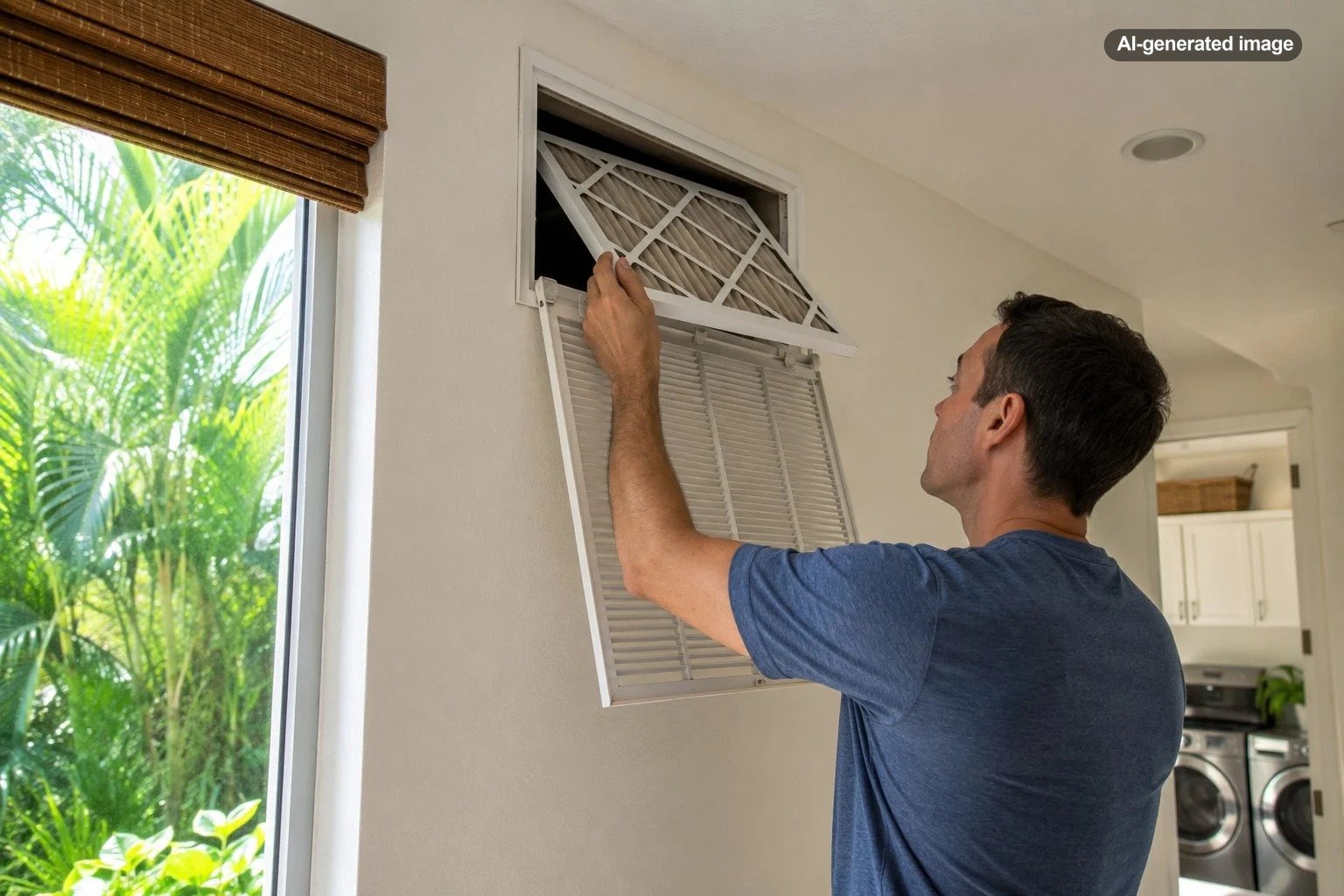
Make the inspection easy to remember by tying it to another monthly household task. Turn the HVAC system off as directed by the equipment manufacturer before accessing the filter, then look at the filter surface under good light. A light coating of dust does not necessarily mean immediate replacement, but a filter that is heavily coated, matted with debris, damaged, damp, or obviously restricting airflow should not simply be left in place because the calendar says it has more time.
What to do
- Check the filter size and replacement instructions specified for your HVAC system.
- Inspect the filter every month during heavy cooling periods.
- Replace a disposable filter when it is visibly dirty or when the manufacturer’s replacement interval is reached.
- If you use a reusable filter, clean it only according to its manufacturer’s instructions and allow it to be handled as directed before reinstalling it.
- If filters become unusually dirty much faster than expected, look for a household or HVAC-related reason rather than simply accepting the new pattern.
What can make a filter need replacement sooner?
Humid weather is only part of the picture. Several ordinary household conditions can make a filter collect debris faster. Homes with shedding pets may see more hair and dander reaching return-air pathways. Remodeling, drywall sanding, woodworking, or other dusty projects can load a filter quickly. Smoke, frequent cooking particles, open doors, tracked-in soil, and unusually dusty indoor conditions can also contribute.
System runtime matters as well. A filter in a house where the cooling system runs briefly each day is not experiencing the same duty cycle as one in a home where cooling is needed for much of the afternoon and evening. The appropriate response is not to guess an aggressively short replacement schedule, but to inspect often enough that you learn what is normal for your own home.
Humidity should be managed separately from filtration
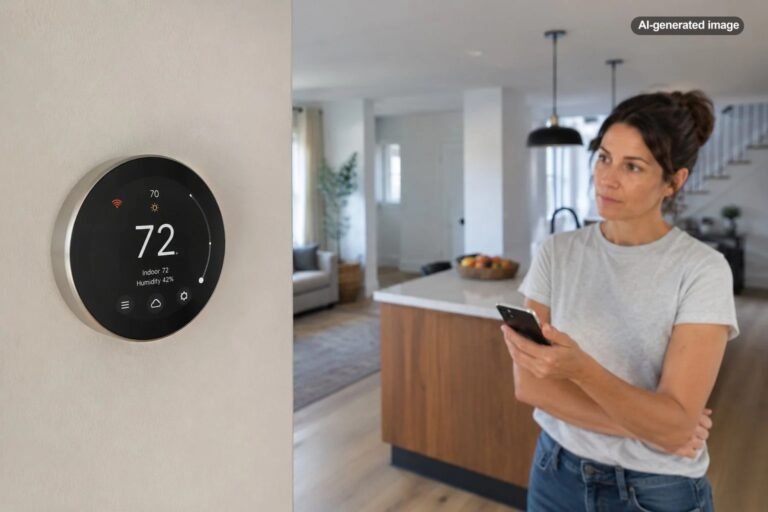
An HVAC filter is primarily there to capture particles moving through the system. It is not a substitute for controlling excessive indoor moisture. The EPA recommends paying attention to indoor relative humidity and says consistently high humidity deserves its own moisture-control strategy. Its consumer indoor-air guidance generally recommends keeping indoor humidity in the 30 to 50 percent range.
Affiliate disclosure: CraneManor.com may earn a commission when you purchase through links on this page. This does not affect the price you pay. Learn more.
If you live in a humid region, tracking indoor conditions can therefore be useful alongside routine filter checks. A basic digital hygrometer can provide a simple room-level reading of temperature and relative humidity. It does not diagnose mold, HVAC problems, or moisture sources, but it can help you see whether a room routinely feels damp because humidity actually is elevated.
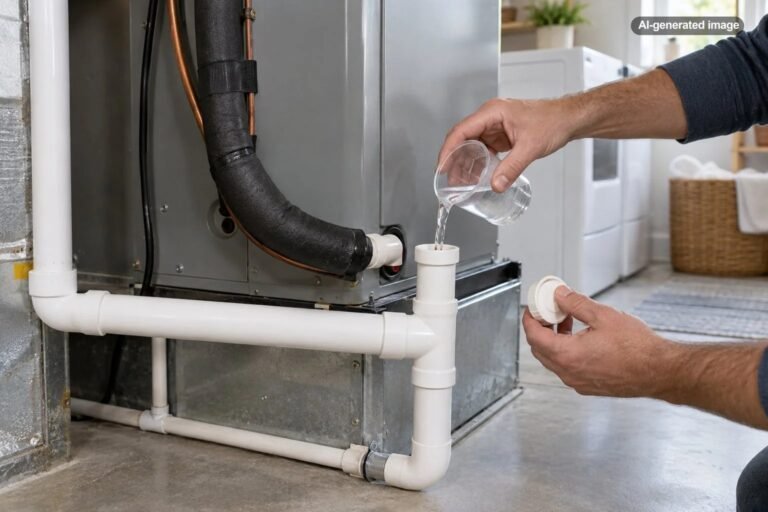
If indoor humidity remains unusually high despite normal cooling operation, replacing the air filter more frequently is not necessarily the solution. Persistent moisture can involve equipment operation, drainage, ventilation, air leakage, system sizing, or other factors that require a broader evaluation.
Do not automatically choose the highest-efficiency filter
It is tempting to assume that a more efficient filter is always better, particularly when air quality is a concern. The EPA recommends using a filter rated at least MERV 13, or the highest efficiency that the HVAC system’s fan and filter slot can accommodate. Compatibility matters because the system must still move air properly through the installed filter.
If you are considering a major jump in filter efficiency, check the HVAC manufacturer’s documentation or ask a qualified HVAC professional what the system can accommodate. The correct filter also needs to fit the slot properly. A filter that is crushed, bent, undersized, or installed with gaps can allow air to bypass the filter media.
When a faster replacement schedule makes sense
You may reasonably shorten the interval if monthly inspections repeatedly show the filter becoming dirty before its normal replacement date. That pattern is more useful than an arbitrary rule such as changing every 30 days simply because the climate is humid.
For example, if a filter consistently looks heavily loaded after six weeks during peak summer operation, checking it around the four-week mark and replacing it as needed is more sensible than waiting three months. Conversely, if a manufacturer permits a longer service interval and the filter remains in good condition during monthly checks, replacing it prematurely may offer little practical benefit.
Keep in mind that a sudden change deserves attention. If filters historically lasted several months and now become dirty within a few weeks, consider what changed. A renovation, new pet, wildfire smoke, unusually heavy system use, or a household dust source may explain it. If there is no obvious reason and the change comes with weak airflow or other HVAC symptoms, professional evaluation is more appropriate than repeatedly installing new filters.
A practical routine for humid-weather HVAC care
Before you decide
- Follow the HVAC equipment and filter manufacturer’s instructions first.
- Check the filter monthly, particularly during heavy cooling season.
- Replace disposable filters when visibly dirty or when their stated service interval is reached.
- Use the correct filter dimensions and make sure it fits without gaps or crushing.
- Do not assume a higher MERV rating is compatible with every HVAC system.
- Track indoor humidity separately instead of expecting the filter to control moisture.
- Investigate filters that become wet or suddenly load with debris much faster than usual.
For most homeowners in humid climates, the simplest answer is also the most reliable: inspect monthly and replace based on condition, manufacturer guidance, and how hard the system is working. Humid weather may increase cooling demands, but it does not create one universal filter-change interval for every house.
Frequently asked questions
Should I change my HVAC filter every 30 days in a humid climate?
Not automatically. Checking every 30 days is a good habit, but the actual replacement interval depends on the filter, HVAC system, household conditions, and how dirty the filter becomes. Follow the manufacturer’s instructions and replace sooner when inspection shows it is needed.
Is every three months enough?
ENERGY STAR commonly advises changing filters at least every three months while checking them monthly. However, heavy cooling use, pets, dust, smoke, or remodeling can make earlier replacement appropriate. Some filter manufacturers also specify their own intervals, which should be followed.
Can a dirty filter make humidity problems worse?
A dirty filter can restrict airflow and interfere with normal HVAC performance, so it should be addressed promptly. But persistent high indoor humidity should not automatically be blamed on the filter. If changing a dirty filter does not resolve an abnormal moisture problem, the system or home may need further evaluation.
Should an HVAC filter ever be wet?
A filter that is unexpectedly wet deserves attention. Replace or service it as directed by the manufacturer, and investigate the moisture source rather than repeatedly installing new filters. Water near HVAC equipment can involve condensation drainage or other system conditions that are better evaluated by a qualified professional.