
How Do You Know If Indoor Air Quality Is Poor?
Poor indoor air quality does not always announce itself with an obvious smell or a cloud of dust. Sometimes the clues are subtler: a room that constantly feels stale, recurring irritation when you are at home, condensation that never seems to disappear, or an odor that returns even after cleaning.
One of the most useful clues is a pattern. The U.S. Environmental Protection Agency notes that some immediate effects associated with indoor pollutants can include irritation of the eyes, nose, and throat, headaches, dizziness, and fatigue. If discomfort consistently appears in a particular building or room and improves after you leave, the indoor environment deserves closer attention. That pattern does not prove that air pollution is the cause, but it gives you a sensible place to investigate.
Look for patterns, not just one symptom
A headache on its own tells you very little about the condition of your home. Neither does a dusty bookshelf or a stuffy bedroom after the door has been closed all day. Indoor air quality is complicated because many ordinary symptoms and household conditions have multiple possible causes.
What matters more is whether several clues point in the same direction. Perhaps two people regularly notice irritated eyes while working in the same home office. Maybe a basement smells musty after rain and shows recurring condensation. Or a recently painted room remains uncomfortable when closed up but feels better after ventilation. Those situations provide more useful information than a single isolated complaint.
The EPA identifies indoor pollutant sources, insufficient ventilation, and temperature and humidity conditions as factors that can contribute to indoor air problems. Common sources can include combustion appliances, building materials and furnishings, cleaning and household products, biological contaminants, smoke, and pollutants entering from outdoors.
Pay attention to persistent odors and stuffiness
Odor is not a complete air-quality test, but recurring smells can be valuable clues. Cooking odors that linger unusually long, strong chemical smells after using household products, tobacco or combustion odors, and a persistent musty smell all justify looking for a source rather than simply covering the odor with fragrance.
A room that continually feels stale may also have inadequate ventilation. Ventilation brings outdoor air indoors and helps dilute pollutants generated inside. Depending on the house, ventilation may come from windows, exhaust fans, or mechanical systems designed to exchange indoor and outdoor air.
That does not mean opening every window is always the right answer. Outdoor smoke, pollen, extreme heat, high humidity, or poor outdoor air conditions may make additional outdoor air undesirable at certain times. Indoor air quality is a balancing act between controlling pollution at its source, providing appropriate ventilation, and using filtration or air cleaning where it is useful.
Moisture is one of the most important clues
Persistent moisture can affect indoor air conditions because damp materials can support unwanted biological growth. Look for recurring condensation, water stains, peeling finishes near damp areas, plumbing leaks, wet materials, or visible mold. Bathrooms, kitchens, basements, laundry areas, and spaces around exterior walls and windows deserve particular attention because everyday activities and building leaks can introduce moisture.
The EPA recommends controlling sources of water and moisture and addressing wet materials promptly. It also notes that indoor relative humidity should generally remain below 60 percent, with 30 to 50 percent described as an ideal range in its guidance on biological contaminants.
If moisture repeatedly returns after cleaning or drying, investigate why. A leaking pipe, water intrusion, condensation, inadequate exhaust, or an HVAC-related issue may require repair rather than another round of surface cleaning. Extensive or unexplained moisture and mold problems can justify evaluation by a qualified professional.
Notice excessive particles, dust, and ventilation problems
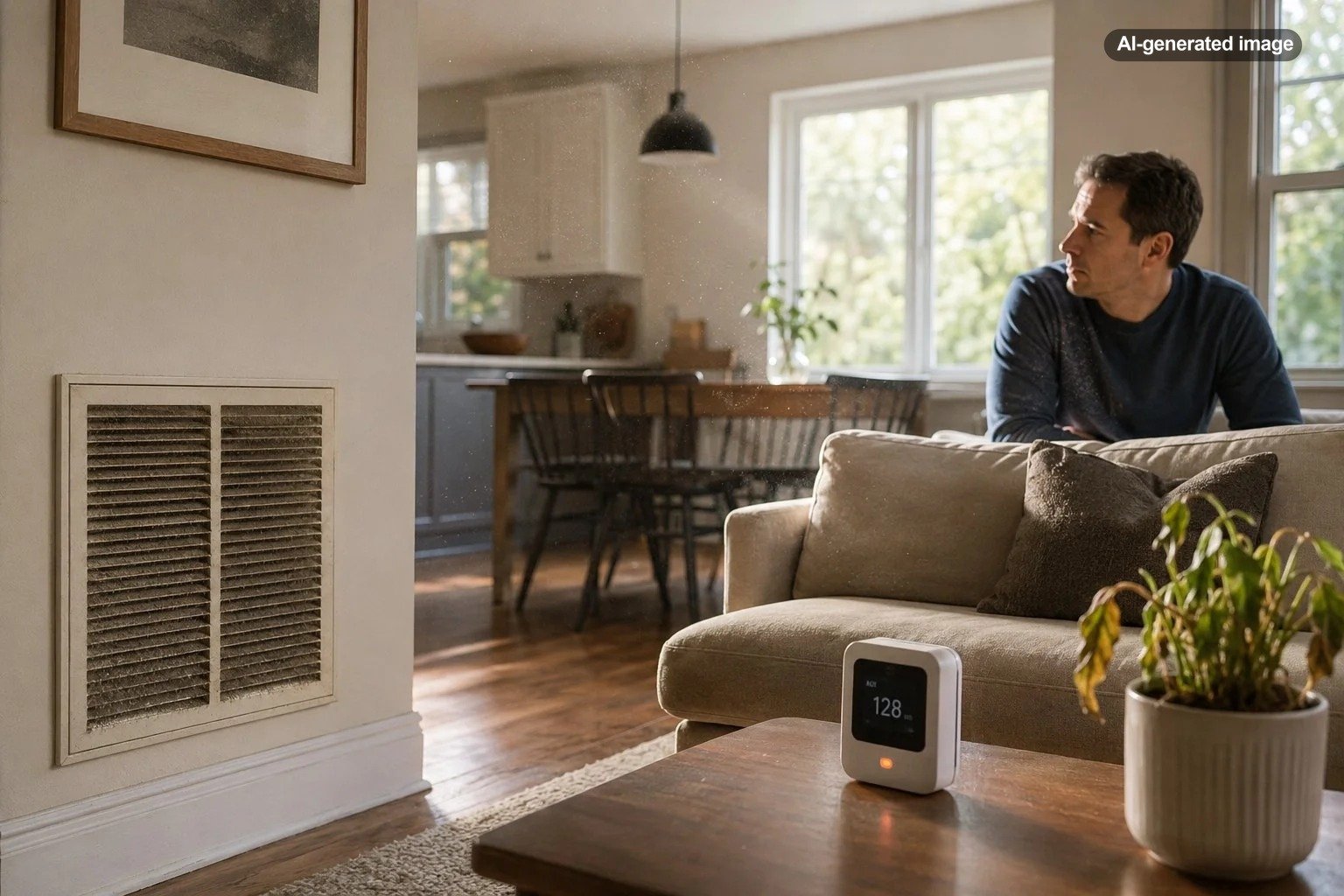
Some dust is normal in an occupied home. Rapid accumulation, however, can prompt a closer look at pollutant sources, housekeeping conditions, renovation activity, filtration, and the heating and cooling system. Particles may originate indoors or enter from outside, and different particles behave differently in the air.
Check whether HVAC filters are installed correctly and replaced or maintained according to the equipment and filter manufacturer’s instructions. A higher-efficiency filter is not automatically appropriate for every system, so avoid assuming that the most restrictive filter available is the best fit for your equipment.
Also consider what has changed. Sanding, construction, candles, smoke, cooking, hobbies, fireplaces, and other activities can affect indoor particles. Source control is often more effective than trying to capture pollution after it has already entered the room.
Do not rely on your nose for serious invisible hazards
Some of the most important indoor air hazards may provide no sensory warning at all. Radon is a naturally occurring radioactive gas that cannot be seen or smelled. The EPA states that testing is the only way to know the radon level in a home and recommends that homes be tested.
Carbon monoxide is another critical example. The U.S. Consumer Product Safety Commission describes carbon monoxide as a colorless, odorless poisonous gas. Fuel-burning appliances and equipment can produce it, which is why a home should have working carbon monoxide alarms rather than relying on smell or physical symptoms as a warning system.
Combustion appliances also deserve proper installation, use, ventilation, and maintenance. Problems involving a furnace, boiler, fireplace, water heater, gas appliance, chimney, or other fuel-burning equipment are not good candidates for casual trial-and-error repairs when combustion safety may be involved.
Use a simple diagnostic sequence
You do not need to identify every compound in the air before you can start improving the environment. A methodical inspection often reveals useful next steps.
What to do
- Identify the pattern. Note which rooms are affected, when the problem occurs, who notices it, and whether conditions improve away from the space.
- Look for obvious sources. Consider smoke, combustion, cleaning products, hobbies, renovation materials, furnishings, stored chemicals, cooking, moisture, pets, pests, and outdoor pollution entering the house.
- Check moisture. Investigate recurring condensation, leaks, water stains, wet materials, musty areas, and visible mold.
- Review ventilation. Confirm that exhaust fans and ventilation systems are working as intended and that HVAC grilles and vents have not been unintentionally blocked.
- Review filtration and maintenance. Follow the HVAC and filter manufacturers’ instructions rather than improvising equipment changes.
- Test where testing is necessary. Radon requires testing, while carbon monoxide requires properly placed and maintained alarms. Other suspected contaminants may require targeted evaluation rather than a generic consumer air-quality reading.
- Escalate when appropriate. Persistent symptoms, combustion concerns, extensive moisture, unexplained odors, or a problem that cannot be traced safely can justify professional evaluation.
Understand what an air-quality monitor can and cannot tell you
Consumer air-quality monitors can be useful for observing certain measurements and trends, depending on the sensors they contain. They should not be treated as a universal detector for everything that can affect indoor air. A device that measures particulate matter, for example, does not automatically tell you whether radon, carbon monoxide, mold-related moisture problems, or every possible chemical pollutant is present.
The better question is not simply, What is my air-quality score? It is What problem am I trying to identify? Choose measurements and testing methods that match the suspected issue. If you have a damp wall, solve the moisture problem. If radon is the concern, use an appropriate radon test. If combustion safety is the concern, rely on proper alarms and qualified inspection rather than a multipurpose gadget.
Good indoor air quality is less about chasing a perfect number and more about controlling sources, managing moisture, ventilating appropriately, and testing for hazards you cannot sense.
How to improve indoor air quality once you find a problem
The EPA organizes the basic approach around three strategies: source control, improved ventilation, and filtration or air cleaning. The order matters. If a pollutant source can be eliminated or reduced, doing so is generally preferable to leaving the source in place and expecting an air cleaner to compensate for it.
Source control might mean repairing a water leak, moving a strong chemical product out of occupied space when appropriate, stopping indoor smoking, using exhaust ventilation during pollutant-producing activities, or having malfunctioning combustion equipment professionally serviced. Ventilation can help dilute many indoor pollutants when outdoor conditions are suitable. Filtration and supplemental air cleaning can then support those measures.
No single strategy fits every home. A renter may need to involve the property manager when moisture, ventilation, or building equipment is involved. A tightly constructed newer home may depend more heavily on designed mechanical ventilation. An older home may have different air leakage and combustion considerations. Climate matters as well: in humid weather, indiscriminately bringing large amounts of moist outdoor air indoors can create another moisture-management problem.
When professional help makes sense
Consider qualified professional evaluation when the problem involves combustion appliances, persistent or unexplained moisture, extensive mold growth, repeated water intrusion, an HVAC malfunction, or odors that cannot be safely traced. Professional help is also appropriate when occupants repeatedly experience symptoms that may be related to the indoor environment.
Medical symptoms should be evaluated by a healthcare professional rather than diagnosed from the condition of the house alone. Similar symptoms can have many causes, and an indoor-air checklist cannot determine an individual’s medical diagnosis.
If you are buying, renovating, or substantially changing a home, it can also be useful to think about air quality before a problem appears. Moisture management, ventilation, combustion safety, filtration compatibility, and careful selection and use of household products are easier to address proactively than after persistent problems develop.
Frequently asked questions
Can poor indoor air quality make a house smell bad?
It can, depending on the source. Persistent musty, smoky, chemical, or combustion-related odors may signal a problem worth investigating. But odor alone cannot determine overall air quality, and some serious pollutants have no smell.
Can indoor air quality be poor even if the house smells clean?
Yes. Radon and carbon monoxide are important examples of hazards you cannot reliably detect with your senses. A pleasant fragrance also does not establish that the underlying air is clean.
Will an air purifier fix poor indoor air quality?
Not necessarily. Air cleaning can be one useful part of an indoor-air strategy, but the EPA emphasizes source control and ventilation along with filtration or air cleaning. A purifier cannot repair a leak, correct unsafe combustion equipment, remove radon from a home by itself, or substitute for necessary ventilation.
Should every home be tested for radon?
The EPA recommends testing homes for radon because the gas cannot be seen or smelled and testing is the only way to know the radon level.
What is the first thing to do if you suspect poor indoor air quality?
Start by identifying patterns and obvious sources. Note where and when the problem occurs, inspect for moisture and pollutant sources, review ventilation and HVAC maintenance, and use hazard-specific testing or professional evaluation when needed. If a carbon monoxide alarm sounds or carbon monoxide exposure is suspected, leave the building and treat it as an emergency rather than beginning a household inspection.
Sources & further reading
- U.S. Environmental Protection Agency: Introduction to Indoor Air Quality
- U.S. Environmental Protection Agency: Indoor Air Quality
- U.S. Environmental Protection Agency: Biological Contaminants and Indoor Air Quality
- U.S. Environmental Protection Agency: Radon
- U.S. Consumer Product Safety Commission: Carbon Monoxide