How Do You Keep Food Cold During a Long Power Outage?
To keep food cold during a long power outage, leave refrigerator and freezer doors closed, monitor temperatures with appliance thermometers, and move priority foods to ice-packed coolers once the refrigerator’s safe window is ending. An unopened refrigerator generally keeps food cold for about four hours, while a closed, full freezer can maintain its temperature for approximately 48 hours; a half-full freezer offers about 24 hours.
Those estimates are planning windows, not guarantees. Starting temperature, room temperature, appliance condition, how full the compartments are, and every opened door affect the result. The safest strategy is to conserve the cold already inside, establish a reliable temperature record, and have ice or another backup ready before the food warms.
Start by protecting the cold you already have
Opening an appliance releases cold air and shortens the time available. Make one person responsible for the refrigerator and freezer so several household members do not independently check the same shelf. A note on each door can prevent an absent-minded opening, which is especially helpful in a busy household.
If you need something essential, decide what it is before opening the door, retrieve it quickly, and close the door firmly. Avoid reorganizing shelves during the outage. Food grouped closely together retains cold better than widely separated packages, particularly in the freezer.
Record the time the power failed. If the outage happened overnight and the exact time is unknown, check utility alerts, clocks, or connected devices for the earliest reliable indication. When the timeline remains uncertain, take the more cautious approach with perishable food.
Know which appliance gives you the most time
| Cold-storage area | Typical unopened window | Best response |
|---|---|---|
| Refrigerator | About 4 hours | Keep closed, then transfer priority perishables to a cooler held at 40 F or below. |
| Full freezer | About 48 hours | Keep closed and leave tightly grouped food in place unless a colder backup is ready. |
| Half-full freezer | About 24 hours | Fill open space before an expected outage and limit every door opening. |
| Ice-packed cooler | Depends on ice, insulation, weather, and use | Monitor with a thermometer and replenish ice before the temperature rises above 40 F. |
A separate chest freezer usually holds cold efficiently because dense cold air does not spill out as readily when its lid opens. Even so, appliance type does not replace temperature measurement. A freezer attached to a refrigerator may warm faster, and an older seal, a hot garage, or repeated access can reduce the expected holding time.
A nearly empty freezer has less frozen mass to absorb heat. Before a forecast storm, freeze containers of water and use them to occupy empty space. Leave room for the water to expand. The frozen containers help the compartment stay cold and can provide drinking water after they thaw if the containers and original water were safe.
Use thermometers to replace guesswork
Keep an appliance thermometer in both the refrigerator and freezer before an emergency. The refrigerator should ordinarily be at 40 F or below, and the freezer should be at 0 F or below. These readings establish that food began the outage at an appropriate temperature and help with decisions when power returns.
A separate food thermometer is useful for checking an individual package. Place the probe between packages rather than repeatedly puncturing food, and clean the probe before and after use. A cooler also needs a thermometer positioned where it can be read with minimal opening.
Do not rely on a package feeling cool to your hand. Touch cannot distinguish a safely chilled 39 F item from one that has spent too long at a warmer temperature. Odor and appearance are also unreliable indicators because harmful bacteria may not produce a noticeable change.
What to do during the outage
- Write down when the power failed and keep appliance doors closed.
- Check the utility’s restoration estimate without opening either appliance.
- If the outage may pass four hours, gather coolers, thermometers, ice, and frozen gel packs.
- At the end of the refrigerator’s safe window, make one quick transfer of priority perishables into a cooler maintained at 40 F or below.
- Replenish melting ice and drain water only when necessary, keeping food in sealed, watertight containers.
- When power returns, record temperatures before normal door opening resumes.
Build a cooler plan around priority foods
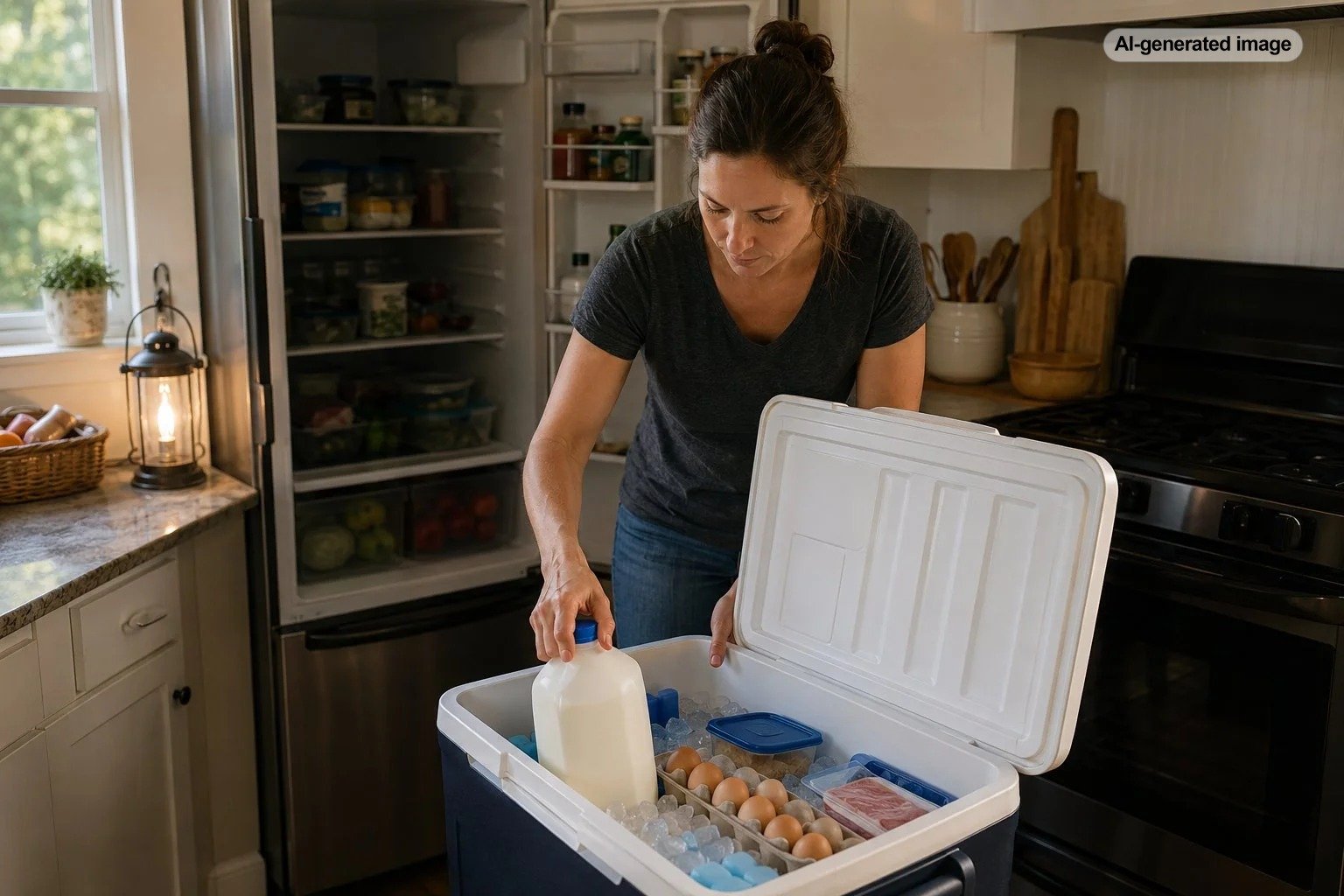
A cooler is most useful when it protects a carefully chosen group rather than the refrigerator’s entire contents. Prioritize medicines according to the manufacturer’s or pharmacist’s storage instructions; food-safety guidance is not a substitute for medication guidance. For food, consider milk, meat, poultry, seafood, eggs, soft cheese, cooked leftovers, and prepared dishes before shelf-stable condiments or uncut produce.
Use one cooler for items that will be opened frequently and another for longer-term cold storage if space permits. Pack food in sealed containers or leak-resistant bags, surround it with ice or frozen gel packs, and keep raw animal products separated from ready-to-eat foods. Place the cooler in the coolest practical indoor location, away from sun, hot windows, vehicles, and cooking equipment.
Ice does not make a cooler automatically safe. Its job is to keep the interior at 40 F or below, and a thermometer confirms whether it is succeeding. Outdoor heat, a loosely fitted lid, frequent access, and a small amount of ice can exhaust the cold supply surprisingly quickly.
For a prolonged outage, block ice generally lasts longer than small cubes, while cubes fill gaps more effectively. Dry ice may extend freezer storage, but it requires careful handling, ventilation, and separation from bare skin and food. Follow the seller’s handling instructions, never touch it with bare hands, and never store or transport it in an airtight container or poorly ventilated occupied space.
Affiliate disclosure: CraneManor.com may earn a commission when you purchase through links on this page. This does not affect the price you pay. Learn more.
Food temperature comes first, but safe lighting makes cooler transfers and thermometer checks easier after dark. A rechargeable LED lantern can provide portable task lighting during an outage; brightness, runtime, and water resistance vary with the selected mode and conditions, so it should be treated as one part of an emergency kit rather than a permanent lighting system.
Decide what to keep after power returns
Check the refrigerator and freezer thermometers before moving food or allowing the appliances time to cool again. For refrigerated perishables, the critical questions are how warm the food became and how long it remained there. FoodSafety.gov advises discarding refrigerated perishable foods such as meat, poultry, fish, eggs, and leftovers after four hours without power. Its detailed chart also identifies foods that should be discarded after exposure to temperatures above 40 F for more than two hours.
Frozen food can often be saved when it still contains ice crystals or measures 40 F or below. It may be refrozen or cooked, although texture and overall quality may decline. Treat each package separately; food near the freezer wall or in the center of a tightly packed compartment may remain frozen longer than food near the door.
Some foods tolerate warming better than others. Butter, hard cheeses, peanut butter, jelly, mustard, pickles, uncut fruits and vegetables, bread, and certain other foods may remain usable under circumstances that make milk, soft cheese, cut produce, cooked rice, leftovers, meat, or seafood unsafe. Consult an official item-by-item chart instead of applying one rule to every shelf.
Prepare now for the next extended outage
A small amount of preparation makes the next outage much more manageable. Keep thermometers installed, freeze gel packs and water containers, and store clean coolers where they can be reached without moving heavy boxes. Learn where block ice and dry ice are sold locally, but remember that availability may be limited during a widespread emergency.
Maintain a modest supply of foods that do not require refrigeration or cooking. Choose items your household will actually eat, account for allergies and dietary needs, and include a manual can opener when appropriate. If an infant, older adult, pregnant person, or someone with a weakened immune system lives in the home, use especially conservative food-safety decisions because these groups can face greater risk from foodborne illness.
A generator can keep selected appliances running, but generator operation introduces carbon monoxide and electrical hazards beyond the scope of food storage. Follow the manufacturer’s instructions and current official safety guidance, operate portable generators outdoors at a safe distance from the home, and use properly rated equipment. A qualified electrician should handle any permanent connection to household wiring.
Frequently asked questions
Should you move food to a cooler immediately?
Usually not. Opening a cold refrigerator immediately can waste the protected four-hour window. If a long outage is expected, prepare the cooler and ice first, then make one quick transfer before the refrigerator’s safe window ends. Transfer sooner when thermometer readings show the appliance is warming faster than expected.
Can you put refrigerated food outside in winter?
Outdoor storage is difficult to control. Sun, changing temperatures, animals, precipitation, and contamination can make it unreliable even when the air feels cold. A closed cooler monitored with a thermometer is a more controlled option.
Can food be refrozen after it partially thaws?
Food that still contains ice crystals or measures 40 F or below may generally be refrozen or cooked, although quality may suffer. Ice cream and frozen yogurt are exceptions in federal guidance and should be discarded when they thaw.
What if there was no thermometer in the freezer?
Inspect each package for ice crystals and check its temperature with a food thermometer. Do not use smell, appearance, or taste as a safety test. If the temperature history cannot be established, follow the more cautious disposal decision.