
How to Keep Bathroom Counters and Showers From Feeling Cluttered
A bathroom feels cluttered when too many objects compete for attention, even if everything is technically useful. The solution is not to hide every item or buy a collection of matching containers. It is to reduce the number of visible products, give daily essentials clear boundaries, and make the easiest storage locations serve the routines that actually happen in the room.
Start by deciding what deserves to remain within reach. Then separate everyday items from occasional products, create one visual zone for each routine, and leave a little empty space around those zones. That combination makes counters and showers easier to clean while giving the entire bathroom a calmer, more intentional appearance.
Define What Counts as a Daily Essential
Bathroom clutter often begins with an overly generous definition of daily use. A product may be used regularly without needing to remain on the counter or shower floor all week. The most visible locations should be reserved for items used almost every time the space is occupied.
On a bathroom counter, that may include hand soap, a toothbrush, toothpaste, and one or two skin-care products. In the shower, it may include shampoo, conditioner, body wash, and a frequently used facial cleanser. Backup bottles, specialty treatments, travel products, and occasional grooming tools can usually live elsewhere.
A useful test is to remove everything from the surface, clean it, and return only the items used during the next two or three days. Products that never make it back naturally may not need prime placement.
Create One Zone for Each Routine
Loose items look more chaotic than grouped items, even when the total quantity is the same. Create compact zones based on how the bathroom is used rather than sorting every product by category.
A morning zone might hold a toothbrush cup, toothpaste, and one skin-care tray. A hand-washing zone may need only soap and a small hand towel. A grooming zone can contain a razor, comb, and frequently used hair product. Keeping each routine together reduces the tendency to scatter products across the counter while searching for what is needed.
Use trays, shallow dishes, cups, or narrow organizers as boundaries, but keep the containers proportionate to the surface. A large tray on a small vanity can create the same crowded feeling as a collection of loose bottles. Ideally, each container should hold a complete routine without becoming a catchall for unrelated objects.
Before you decide
- Confirm that the organizer fits without blocking the sink or faucet.
- Choose a shape that leaves room for wiping around it.
- Avoid deep containers that hide small items at the bottom.
- Allow space for temporary items, such as a watch or pair of glasses.
- Make sure frequently used products can be returned with one hand.
Move Occasional Products Out of Sight
Cabinets and drawers work best when they are organized by frequency of use. The easiest drawer should hold the next tier of products: items used several times a week but not during every bathroom visit. Lower shelves, higher cabinets, and less convenient corners can hold refills and occasional supplies.
Separate backups from active products. Keeping two open shampoos, three nearly identical moisturizers, or several packages of cotton swabs in the same visible area makes it difficult to see what is actually available. Store unopened replacements together and bring them out only when the current item is nearly finished.
Drawer dividers can help, but the goal is not to create a tiny compartment for every object. Broad categories such as dental care, hair accessories, skin care, grooming tools, and first-aid basics are often easier to maintain. Leave enough room within each category for products to be returned without precise arranging.
Give Shower Products Firm Boundaries
Showers become visually crowded quickly because bottles vary in height, color, and shape. Water also encourages products to migrate toward corners, ledges, the tub rim, and the floor. A defined storage area prevents that gradual spread.
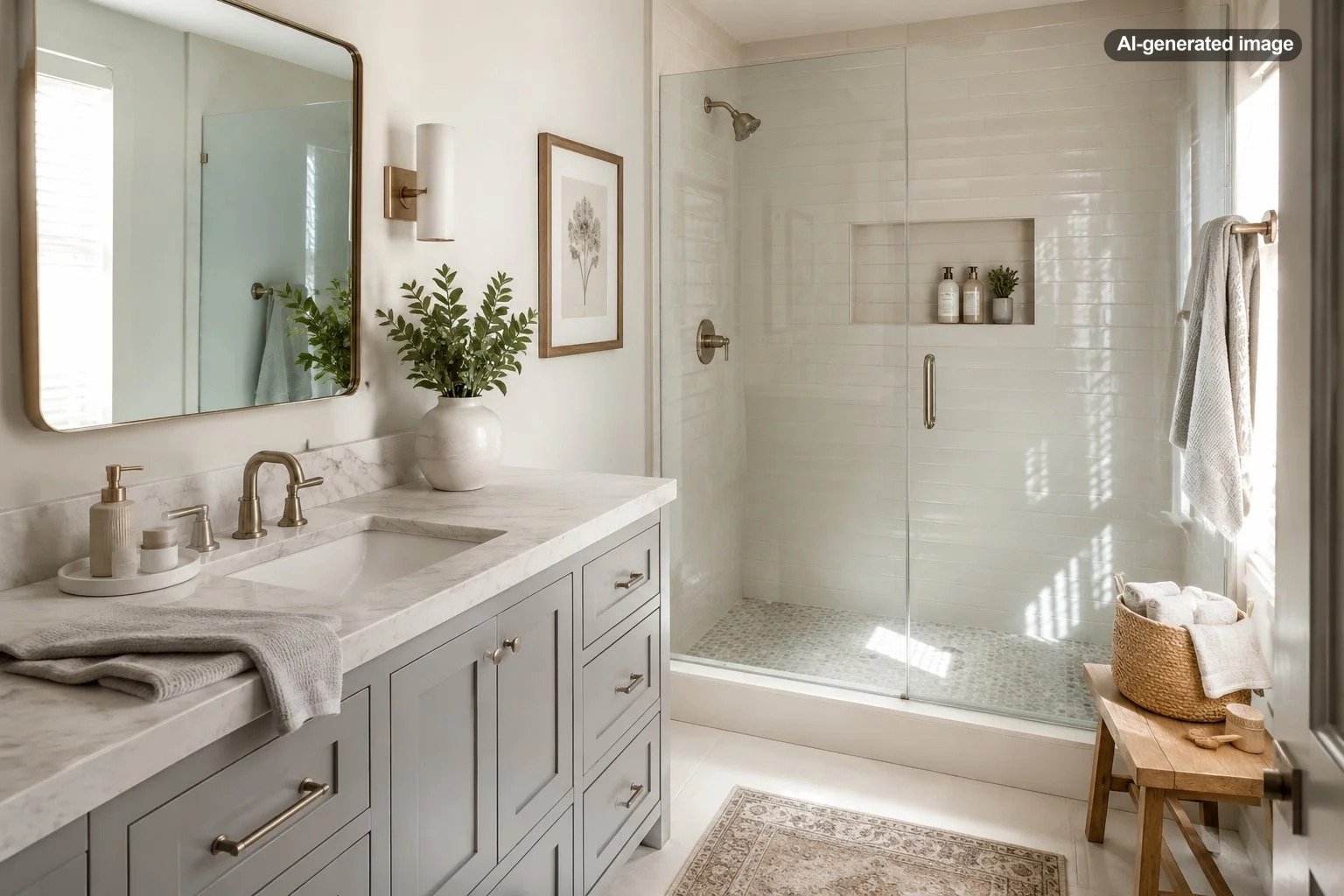
Built-in niches are useful when available, but they still need limits. Arrange products in a single row when possible, with the tallest bottles toward the back or side. Avoid stacking items in front of one another if doing so makes labels impossible to see. When the niche is full, remove something before adding another product.
In showers without built-in storage, choose one method that suits the layout: a compact corner shelf, an over-the-showerhead caddy, a tension-pole unit, or wall-mounted shelves designed for wet locations. Using several small systems at once often looks busier than using one well-sized option.
Reduce Visual Noise Without Decanting Everything
Matching bottles can create a polished appearance, but transferring every soap and shampoo into another container adds maintenance. Labels must remain clear, containers need cleaning, and family members must know what is inside. Decanting works best for products that are purchased consistently and used quickly.
For most bathrooms, a simpler approach is to reduce the number of visible labels. Keep bottles facing the same direction, remove empty containers promptly, and avoid displaying multiple versions of the same product. Neutral trays, clear organizers, or storage that matches the wall or vanity can provide visual continuity without requiring every package to match.
A bathroom looks calmer when the eye can understand where each routine begins and ends.
Use Vertical Space Carefully
Vertical storage can free a small counter, but it should not turn the wall into another crowded surface. A narrow medicine cabinet, recessed storage, or a pair of shallow shelves can be useful when floor and vanity space are limited. Keep frequently handled items between waist and eye level, and reserve higher shelves for lightweight backups.
Open shelves look best when they hold fewer, larger groupings rather than many small objects. Folded towels, one lidded container, and a small basket usually read more clearly than rows of exposed toiletries. Avoid storing heavy glass containers above a tub or toilet where they could be knocked down.
Make Cleaning Part of the Storage Plan
A storage solution is unlikely to last if it makes cleaning difficult. Countertop containers should lift easily, shower shelves should drain, and frequently wet items should have room to dry. Avoid placing bottles directly against grout lines or in corners where residue is difficult to reach.
Once a week, remove empty containers, return misplaced products, and wipe beneath trays and organizers. This does not need to become a full bathroom deep clean. A brief reset keeps temporary clutter from becoming the room’s permanent arrangement.
What to do
- Clear the counter and shower completely.
- Discard empty containers and set aside duplicates.
- Return only products used daily.
- Group those products into compact routine-based zones.
- Store occasional items and refills in drawers or cabinets.
- Leave at least one visible section of the counter and shower ledge empty.
- Schedule a quick weekly reset.
Avoid the Most Common Clutter Traps
One common mistake is buying organizers before deciding what should be stored. This can preserve unnecessary products instead of solving the underlying problem. Edit first, measure the available space, and choose storage only after the true quantity is clear.
Another trap is using the bathroom as overflow storage for household supplies. Bulk paper goods, cleaning refills, unopened toiletries, and travel kits may fit better in a nearby linen closet or utility cabinet. The bathroom should hold a practical working supply, not necessarily the entire household inventory.
Finally, avoid expecting a highly precise system to survive a busy morning. The best arrangement is forgiving. Products should have obvious homes, but returning them should not require aligning labels, nesting containers, or rearranging several other items.
Frequently Asked Questions
How many products should stay on a bathroom counter?
There is no universal number, but each visible item should support a frequent routine. In many bathrooms, one compact grouping near the sink and one hand-soap area are enough. The counter should still have open space for cleaning and temporary use.
What should not be stored in the shower?
Remove empty bottles, infrequently used products, backup containers, and tools that do not dry well. Items that can be damaged by constant moisture should be stored outside the wet area.
Are clear organizers better than opaque ones?
Clear organizers make contents easy to find, but they also display every label and small object. Opaque or frosted storage can look calmer, while clear containers work well inside drawers and cabinets. Choose based on whether visibility or visual quiet matters more in that location.
How can renters add shower storage?
Look for removable options that do not require drilling, such as over-the-showerhead caddies, tension-pole shelves, or properly rated removable wall systems. Follow the product instructions and avoid attaching storage to loose tile, damaged grout, or unstable surfaces.
How do you keep shared bathrooms organized?
Assign each person a defined drawer section, basket, shelf, or shower zone. Shared essentials can occupy one central area, while personal products remain within individual boundaries. This makes overflow visible before it spreads across the room.
The Goal Is a Bathroom That Resets Easily
A bathroom does not need to look empty to feel organized. It needs visible limits, convenient storage, and enough breathing room for the eye to rest. Keep daily products close, move occasional items out of sight, and make every storage choice easy to clean and easy to maintain.
The most successful system is not the one that looks perfect immediately after organizing. It is the one that can return to order in a few minutes after an ordinary week.