Should You Lubricate Sliding Door Tracks?
Yes, many sliding door tracks and rolling components benefit from lubrication, but lubrication should usually be the second step, not the first. A sliding door that feels heavy, gritty, or reluctant to move often has dirt packed into the track. Adding lubricant over that debris can create a sticky mixture that makes the problem worse.
The better approach is to clean the track thoroughly, inspect it and the rollers, and then use a lubricant appropriate for the particular door. Dry silicone or another manufacturer-approved dry lubricant is commonly suitable for sliding-door components because it reduces friction without leaving the same oily residue that can collect dust and grit.
Why cleaning matters more than adding lubricant
Sliding patio doors operate close to the floor, which makes their tracks natural collection points for dust, sand, pet hair, crumbs, pollen, and outdoor debris. Even a small amount of gritty material can interfere with the rollers.
If you spray lubricant directly onto a dirty track, you may temporarily make the door seem easier to move. The improvement can be short-lived, however, because some oily products hold onto more debris. Eventually the track can become coated with a dark, sticky residue that is harder to remove than the original dust.
Start by opening the door as far as practical and vacuuming loose debris from the exposed track. A narrow crevice attachment works well. Move the door to expose the other portion of the track and repeat. Wipe accessible surfaces with a soft cloth and a mild cleaner compatible with the door material, then allow the area to dry.
A lubricant works best when it is reducing friction, not floating dirt around the track.
What type of lubricant should you use?
There is no single lubricant that is correct for every sliding door. Door manufacturers may specify different products depending on the track, roller, weatherstripping, frame material, and hardware design. If you have the care manual for your door, its instructions should take priority.
For many residential sliding-door systems, a dry silicone spray or another non-oily dry lubricant is a practical choice. These products are designed to leave a low-residue lubricating film rather than a wet coating. Some doors or components may call for another treatment, so compatibility matters more than simply grabbing the nearest can from the garage.
| Approach | Typical advantage | Main concern |
|---|---|---|
| Dry silicone lubricant | Low-residue lubrication for many sliding components | Confirm compatibility with the door |
| Other dry lubricant | Can reduce friction without remaining oily | Formulations differ, so follow product and door instructions |
| Oil-based lubricant | May initially make movement feel smoother | Can attract dust and grime on exposed tracks |
| Heavy grease | Useful for certain mechanical applications | Usually too messy for an exposed residential track unless specifically required |
More is not better. A light application is generally easier to control and less likely to leave residue on flooring, weatherstripping, or nearby finishes.
How to lubricate a sliding door track
Once the track is clean and dry, inspect it before applying anything. Look for obvious dents, rough areas, loose material, unusual scraping, or a door panel that appears to sit crooked in the opening. Lubrication will not correct those conditions.
What to do
- Vacuum loose dirt, sand, hair, and other debris from the full accessible length of the track.
- Wipe away remaining grime using a cleaning method appropriate for the frame and track material.
- Let the track dry and inspect it for physical damage.
- Check the door manufacturer’s care instructions when available and select a compatible dry lubricant.
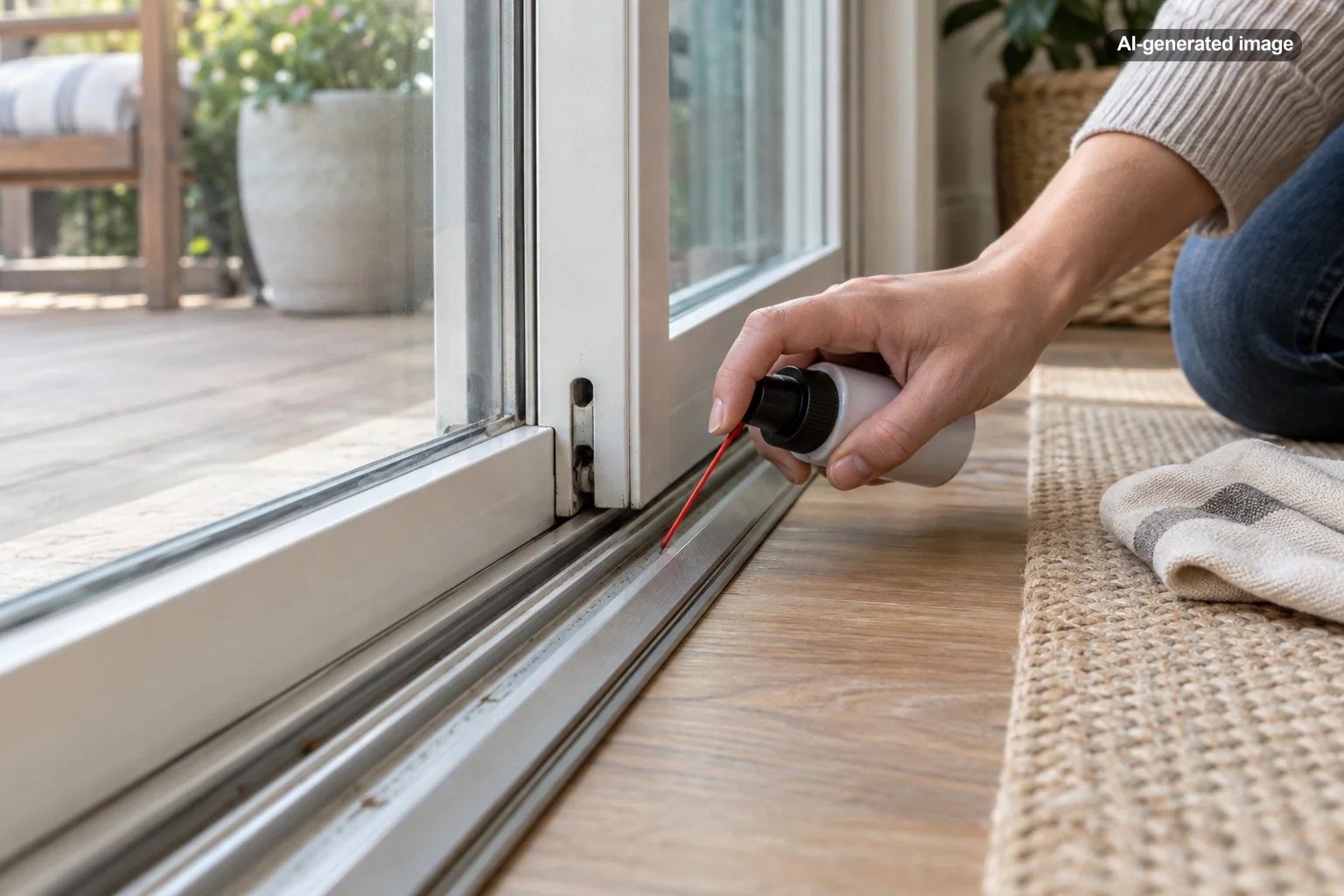
- Apply only a light amount to the surfaces specified for lubrication rather than soaking the entire threshold.
- Slide the door back and forth several times to distribute the lubricant through the moving contact areas.
- Wipe away obvious excess and check whether the door now moves smoothly.
Try to keep overspray away from glass, finished flooring, rugs, and surfaces where a slippery residue would be unwelcome. If using an aerosol product, follow its ventilation, handling, and application directions.
The track may not actually be the problem
A common mistake is assuming every difficult sliding door simply needs a slicker track. The door usually rides on rollers, and those rollers do much of the real work. If they are dirty, damaged, worn, seized, or incorrectly adjusted, coating the visible track with lubricant may accomplish very little.
Pay attention to how the door behaves. Gritty movement that improves after vacuuming points toward track contamination. A door that feels consistently heavy may have a roller or adjustment issue. Scraping at one end, uneven gaps, or a panel that seems to tilt can suggest alignment or roller-height trouble rather than a lubrication problem.
What should you avoid putting on the track?
Avoid automatically reaching for a wet, oily household lubricant simply because it makes metal parts feel slippery. On an exposed floor-level track, oil can collect dust, pet hair, and outdoor grit. The resulting residue can interfere with smooth movement and create more cleaning work later.
Also avoid abrasive scrubbing or aggressive chemicals unless the door manufacturer specifically permits them. Tracks can include painted, vinyl, aluminum, anodized, coated, plastic, and weathersealed components, and a cleaning method that seems harmless on bare metal may damage a nearby finish.
Do not force a stubborn door repeatedly. Sliding a very heavy panel back and forth under excessive resistance can put unnecessary stress on the rollers and hardware.
When lubrication is not enough
If the door remains difficult to move after the track has been cleaned and appropriately lubricated, stop adding more lubricant. The next step is to look for a mechanical cause.
Potential issues include worn or damaged rollers, incorrect roller adjustment, a dented track, loose hardware, frame movement, or debris lodged where it is difficult to see. Some doors have accessible roller-adjustment screws, but adjustment procedures vary by design. Follow the instructions for your particular door rather than turning screws experimentally.
How to keep a sliding door moving smoothly
The simplest maintenance habit is not frequent lubrication. It is keeping the track clean. Vacuuming visible debris before it becomes compacted can prevent many of the gritty, sticky symptoms that prompt people to reach for lubricant in the first place.
Homes with pets, sandy yards, frequent patio traffic, or doors that remain open during pleasant weather may accumulate debris faster. In those situations, inspect the track when you are already vacuuming or cleaning near the door rather than waiting until movement becomes noticeably difficult.
Before you decide
- Clean the track before assuming it needs lubricant.
- Check the manufacturer’s care instructions when available.
- Favor a compatible dry lubricant over a product that leaves an oily film.
- Use a small amount rather than soaking the track.
- Check rollers and alignment if cleaning and lubrication do not solve the problem.
- Do not use lubricant to disguise obvious mechanical damage.
FAQ
Can you use silicone spray on sliding door tracks?
Dry silicone spray is commonly used for sliding-door tracks, rollers, and other moving door components. Confirm that it is appropriate for your specific door and apply it according to both the door manufacturer’s and lubricant manufacturer’s instructions.
Should you lubricate the entire bottom track?
Not necessarily. The goal is to lubricate the surfaces that actually require it, not to leave the entire threshold wet or slippery. Door designs differ, so the manufacturer’s maintenance instructions are the best guide to exactly where lubricant belongs.
Why is my sliding door still hard to open after lubrication?
The problem may be worn rollers, incorrect roller height, a damaged track, alignment trouble, or debris that was not fully removed. Repeatedly adding lubricant is unlikely to correct a mechanical problem.
Should you lubricate a sliding screen door too?
A screen door may benefit from a compatible dry lubricant when its track or rollers need it, but screen-door mechanisms can differ from the main glass panel. Treat the two as separate systems and follow the appropriate maintenance instructions for each.
Is lubrication preventative maintenance or only a fix for sticking?
It can be part of routine maintenance when the door manufacturer recommends it, but regular cleaning is equally important. A clean, correctly adjusted rolling system should not need to be drenched in lubricant to operate properly.