
Can an Air Filter Be Too Restrictive for an Air Conditioner?
Yes, an air filter can be too restrictive for an air conditioner. If the filter creates more resistance than the system was designed to handle, the blower may be unable to move enough air across the evaporator coil and through the ducts. That can reduce comfort, lengthen cooling cycles, and contribute to equipment problems.
The important nuance is that a high MERV number does not automatically make a filter unsuitable. Filter thickness, surface area, construction, condition, airflow rate, duct design, filter-grille size, and blower capacity all affect resistance. The right filter is the most effective one that the complete HVAC system can accommodate while maintaining proper airflow.
What makes an air filter restrictive?
Air must pass through the filter before the blower can distribute it through many central air-conditioning systems. Every filter creates some resistance, commonly described as pressure drop. The HVAC system must have enough available fan capacity to overcome that resistance along with resistance from the coil, ducts, grilles, and other components.
A filter can create excessive resistance for several reasons:
- It is dirty. Captured dust gradually blocks portions of the filter media, often increasing resistance.
- It has denser filter media. A filter designed to capture smaller particles may require more pressure to move air through it.
- It has too little surface area. A narrow filter or small return grille may force a large volume of air through a limited area.
- It is the wrong physical size. A filter that is crushed into the slot, bows inward, or does not sit correctly can interfere with airflow or allow air to bypass the media.
- The system already has airflow limitations. Undersized return ducts, blocked registers, a dirty coil, an incorrect blower setting, or other restrictions can leave little capacity for additional filter resistance.
The U.S. Environmental Protection Agency notes that higher-MERV filters tend to restrict airflow and recommends using the highest-rated filter that the fan and filter slot can accommodate. It also explains that wider or thicker filters can provide more surface area and may produce less static pressure than a shallower filter designed for the same general filtration goal.
MERV rating is only part of the decision
MERV, or Minimum Efficiency Reporting Value, describes how effectively a filter captures particles in specified size ranges. It is an efficiency rating, not a direct statement of how much resistance a particular filter will create in a particular house.
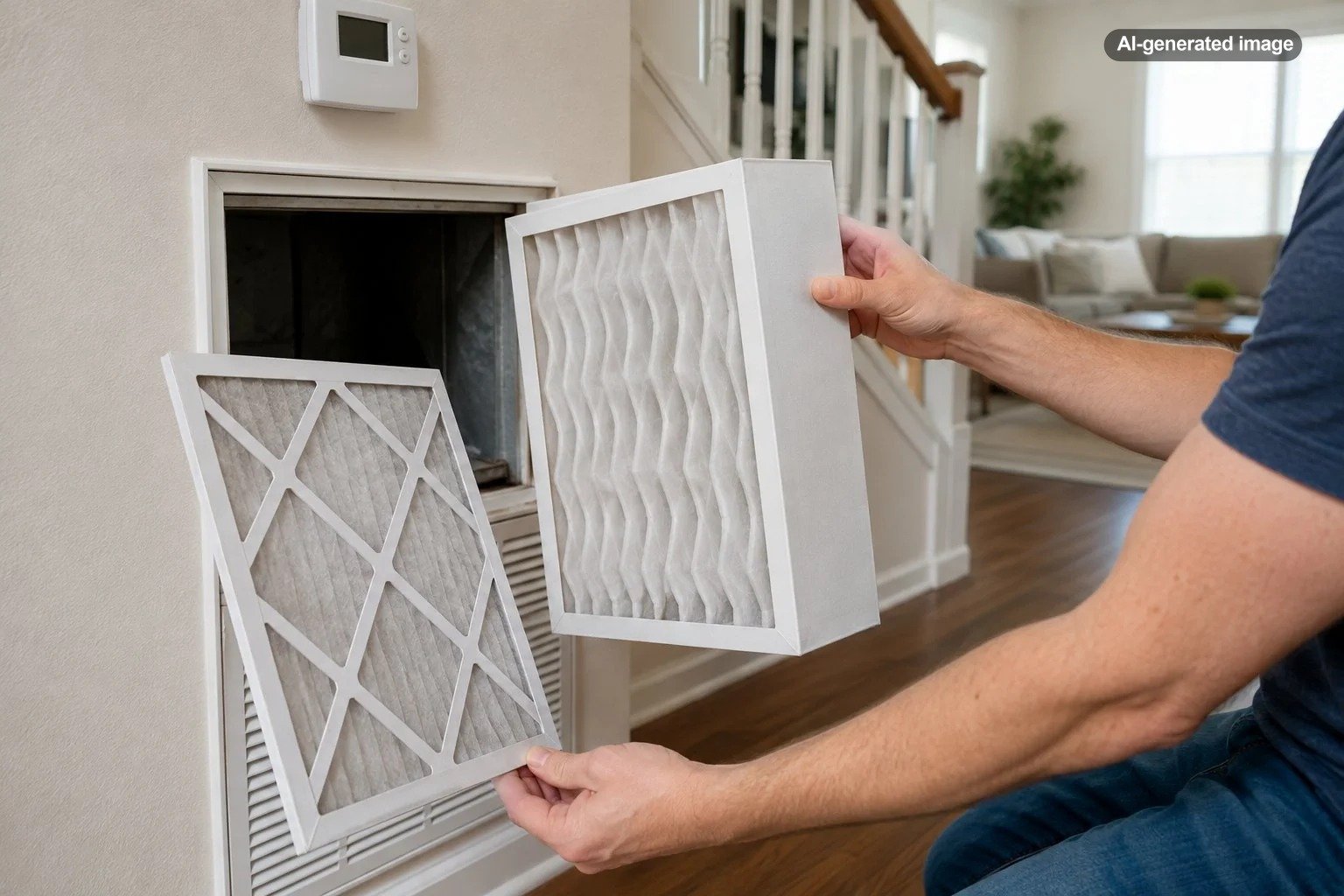
Two filters with the same MERV rating can have different pressure-drop characteristics because their pleat design, media area, frame, and construction differ. Likewise, a well-designed 4-inch media filter may offer stronger particle capture without causing the same resistance as a densely pleated 1-inch filter squeezed into a small return opening. Physical thickness alone is not proof of compatibility, however; the cabinet must be designed for it.
| Filter choice | Likely benefit | What to verify |
|---|---|---|
| Basic low-MERV filter | Protects equipment from larger debris with relatively modest filtration | Whether it meets the equipment and household’s filtration needs |
| Midrange pleated filter | Captures more common household particles | Rated pressure drop, exact size, and system compatibility |
| Higher-MERV filter | Improved capture of smaller particles | Available blower capacity, return sizing, filter area, and manufacturer guidance |
| Deep media filter | More media surface area and potentially lower resistance for its efficiency | A compatible cabinet, adequate clearance, and professional installation when modification is required |
| HEPA filter | Very high particle-removal efficiency | Whether it is part of a purpose-designed system; it is not normally a casual drop-in replacement |
Signs that the filter may be limiting airflow
No single symptom proves that the filter is responsible. Several other HVAC faults can look similar. The timing of the change is useful: suspicion is stronger when a problem begins directly after installing a different type of filter and improves after fitting a clean, known-compatible replacement.
Possible signs include:
- Airflow feels weaker at many supply registers, not merely one closed or obstructed vent.
- The air conditioner runs longer but has difficulty reaching the thermostat setting.
- The filter bends, collapses, or is pulled tightly against its support.
- A whistle or air-leak noise appears around the return grille or filter cabinet.
- Rooms become less evenly cooled after a filter change.
- Ice develops on the refrigerant line or indoor coil area.
- The system cycles off unexpectedly or produces unusually little conditioned air.
A dirty evaporator coil, failing blower component, obstructed return, duct problem, refrigerant issue, or incorrect equipment setup can cause overlapping symptoms. Changing filters repeatedly is not a substitute for diagnosis when cooling remains poor.
How to check the filter without creating another problem
What to do
- Set the system to off before opening the filter compartment. Follow the equipment manual and avoid accessing electrical or internal mechanical components.
- Confirm the required dimensions. Read the size printed on the existing filter and compare it with the cabinet label or equipment documentation. Nominal and actual dimensions can differ, so a package label alone is not always enough when the fit is questionable.
- Check the airflow arrow. It should normally point toward the air handler or blower, following the direction of airflow. Use the unit’s instructions if the layout is unclear.
- Inspect the condition and fit. Replace a visibly loaded disposable filter. Clean a reusable filter only according to its instructions, and allow it to dry as directed before reinstalling it.
- Use a clean, documented-compatible filter. If the trouble began after an upgrade, use the type specified by the manufacturer or the previously successful rating until compatibility can be evaluated.
- Close the access panel fully. Gaps can allow unfiltered air to bypass the filter and may create noise.
- Observe the next cooling cycle. Note airflow, noise, run time, and whether the system reaches its setting. Do not run the system without a filter as a routine experiment.
How to choose a filter that balances airflow and air quality
Begin with the air-conditioner or air-handler manual. Look for the required size, approved filter type, replacement instructions, and any stated efficiency or pressure-drop limits. If the documentation is missing, obtain it from the manufacturer using the exact model number or ask a qualified HVAC contractor.
Household needs matter, but they do not override mechanical compatibility. A home with pets, renovation dust, outdoor smoke, or a household member who wants better particle control may benefit from more effective filtration. The solution may be a larger filter cabinet, additional return area, a deep media filter, or a separate portable air cleaner rather than placing an increasingly dense 1-inch filter in an undersized slot.
Also compare filters by more than MERV. When manufacturers publish resistance or pressure-drop data, verify that the figure applies at an airflow rate relevant to the system. A low resistance value measured under different conditions may not describe performance in your installation.
The best filter is not simply the one that captures the most particles; it is the one that does so while the HVAC system still moves the air it was designed to move.
When an HVAC technician should measure the system
Professional evaluation is sensible when airflow remains weak with a clean, compatible filter; the coil freezes; the equipment is noisy; cooling is uneven; or the system has a history of blower or motor trouble. It is also worthwhile before making a substantial filtration upgrade in an older system or a home with a small return grille.
A technician can measure total external static pressure, pressure drop across the filter, and airflow across the evaporator coil. Those measurements help distinguish a filter problem from undersized returns, dirty components, duct restrictions, blower configuration issues, and other causes. The Department of Energy specifically includes measuring airflow across the evaporator coil among the tasks a trained technician may perform when an air conditioner needs more than routine maintenance.
If improved filtration is the goal, ask what MERV level the existing equipment can support, whether the filter area should be enlarged, and whether the return system has enough capacity. A filter cabinet or duct modification should be designed around the equipment rather than improvised.
Keeping the filter from becoming restrictive
There is no single replacement interval that suits every home. The Department of Energy advises following the manufacturer or contractor’s guidance and notes that filters may need attention every month or two during the cooling season, particularly with constant use, pets, or dusty conditions. ENERGY STAR recommends checking monthly during heavy-use periods and replacing a dirty filter rather than relying only on the calendar.
- Write the installation date on the filter frame.
- Check it more often during construction, wildfire smoke, heavy pollen, or periods of continuous cooling.
- Keep return grilles clear of furniture, curtains, boxes, and rugs.
- Use the exact filter dimensions rather than accepting a loose or forced fit.
- Schedule regular HVAC maintenance so dirty coils and blower problems are not mistaken for filter trouble.
Frequently asked questions
Is MERV 13 too restrictive for a home air conditioner?
Not necessarily. Some systems are designed to use MERV 13 filtration, especially when the filter has ample surface area. Others cannot maintain proper airflow with a particular MERV 13 filter. Check the equipment guidance or have static pressure and airflow measured.
Can a restrictive filter cause an evaporator coil to freeze?
Insufficient airflow can allow the coil to become excessively cold and ice over, but filter restriction is only one possible cause. Turn off normal cooling and obtain professional diagnosis rather than assuming that a new filter will resolve an iced coil.
Will installing a cheaper fiberglass filter fix low airflow?
It may change airflow if the existing filter is the primary restriction, but it may also reduce particle capture and fail to address an underlying duct, coil, or blower problem. Use a filter that meets documented system requirements and investigate persistent symptoms.
Should all return vents have filters?
Only if the system was designed that way. Some homes use filters at return grilles, while others use one central filter at the air handler. Adding filters at multiple locations can create unintended resistance, so follow the system design and equipment instructions.