
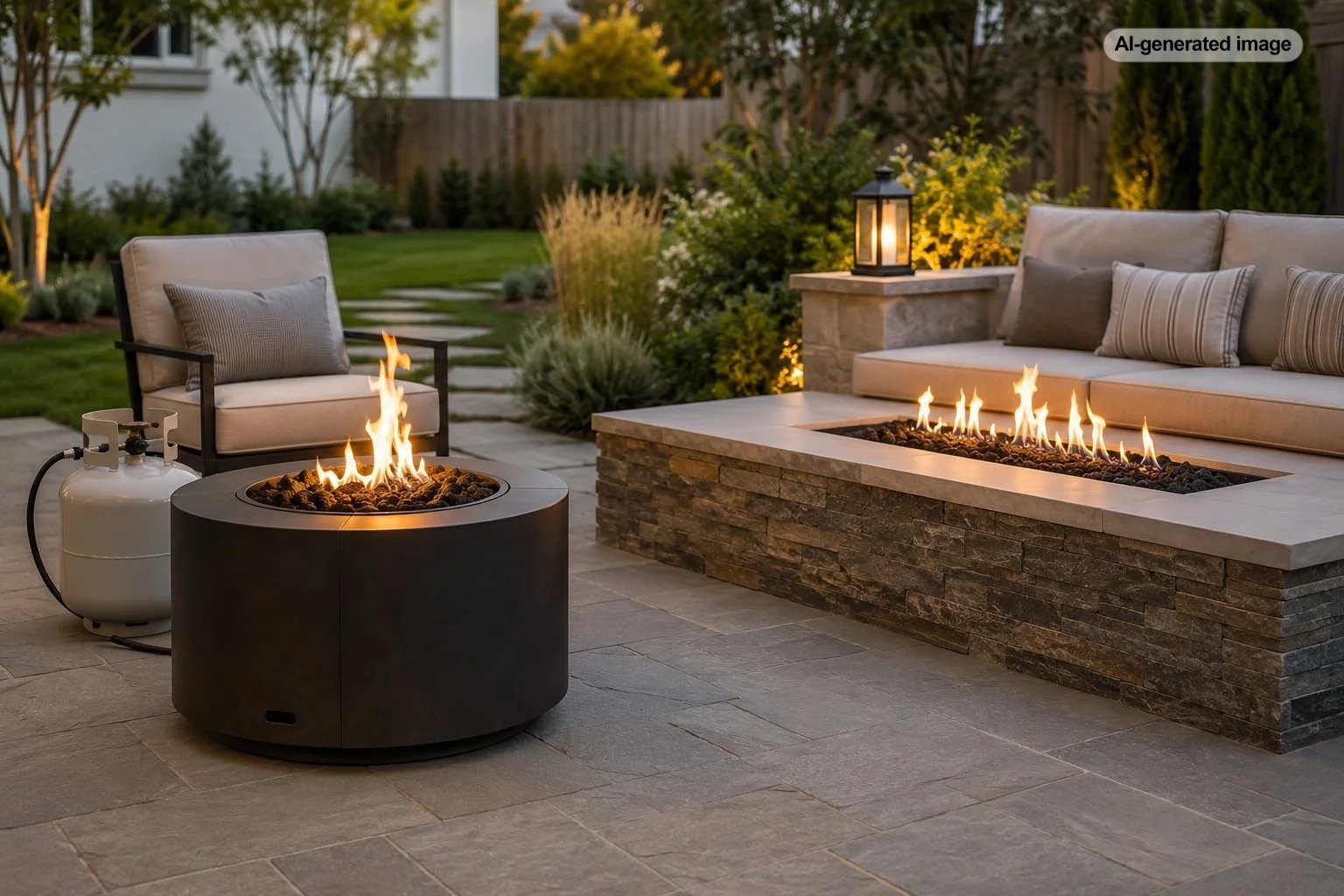
Propane Fire Pit Versus Natural Gas Fire Pit: What Is the Difference?
A propane fire pit stores its fuel in a refillable or exchangeable cylinder, while a natural gas fire pit connects to a permanent gas supply line. That single difference affects nearly everything else: where the fire pit can sit, whether it can move, how it is installed, and what happens when you want to use it for several hours.
Propane is generally the more flexible choice for a patio that may change over time. Natural gas is often the more convenient choice for a permanent outdoor living area where a suitable gas connection can be installed. Neither fuel is universally better, and neither makes an improperly placed or poorly maintained fire pit safe.
The main differences at a glance
| Consideration | Propane | Natural gas |
|---|---|---|
| Fuel source | Portable cylinder or larger property tank | Permanent utility or residential supply line |
| Placement | More flexible, subject to the manual and safe clearances | Determined largely by the installed gas connection |
| Installation | Some listed portable models connect to a compatible cylinder as directed by the manufacturer | Normally requires a properly sized line and qualified installation |
| Refueling | Cylinder must be refilled or exchanged | No portable cylinder to replace |
| Long gatherings | Use ends when the available cylinder runs out | Continuous supply while utility service is available |
| Future relocation | Usually easier | May require gas-line changes |
| Visual effect | Available in many portable and tank-concealing designs | Well suited to built-in burners and permanent fire tables |
Propane favors flexibility
A propane fire pit is appealing when there is no natural gas line near the patio or when the furniture arrangement is still evolving. Depending on its size and design, the unit may be moved to a different approved location after it has cooled and the fuel has been shut off and disconnected according to its instructions.
The tradeoff is fuel management. Someone must monitor the remaining fuel, obtain refills or exchanges, and handle the cylinder correctly. A gathering can lose a little of its glow if the cylinder empties halfway through dessert.
Portable cylinders also require disciplined storage and inspection. The Propane Education & Research Council advises keeping cylinders upright, outdoors, and away from ignition sources and excessive heat. It also recommends checking connections for leaks before seasonal use and whenever a cylinder is connected. Follow the appliance manual’s procedure and use only the cylinder size, regulator, hose, and connections specified for that fire pit.
Who is propane best for?
- Renters or homeowners who cannot add a permanent gas line, provided the property rules permit the appliance.
- Households that rearrange or renovate their patios regularly.
- Seasonal users who do not mind managing cylinders.
- Outdoor spaces where a qualified professional confirms that a natural gas connection would be impractical.
Natural gas favors permanence and convenience
A natural gas fire pit connects to the home’s fuel system rather than a portable cylinder. Once properly installed, it can run without someone stopping to exchange a tank. That is particularly useful for a built-in seating area, an outdoor kitchen, or a fire feature used frequently.
The limitation is that the fire pit effectively becomes part of the patio plan. Its position depends on the route, capacity, valves, and approved termination of the gas line. Moving it later may involve opening finished surfaces and altering the fuel connection.
Natural gas installation is not a casual do-it-yourself connection. A qualified gas professional should determine whether the existing system can support the additional appliance, size and route the line, provide the required shutoff, test the completed work, and address applicable permits and local rules. Those requirements vary by jurisdiction and property.
Which fuel produces the better flame?
Fuel name alone does not determine how satisfying the flame will look or feel. Burner design, rated heat output, media placement, gas pressure, wind, enclosure design, and seating distance all matter. Compare the specifications and installation manual for the exact model rather than assuming every propane unit burns hotter or every natural gas unit produces a gentler flame.
Both fuels can support restrained linear burners, traditional round bowls, and substantial fire tables. Lava rock, approved fire glass, and other listed media can change the appearance, but they must be installed in the quantity and arrangement allowed by the manufacturer. Blocking burner ports or ignition components with excess media can interfere with operation.
Wind is another practical concern. An exposed, breezy patio may produce an unstable-looking flame even when the appliance is functioning normally. Choose a model designed for the intended setting and observe its required clearances; do not improvise a wind barrier that traps heat or combustion gases.
Installation and total cost
Propane often has the lower barrier to entry because many portable fire pits are designed to work with a compatible cylinder. That does not mean every propane installation is inexpensive: large built-in units may use a remote cylinder enclosure or connect to a residential propane tank, which can require professional planning.
Natural gas commonly carries more upfront site work. The scope depends on whether gas is already available, the distance to the patio, the capacity of the existing system, the surfaces the line must cross, and local approval requirements. A short accessible route and a long route beneath finished hardscape are very different projects.
Ongoing fuel cost is equally site-specific. Utility rates, propane prices, appliance output, frequency of use, and operating time all affect the result. Request current local estimates based on the exact appliance rating instead of relying on a generic claim that one fuel will always be cheaper.
Maintenance differs, but neither option is maintenance-free
Both types need routine inspection and protection from debris, moisture, pests, and blocked burner openings. Let the unit cool before cleaning, use only methods approved in its manual, and keep drainage openings clear. A fitted cover may help when the manufacturer allows one, but it should never be placed over a warm appliance.
With propane, pay particular attention to the cylinder, valve, regulator, hose, and connection. Do not use a damaged cylinder or attempt to repair or modify propane equipment yourself. Keep spare cylinders away from the appliance and never store them in a basement, garage, shed, tent, or other enclosed space.
With natural gas, inspect accessible components for deterioration and protect the shutoff valve from accidental damage. A weak or irregular flame, repeated ignition trouble, unexplained shutdowns, unusual soot, or a suspected leak warrants stopping use and contacting the manufacturer or an appropriately qualified gas professional.
Safety and placement come before style
Gas fire pits are outdoor appliances unless the exact product is specifically listed for another application. Do not operate an outdoor fire pit inside a house, garage, tent, enclosed porch, or other enclosed space. Fuel-burning outdoor equipment can create dangerous carbon monoxide concentrations when used indoors or without adequate ventilation.
Required distances from walls, roofs, furniture, vegetation, deck surfaces, and overhead structures differ among products. Use the exact clearances in the installation manual and comply with local fire restrictions. A patio that looks open in photographs may still be unsuitable because of a low ceiling, combustible pergola, narrow exit path, or nearby landscaping.
Keep children and pets outside the hot zone, maintain a clear path around the unit, and never leave the flame unattended. Shut the appliance down as directed before going indoors. During dry, windy, or wildfire-prone conditions, follow local restrictions and postpone use when authorities advise against outdoor burning or open-flame activities.
Before you decide
- Confirm that the chosen model is approved for the intended outdoor location.
- Read its clearance, ventilation, surface, and overhead-cover requirements.
- Decide whether future portability matters more than continuous fuel access.
- Obtain a site-specific installation assessment for natural gas.
- Plan a compliant outdoor location for propane cylinders.
- Compare rated output and burner design, not fuel labels alone.
- Check local fire, permit, HOA, condo, and landlord rules.
- Leave enough room for people to circulate without passing close to the flame.
The practical verdict
Propane is usually the better fit for flexibility, seasonal use, and patios without an existing gas connection. Natural gas is usually the better fit for a permanent fire feature that will be used frequently and can be professionally connected without disproportionate site work.
The best choice is therefore less about which fuel wins and more about how settled the patio plan is. If the location is permanent and convenience matters most, natural gas deserves serious consideration. If the layout may change or installation access is limited, propane keeps more options open.
Frequently asked questions
Can a propane fire pit be connected to natural gas?
Only if the manufacturer identifies the exact model as convertible and provides approved instructions or components. Never change or drill burner parts, substitute a regulator, or assemble a conversion from unrelated fittings.
Can a gas fire pit sit under a covered patio?
Not automatically. The appliance must be listed for the proposed setting, and the space must satisfy the manufacturer’s overhead clearance and ventilation requirements as well as local rules. Ask a qualified professional to evaluate an uncertain location.
Can a propane cylinder remain inside the fire pit table?
Use only the cylinder location and enclosure specified by the manufacturer. Some fire tables are designed to conceal a connected cylinder with required ventilation and separation; other burners require remote cylinder placement.
Does natural gas mean the fire pit can never be moved?
The furniture or enclosure may sometimes be reconfigured, but the appliance must remain connected through an approved arrangement. Relocating the gas connection should be treated as professional gas work rather than a simple furniture move.