How Much Space Should Be Left Around an Ottoman?
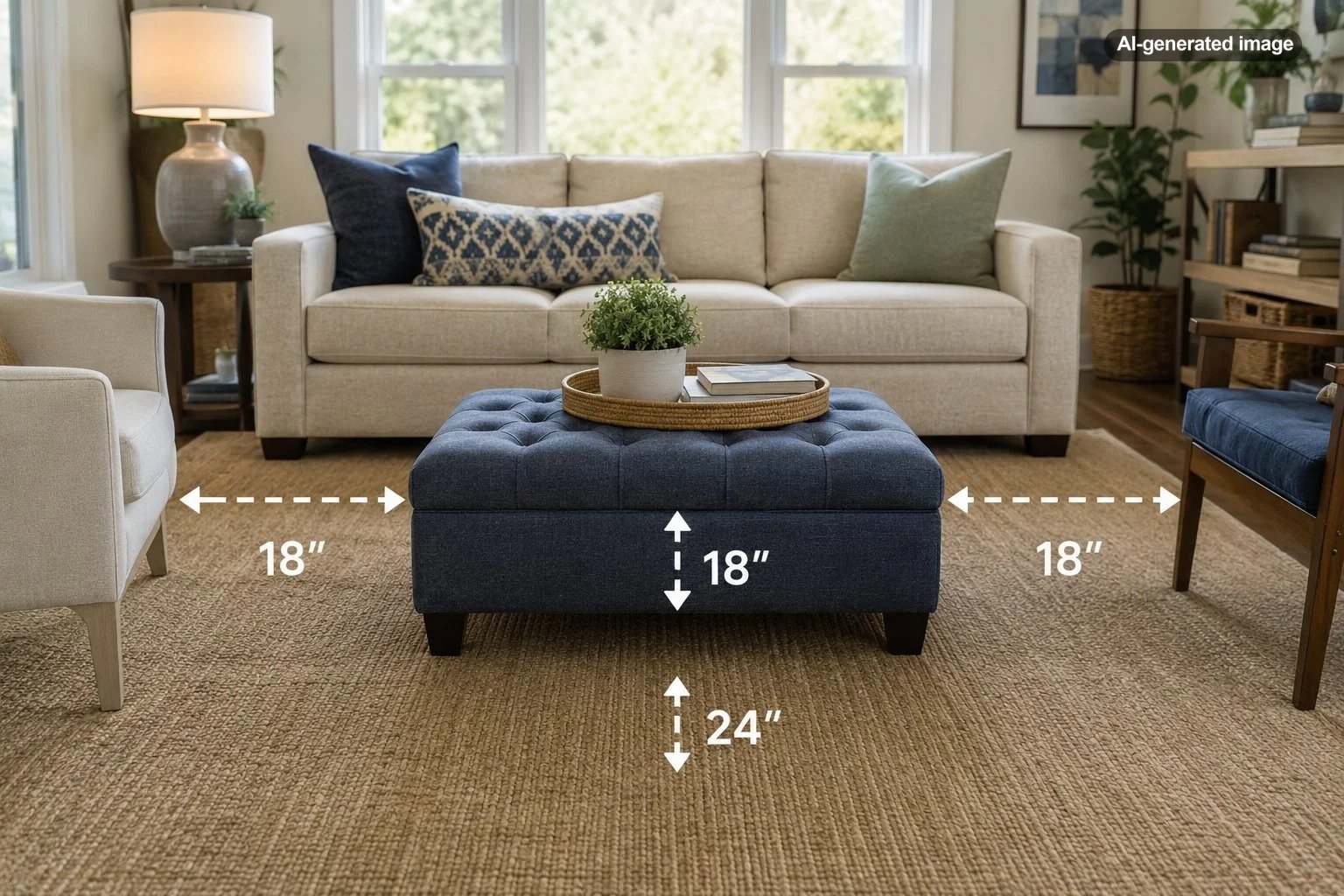
For a central ottoman used with a sofa or sectional, leaving about 18 inches of space between the ottoman and surrounding seating is a reliable starting point. That distance generally provides enough room to move through the seating area while keeping the ottoman close enough to use as a footrest, serving surface, or informal coffee table.
It is not an absolute rule. A compact room may work better with roughly 12 to 15 inches in selected spots, while a major walking route may need considerably more room. The right spacing depends on how people use the ottoman, how large it is, and whether anyone needs to walk between it and the surrounding furniture.
Start With the Ottoman’s Job
Ottomans can perform several jobs, and each one changes the spacing equation. An ottoman primarily used as a footrest should be close enough that someone can comfortably reach it from the sofa. An oversized upholstered ottoman acting as a coffee table needs enough clearance for people to sit down and stand up without squeezing around its corners.
A movable pouf or small accent ottoman is different again. Because it can be pulled toward a chair when needed and pushed aside afterward, its permanent position does not have to follow the same geometry as a large stationary piece.
Before measuring anything, decide whether the ottoman is functioning mainly as a footrest, coffee-table substitute, extra seat, decorative accent, or combination of those roles. Trying to make one oversized piece do everything is a common reason a seating area begins to feel crowded.
Why About 18 Inches Often Works
An 18-inch gap places a central ottoman within easy reach without pressing it against the seating. It also gives legs, knees, and feet some room when people sit down or rise from the sofa. Furniture retailers and designers commonly use roughly this amount of clearance when planning coffee tables and ottomans in conversational seating arrangements.
That measurement should be taken from the nearest edge of the sofa or chair to the nearest edge of the ottoman. Do not measure from the furniture legs if cushions, arms, or upholstery project farther into the room.
The best ottoman spacing keeps the piece close enough to be useful without turning the center of the room into an obstacle course.
When 12 to 15 Inches Can Be Enough
Smaller gaps can work in compact living rooms, apartments, and narrow seating arrangements, particularly when nobody regularly walks between the ottoman and sofa. A modest reduction from the typical 18-inch starting point can make room for an ottoman that otherwise would not fit.
There is a practical limit, however. If knees strike the ottoman when someone sits down, people have to turn sideways to enter the seating area, or the ottoman must constantly be pushed away, the arrangement is too tight regardless of what the tape measure says.
Give Actual Walkways More Room
The gap directly in front of a sofa and a room’s primary traffic path are not the same thing. If people routinely walk between an ottoman and another piece of furniture, prioritize comfortable circulation rather than trying to maintain a symmetrical gap on every side.
For example, an ottoman could sit relatively close to the sofa while leaving substantially more open floor on the side facing the room entrance. This asymmetrical arrangement often functions better than centering the ottoman perfectly and creating equally cramped passages around it.
Also consider how the room behaves when several people are present. Open cabinet doors, reclining furniture, children’s play areas, pet beds, and frequently moved dining chairs can all consume floor space that looks empty when the room is photographed or measured.
Match the Ottoman to the Seating Area
Spacing cannot rescue an ottoman that is simply too large for the furniture around it. A substantial sectional can visually support a broad ottoman, while the same piece may overwhelm a compact two-seat sofa. Once appropriate clearance is subtracted from the available floor area, the remaining space tells you the maximum practical footprint.
What to do
- Measure the open area in front of the sofa or sectional.
- Subtract the clearance you want between the ottoman and each nearby seat.
- Reserve additional space wherever people actually walk through the room.
- Use painter’s tape on the floor to outline the proposed ottoman footprint.
- Live with the taped outline briefly and test sitting, standing, walking, and reaching before choosing the final size.
This method is especially useful for round ottomans and large squares, whose corners or widest points can occupy more usable floor than expected. Measure the actual outer dimensions rather than relying on how visually light the piece appears.
Sectionals Need Special Attention
A sectional often wraps around two or three sides of an ottoman, making clearance more important. If the ottoman nearly fills the opening inside an L-shaped or U-shaped sectional, occupants can feel boxed in even when the individual pieces look proportional.
Start by allowing roughly 18 inches from the ottoman to the seating faces where possible. Then identify the natural entry point into the sectional. That entrance may deserve additional clearance, particularly if it is the only convenient way to reach an inner seat.
For a very long sectional, one enormous ottoman is not always the most flexible answer. Two smaller ottomans can sometimes preserve easier circulation and allow individual users to pull a footrest closer without blocking the entire seating group.
Remember Height as Well as Distance
Floor clearance is only part of comfortable ottoman placement. A piece used mainly for resting feet generally feels most natural when its top is near the height of the surrounding seat cushions. A noticeably taller ottoman can make leg positioning awkward, while a very low one may function more as a decorative table substitute than a comfortable footrest.
If the ottoman doubles as a coffee table, consider what will sit on top. Upholstered surfaces can be soft and inviting but less stable for glasses and small objects. A tray can provide a firmer surface without changing the spacing around the furniture.
Use the Rug to Help the Arrangement Feel Intentional
A properly sized area rug can visually connect a sofa, chairs, and ottoman even when the gaps between them are generous. This is useful because homeowners sometimes push furniture too close together simply to make the pieces appear related.
If the rug accommodates the seating group comfortably, the ottoman does not have to crowd the sofa to look connected. Conversely, a tiny rug beneath a large ottoman can exaggerate the impression that the center of the room is packed with furniture.
Round ottomans can be particularly effective where circulation angles are awkward because the absence of sharp corners can make movement around the piece feel easier. Rectangular and square ottomans often create a stronger relationship with similarly shaped sofas and sectionals, but their corners deserve careful attention in narrow rooms.
Common Ottoman Spacing Mistakes
- Centering at all costs: A mathematically centered ottoman may obstruct the room’s natural walking route.
- Buying before measuring: Showroom proportions can make a large ottoman appear smaller than it will in a modest living room.
- Ignoring projecting upholstery: Measure from the true furniture edge, not merely from the legs or frame.
- Leaving too much distance: An ottoman several feet from the sofa may look disconnected and stop functioning as a practical footrest.
- Forgetting movable pieces: Recliners, swivel chairs, nesting tables, and pull-out furniture may require extra clearance.
FAQ
How far should an ottoman be from a sofa?
About 18 inches is a useful starting point for a central ottoman. A smaller gap may work where space is tight and no one needs to walk through it regularly.
Does an ottoman need equal space on every side?
No. Functional circulation is more important than perfect symmetry. It is often sensible to place the ottoman closer to the sofa while leaving a wider passage on the side people use to enter the room.
Can an ottoman be too large for a sectional?
Yes. If the ottoman leaves occupants with cramped legroom or blocks the natural opening into the sectional, choose a smaller piece even if the proportions look attractive from above.
Should an ottoman be centered on the sofa?
Usually it can be, but centering is a visual preference rather than a functional requirement. Shift the ottoman when doing so creates a better walkway or makes the most-used seats more comfortable.
What is the easiest way to test ottoman size?
Outline the proposed dimensions with painter’s tape. Then sit in each seat, stand up, walk around the arrangement, and test the main routes through the room. A few minutes of physical testing often reveals problems that a floor plan misses.
The simplest rule is to begin with roughly 18 inches around the seating-facing sides of a central ottoman, then adjust for the room you actually have. Preserve wider pathways where people walk, tighten the gap modestly where space is limited, and choose an ottoman whose scale still leaves the seating area comfortable. Good spacing should make the ottoman feel useful and connected to the room rather than merely fitted into the last available patch of floor.