How Far Should an Air Purifier Be From a Wall?
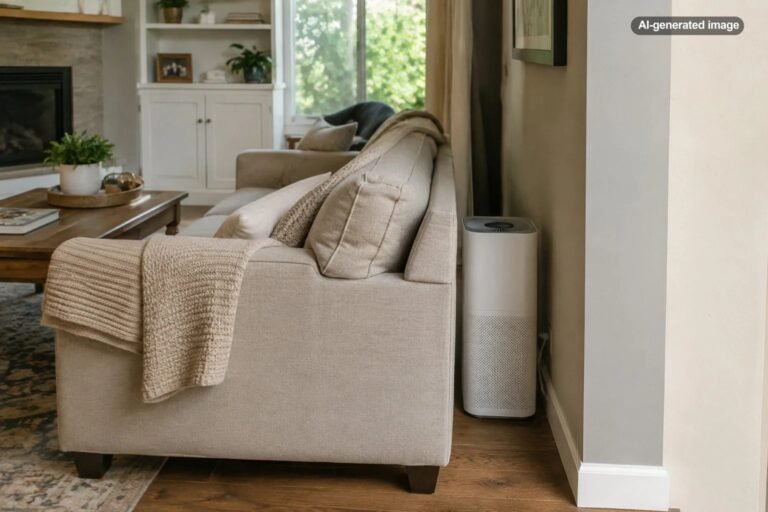
An air purifier should generally sit at least 6 to 12 inches away from nearby walls and furniture as a practical starting point, unless its manufacturer specifies a different clearance. The exact distance depends on where the machine pulls in air, where it releases filtered air, and how much room it needs to circulate that air without obstruction.
Some models require less space. Others need considerably more, particularly around their air outlets. The owner’s manual should always take precedence over a general spacing recommendation.
Fortunately, getting the placement right rarely requires rearranging an entire room. A few inches of additional breathing room, a clear air outlet, and a sensible location can make a meaningful difference in how effectively an air purifier serves your space.
Why Distance From the Wall Matters
A portable air purifier typically operates by pulling room air through one or more filters and pushing cleaned air back into the surrounding space. For that process to work as intended, the machine needs adequate access to the room’s air.
When an intake sits too close to a wall, cabinet, or upholstered chair, the obstruction may restrict the air entering the machine. Likewise, placing an outlet directly beneath a shelf or behind furniture can interfere with the distribution of filtered air.
The result is not necessarily that the purifier stops working. It may continue running normally while circulating air less effectively than it could in a better location.
Airflow restrictions can also vary substantially between machines. A model drawing air through its front panel has different placement needs from one drawing air through its rear or all four sides.
How Much Clearance Do Different Air Purifiers Need?
There is no universal wall-clearance measurement that applies to every portable air cleaner. The most useful approach is to identify the machine’s airflow design and then follow the manufacturer’s stated minimum distances.
| Air purifier design | Placement consideration |
|---|---|
| Front-intake model | Keep the front intake open and maintain the manufacturer’s required space around other surfaces. |
| Rear-intake model | Avoid pushing the rear grille toward the wall; preserve the specified rear clearance. |
| Multiple-side intake | Leave space around all intake surfaces rather than protecting only one side. |
| Top-outlet model | Maintain the required space above the outlet and avoid low shelves. |
| Wall-mounted design | Follow its dedicated mounting and airflow instructions instead of freestanding-unit guidance. |
For a concrete manufacturer example, the Coway Airmega AP-1512HH manual specifies at least 20 centimeters, or approximately 8 inches, from walls or adjacent objects. It also calls for 30 to 60 centimeters of space above the product. Those measurements are specific to that model, not a rule for all air purifiers.
This distinction matters when comparing products. Two machines that appear similarly sized may have very different requirements for the space around them.
Can You Put an Air Purifier Against a Wall?
Sometimes, but only when the manufacturer’s instructions allow that installation or placement. Certain wall-mounted or specially designed models are intended to operate close to a vertical surface. A typical freestanding purifier should not automatically be treated the same way.
If your machine has a rear intake, positioning it flush against the wall is especially questionable because the wall may block much of the available intake area.
Even when a model draws air through the front, a wall-hugging position might still conflict with the manufacturer’s instructions for side clearance, outlet airflow, servicing, or heat dissipation.
Where Should You Place an Air Purifier in a Bedroom?
In a bedroom, the best location balances unobstructed airflow, adequate room coverage, comfort, and practical considerations such as electrical outlets and walking paths.
A reasonable starting point is an open area along a wall, with the purifier pulled forward enough to satisfy its clearance requirements. This usually looks less intrusive than placing the appliance in the middle of the floor, while still leaving room for air movement.
Beside the Bed
A purifier can sometimes sit near a bedside table, provided the furniture does not block its intake or outlet. Avoid wedging the machine tightly between the nightstand and the bed frame.
Also consider the direction of the outgoing air. An uninterrupted stream of air blowing directly across your face may feel uncomfortable at night, even if the machine is otherwise positioned correctly. Adjust the location or airflow direction according to the manufacturer’s instructions.
Near a Dresser
A dresser can provide a convenient visual anchor for a floor-standing purifier, but leave the required clearance between the appliance and the dresser’s side or front. Keep hanging clothing, fabric storage bins, and other objects away from intake grilles.
Under a Window
A location beneath a window may work if curtains, blinds, and other obstructions cannot interfere with the airflow. Be mindful of potential condensation, direct sunlight, and the manufacturer’s environmental restrictions.
If long curtains can drift toward the intake, choose a different location or secure the fabric safely away from the appliance.
Should an Air Purifier Go in a Corner?
A corner can be attractive from a decorating standpoint. It keeps the appliance away from furniture arrangements and makes it less conspicuous. However, two nearby walls can create airflow limitations, particularly for machines with side or rear intakes.
A purifier positioned tightly between two walls may have fewer open directions from which to draw room air. Furniture placed in the same corner can further restrict its circulation.
If a corner is your only practical option, pull the appliance away from both walls enough to meet the manufacturer’s requirements. Make sure the outgoing airflow does not immediately encounter furniture, curtains, or a low shelf.
How Far Should an Air Purifier Be From Furniture and Curtains?
The same general principle applies to furniture as to walls: the most important question is whether an object interferes with an intake or outlet.
A solid bookcase immediately beside an intake can obstruct airflow. A sofa positioned in front of a low-mounted intake can create a similar problem. Curtains are particularly troublesome because moving fabric may approach or cover the grille.
Keep curtains well clear of the machine, not merely a fraction of an inch away when the fabric is hanging still. Account for airflow, drafts, and movement when windows or doors open.
Overhead space matters too. If your purifier exhausts air upward, positioning it beneath a deep floating shelf or the underside of a desk may prevent the outgoing air from dispersing as intended.
Always consider the machine’s entire operating environment, not just the measured gap behind it.
Is the Center of the Room Better Than Near a Wall?
From an airflow perspective, an open position can reduce the likelihood of obstruction. The New York State Department of Health recommends placing portable air cleaners near the center of a room to help avoid blocked airflow from walls, corners, and furniture.
That does not mean every household should leave a purifier in the middle of its living room. A centrally positioned appliance can become an obstacle in a busy walkway, create an awkward cord route, or disrupt how the room is used.
A location closer to a wall can be a sensible compromise if the purifier’s clearance requirements are satisfied and its airflow remains unobstructed.
The practical goal is not to achieve a mathematically perfect location. It is to find a place where the machine can move air effectively and operate consistently without creating household hazards.
Does Air Purifier Placement Matter More Than Room Size?
Both are important, but they address different problems.
Placement helps the appliance draw in and distribute air without unnecessary obstruction. Room sizing determines whether the purifier has sufficient air-cleaning capacity for the space it serves.
The U.S. Environmental Protection Agency recommends choosing a portable air cleaner with a clean air delivery rate, or CADR, appropriate for the room’s size. An appliance with insufficient capacity may struggle to provide the desired particle filtration across a large space, even when perfectly positioned.
Conversely, a suitably sized machine may underperform when furniture or walls significantly restrict its airflow.
Affiliate disclosure: CraneManor.com may earn a commission when you purchase through links on this page. This does not affect the price you pay. Learn more.
If you are evaluating a replacement, look for a model with an appropriate CADR and a layout that suits your available floor space. For example, a HEPA air purifier with automatic mode may appeal to someone seeking straightforward operation with air-quality monitoring. Its airflow clearances and room suitability still need to be checked against the manufacturer’s documentation.
In larger open-plan rooms, consider the entire connected area rather than calculating capacity for only the spot where the appliance will stand.
How to Find the Best Placement in Your Room
You do not need specialized instruments to perform a useful first-pass placement check. Start with the appliance’s instructions, inspect the surrounding space, and make changes that preserve unobstructed airflow.
What to do
- Read the placement instructions. Find the minimum clearances required behind, beside, and above the purifier.
- Locate the intake and outlet. Identify the actual grilles rather than assuming airflow follows the appliance’s appearance.
- Choose an open, stable location. Avoid cramped corners, unstable surfaces, wet areas, and positions where the appliance could be knocked over.
- Measure the gaps. Use a tape measure to confirm every required clearance, including any overhead space.
- Check nearby fabric and furniture. Make sure curtains, bedding, decorative objects, and furniture cannot obstruct the airflow.
- Review the cord route. Keep cords away from walking paths and follow the manufacturer’s electrical safety instructions.
- Recheck after rearranging. If you move furniture or the purifier, confirm that the new position still meets the requirements.
When choosing between two otherwise suitable locations, favor the one that makes it easy to operate the appliance regularly and access its filters for cleaning or replacement.
Common Air Purifier Placement Mistakes
Some placement problems are obvious, while others are easy to overlook because the appliance continues to run.
- Pushing the unit into a narrow gap: A machine wedged between a cabinet and wall may have little usable intake space.
- Blocking the top outlet: An overhead shelf can interfere with the filtered air leaving an upward-exhaust model.
- Placing it behind a sofa: Upholstery can obstruct airflow, and the machine may become difficult to maintain.
- Letting curtains touch the housing: Moving fabric can cover an intake or outlet.
- Ignoring room size: Moving an undersized purifier farther from a wall does not compensate for inadequate CADR.
- Choosing an inconvenient location: An appliance that is constantly unplugged or moved out of the way may provide less consistent filtration.
Frequently Asked Questions
Is 6 inches from the wall enough for an air purifier?
It may be enough for some models, but not for others. Six inches is only a general planning starting point. If the manufacturer specifies 8, 12, or more inches of clearance, follow that requirement instead.
Can I put an air purifier under a desk?
Only if the appliance’s instructions permit the arrangement and all required intakes, outlets, and overhead clearances remain open. Many desks create a restricted space around the purifier, making an open floor location a better option.
Should an air purifier face the wall or the room?
Orient the purifier so its intake and outlet are unobstructed, following the manufacturer’s placement guidance. The correct direction depends on the machine’s airflow design rather than a universal rule that it must face either the wall or the center of the room.
Can an air purifier sit on a table instead of the floor?
Yes, if the model is designed or approved for tabletop use. Place it on a stable, appropriately sized surface with the required clearances. Do not assume a floor-standing machine can be placed on furniture simply because it fits.
Will moving my air purifier farther from the wall improve air quality?
It can help if the previous location restricted airflow. However, moving a properly positioned machine farther into the room does not guarantee better results. Appropriate CADR, operating time, filter condition, and pollution sources also influence indoor air quality.
The Bottom Line
For most freestanding air purifiers, leaving approximately 6 to 12 inches between the unit and nearby walls is a reasonable preliminary placement target, but the manufacturer’s instructions determine the actual minimum. Some models require additional side or overhead space.
Focus on unobstructed intake and exhaust airflow, appropriate room coverage, safe cord placement, and a position that works comfortably with your furniture. A purifier does not need to dominate the room to work well, but it does need enough open space to do its job.
Remember that portable air filtration supplements, rather than replaces, reducing indoor pollution sources and providing appropriate ventilation. The right placement helps you get more from the appliance without treating it as a complete solution to indoor air quality.