Should You Close the Door When Running an Air Purifier?
Yes, you should generally close the door when running an air purifier if your goal is to clean the air in one particular room. A closed door limits how much untreated air enters from adjoining spaces, allowing the purifier to concentrate on a smaller volume of air. However, leaving the door open can make sense when you want airflow between rooms, provided you understand that a single portable purifier may not clean the combined space as effectively.
The right choice depends on your room size, purifier capacity, ventilation needs, and what you are trying to remove from the air. A bedroom with a closed door behaves differently from an open-plan living area, and the most effective arrangement is not always the most convenient one.
Why an Air Purifier Usually Works Better With the Door Closed
A portable air purifier draws surrounding air through its filtration system and releases filtered air back into the room. As it operates, air repeatedly passes through the filter, which can gradually reduce concentrations of particles the filter is designed to capture.
Closing the door helps establish a more defined treatment area. Instead of continually receiving air from the hallway, kitchen, or other rooms, the purifier primarily processes air within its immediate space. The room is not airtight, but the reduced mixing can help the unit achieve and maintain lower particle levels.
The U.S. Environmental Protection Agency explains that portable air cleaners are generally more effective for a specific room when exterior doors and windows are closed. The same principle of limiting unwanted air exchange helps explain why closing an interior door often improves room-specific filtration.
Consider a bedroom next to a busy hallway. When its door remains open, dust and other airborne particles can move between the spaces as people walk through the house or the HVAC system circulates air. Closing the bedroom door reduces some of that exchange, giving the purifier a more manageable area to serve.
This does not mean a closed door guarantees perfectly clean air. Particle sources inside the room, filter efficiency, fan speed, leakage around doors, and the room’s ventilation all influence the result.
What Happens When You Leave the Door Open?
An air purifier does not stop working when you open the door. It continues pulling air through its filters. What changes is the volume of air it may effectively be asked to clean and the movement of particles between spaces.
In some homes, opening the door exposes the purifier to air from a much larger area. A unit sized for a small bedroom may struggle to produce the same particle reduction when connected to a hallway and several other rooms.
Airflow also becomes less predictable. Air moving through an open doorway may carry filtered air elsewhere while introducing particles from another room. Depending on the layout and air movement, some areas may benefit from that circulation while others receive comparatively little filtration.
| Situation | Door closed | Door open |
|---|---|---|
| Small bedroom | Usually better for focused particle reduction | Allows more mixing with hallway air |
| Home office | Helps define the purifier’s treatment area | Convenient for shared access and circulation |
| Large connected living space | May help isolate one room | Requires sizing for the larger connected area |
| Room with a temporary dust source | May limit particle movement into adjoining rooms | Can allow particles to spread beyond the room |
| Room needing ventilation | Not a substitute for required fresh air | May support airflow, depending on the ventilation setup |
The central distinction is between cleaning one room effectively and attempting to influence air quality across several rooms. An open door may support the second goal, but it does not automatically make the purifier capable of handling the extra space.
Should You Close Your Bedroom Door at Night?
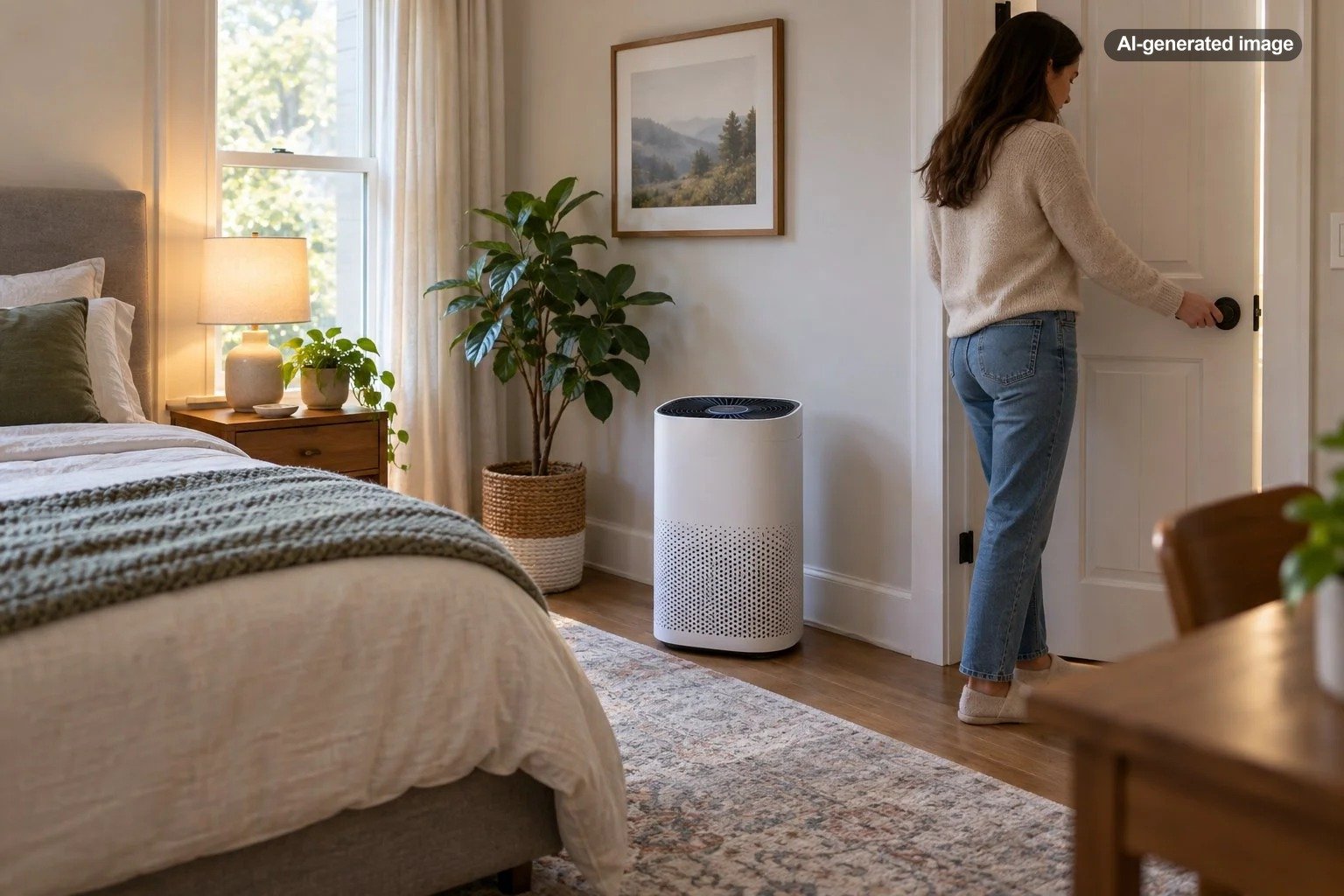
For many bedrooms, closing the door is a sensible way to get more focused filtration overnight. Bedrooms often have relatively defined floor areas, making it easier to match a portable purifier to the intended space.
Start by checking that the purifier is appropriately sized for the bedroom. Position it where furniture, bedding, and curtains will not obstruct the air intake or outlet. Then choose a fan setting that provides useful filtration without making sleep difficult.
There is an important distinction between filtration and ventilation. An air purifier that recirculates room air does not ordinarily introduce outdoor air or remove accumulated carbon dioxide. Closing a bedroom door may improve particle filtration while reducing air exchange, depending on the home’s ventilation design.
If the room becomes stuffy, unusually warm, or uncomfortable, investigate ventilation rather than assuming the purifier will solve the problem. Avoid blocking required ventilation openings, and follow any ventilation guidance specific to the building.
How Room Size Changes the Answer
Door position matters, but purifier capacity is often the more important starting point. A machine that is too small for the intended area may provide limited particle reduction even when the door remains closed.
Look for the purifier’s Clean Air Delivery Rate (CADR), which describes its rate of delivering air cleaned of certain particles. A higher CADR generally means the purifier can remove particles from a larger room more quickly under comparable conditions.
EPA guidance offers a useful sizing rule: for rooms with typical 8-foot ceilings, a smoke CADR of approximately two-thirds of the floor area in square feet is a reasonable minimum selection guide.
For example, a 150-square-foot bedroom would call for a smoke CADR of roughly 100 cubic feet per minute. A 300-square-foot room would call for approximately 200 cubic feet per minute. Higher ceilings increase the volume of air, potentially requiring a more capable unit.
These are general particle-filtration sizing guidelines, not guarantees about performance in a particular home. Actual results vary with airflow, fan setting, particle sources, and room configuration.
When you leave a door open, consider the connected space rather than only the room containing the appliance. If a 150-square-foot bedroom opens into a 200-square-foot adjoining area, a purifier sized solely for the bedroom may be inadequate for both spaces together.
What About Open Floor Plans and Connected Rooms?
Open floor plans present a different challenge because there may be no convenient door to close. A portable purifier placed in one corner of a combined kitchen, dining, and living area is not necessarily cleaning every part of that space equally.
Begin by estimating the total area served by the purifier. Include connected sections where air moves freely, and account for higher ceilings when choosing equipment.
Large or unusually shaped areas may benefit from more than one appropriately sized purifier. Separate units can help provide filtration nearer the places where people spend time instead of depending on one machine to circulate air throughout the entire layout.
Hallways, staircases, partial walls, and furniture can also affect how filtered air travels. Multiple machines are not automatically necessary, but a larger coverage claim on a product label should not be taken as proof that every connected room will receive equal filtration.
When You Should Not Keep the Door Closed Just for Filtration
Filtration is only one part of indoor air management. There are situations where ventilation, access, or household safety should take priority over keeping a room isolated.
When the room needs fresh air
Portable particle-filtering purifiers generally recirculate indoor air rather than exchanging it with outdoor air. If ventilation is inadequate, closing the door may contribute to discomfort or stuffiness. Address the underlying ventilation issue instead of relying on filtration alone.
When there is a strong pollution source indoors
Cooking fumes, chemical vapors, smoke, and certain household odors require more than ordinary particle filtration. The preferred approach is to control the pollution source and use appropriate ventilation or exhaust when safe.
Never treat an air purifier as protection against carbon monoxide, a gas leak, or another immediate hazardous condition. Follow emergency guidance and leave the affected area when necessary.
When equipment depends on designed airflow
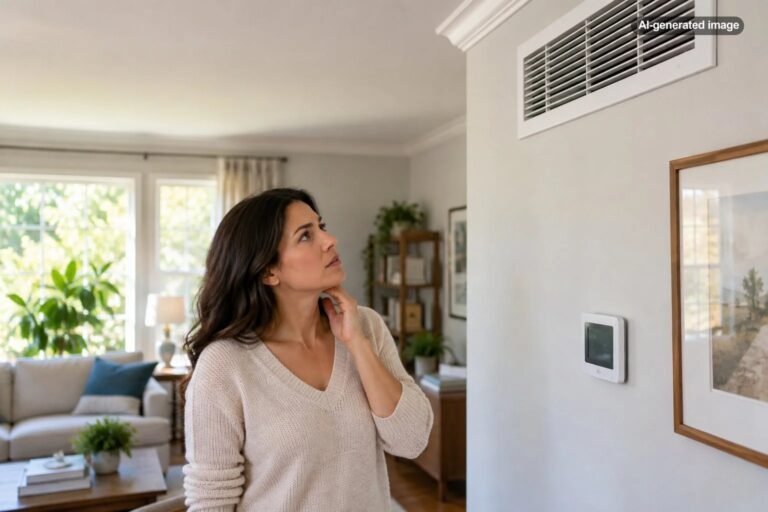
Some homes have particular ventilation or pressure-balancing requirements. Closing interior doors can affect airflow in certain HVAC configurations, especially where return-air pathways are limited. If closing a door causes significant pressure differences, unusual drafts, or comfort problems, ask a qualified HVAC professional to evaluate the system.
When household access matters
Caregiving arrangements, mobility needs, and everyday household routines may require an open doorway. In those cases, choose a filtration arrangement that accommodates actual living conditions rather than treating a closed door as an absolute rule.
How to Make an Air Purifier More Effective
Whether the door is open or closed, several practical adjustments can improve the purifier’s ability to serve its intended space.
What to do
- Define the area. Decide whether the priority is a bedroom, office, living room, or larger connected space.
- Check the CADR. Compare the purifier’s particle-filtration capacity with the room area and ceiling height.
- Choose a clear location. Keep furniture, curtains, and bedding away from the intake and outlet. Follow the manufacturer’s clearance instructions.
- Close doors and windows when appropriate. This can reduce the introduction of unfiltered air, but preserve needed ventilation and safety access.
- Use an effective fan setting. Higher settings generally filter more air. A comfortable setting that allows longer operation may be preferable to a loud setting that encourages frequent shutdowns.
- Maintain the filters. Clean or replace filters according to the manufacturer’s directions. Do not assume a clogged filter continues working normally.
- Reduce pollution at the source. Control dust, use suitable kitchen exhaust, avoid indoor smoking, and choose cleaning practices that minimize airborne particles.
Consistency matters. A well-positioned purifier operating for extended periods is generally more useful than an appliance switched on briefly after a room already feels dusty.
If you are considering a straightforward room appliance, CADR, filtration type, operating noise, and replacement-filter availability are more meaningful considerations than an extensive list of connected features.
Some models also offer automatic fan adjustment or air-quality indicators. These features may improve convenience, although the built-in sensor does not necessarily measure every pollutant you are concerned about.
Affiliate disclosure: CraneManor.com may earn a commission when you purchase through links on this page. This does not affect the price you pay. Learn more.
For example, a Coway Airmega purifier is one option for readers interested in an automatic operating mode and air-quality monitoring. Regardless of the model, confirm its current specifications and suitability for the actual room before choosing it. Automatic operation does not replace appropriate sizing, ventilation, or regular maintenance.
Common Mistakes That Limit Air Purifier Performance
Closing the door is helpful in many situations, but it cannot compensate for every setup problem.
- Placing the purifier behind furniture: A concealed unit may look tidier, but blocked airflow can reduce its effectiveness.
- Assuming an open door doubles the coverage: The purifier’s capacity stays the same even when connected to a larger area.
- Running only the quietest setting: Low fan speeds often provide lower particle-removal rates than the settings used for advertised performance measurements.
- Ignoring filter maintenance: Dirty filters can restrict performance and should be maintained according to the manufacturer’s instructions.
- Expecting particle filtration to eliminate every odor: Many odors involve gases, which require different filtration media or source control.
- Confusing filtration with ventilation: Removing airborne particles does not automatically deliver fresh air or correct indoor carbon dioxide buildup.
Another overlooked issue is the location of pollution sources. If the purifier sits in a bedroom while the main source of particles is cooking in the kitchen, managing kitchen emissions with suitable exhaust may be more effective than expecting the bedroom purifier to compensate.
Frequently Asked Questions
Can an air purifier clean two rooms if the door is open?
It may reduce some airborne particles in both rooms, but results depend on the combined area, purifier capacity, doorway geometry, and airflow. A purifier sized for one small room should not be assumed to deliver adequate filtration across two rooms. Separate appropriately sized units may provide more predictable coverage.
Should you close the windows when using an air purifier?
Generally, yes, when outdoor particle pollution is a concern or you want to maximize room-specific particle reduction. Open windows introduce additional air that the purifier must process. However, natural ventilation can be beneficial when outdoor air is suitable and indoor sources need dilution. The decision should account for outdoor air conditions and ventilation requirements.
Does an air purifier still work with the bedroom door open?
Yes. It continues filtering air passing through the machine. An open door simply makes room-specific results less predictable because of additional air movement and the potentially larger space being served.
Should you run an air purifier all night?
Extended operation can improve particle filtration compared with short operating periods, provided the appliance is designed for that use and operated according to its instructions. Select a comfortable fan speed, maintain clear airflow, and follow the manufacturer’s operating and maintenance guidance.
Will closing the door help remove odors faster?
Possibly, but the outcome depends on the odor source and the purifier’s filter design. A particle-focused HEPA filter is not intended to remove all gases or odors. Activated carbon or other gas-removal media may help with certain contaminants, while source removal and appropriate ventilation often remain essential.
The Bottom Line
Close the door when you want a portable air purifier to concentrate on one room. This usually creates a more manageable filtration area and limits mixing with untreated air from adjoining spaces. A bedroom, home office, or other enclosed room is often the clearest example.
Leave the door open when access, ventilation, or household airflow makes that more practical, but evaluate the larger connected area rather than expecting the purifier’s coverage to remain unchanged. Proper sizing, unobstructed placement, adequate run time, filter maintenance, and control of pollution sources all matter more than any single doorway decision.
The best arrangement is the one that improves filtration without compromising the ventilation, comfort, and safety requirements of the home.
Sources & Further Reading
- U.S. Environmental Protection Agency: Guide to Air Cleaners in the Home – Guidance on purifier sizing, CADR, filtration limits, placement, and operation.
- U.S. Environmental Protection Agency: Residential Air Cleaners – A Technical Summary, Third Edition – Technical information about room air cleaners, airflow, and the importance of unobstructed placement.
- U.S. Environmental Protection Agency: Indoor Air Filtration – Practical guidance on maximizing portable air-cleaner effectiveness.
- U.S. Environmental Protection Agency: How to Create a Cleaner Air Room at Home – Recommendations for choosing and operating filtration equipment in a designated room.